A beat before this, she was still arranging herself: settling the cream shawl over her head, testing the weight of the coral beads at her throat. Now she holds the lace edge open at her hips like a performer parting a curtain, and everything underneath announces itself at once. The gaze goes sideways, unhurried, a little imperious; the wheat has been ready all summer.
The costume is the whole show, and what a show: skirt over skirt, black velvet flocked with damask blooms, panels of embroidered roses boxed in red, tier after tier of pink and blue trim flashing at the hem like a chorus line. Red stockings stitched with flowers climb out of beaded shoes; a crucifix and a scarlet tassel hang at the waist among strands of beads. This is Lagartera needlework, generations deep, out-embellishing any atelier’s fantasy of folk dress. And the setting knows its job: dry gold stubble, a scribble of olive trees on the horizon, a washed blue sky giving all that ornament room to ring.
Yeste built his reputation in the great glossies, Numéro, Harper’s Bazaar, Vogue, and in his Folk Pride pictures he turns that editorial polish toward Spain’s own inherited wardrobes, giving regional dress the full-page reverence usually reserved for couture. The archival pigment print is where the argument lands: reds held at full pitch, gold braid you can almost feel, lace rendered thread by thread against the straw. It’s a fashion photograph with a long memory, and the memory holds the pose beautifully.
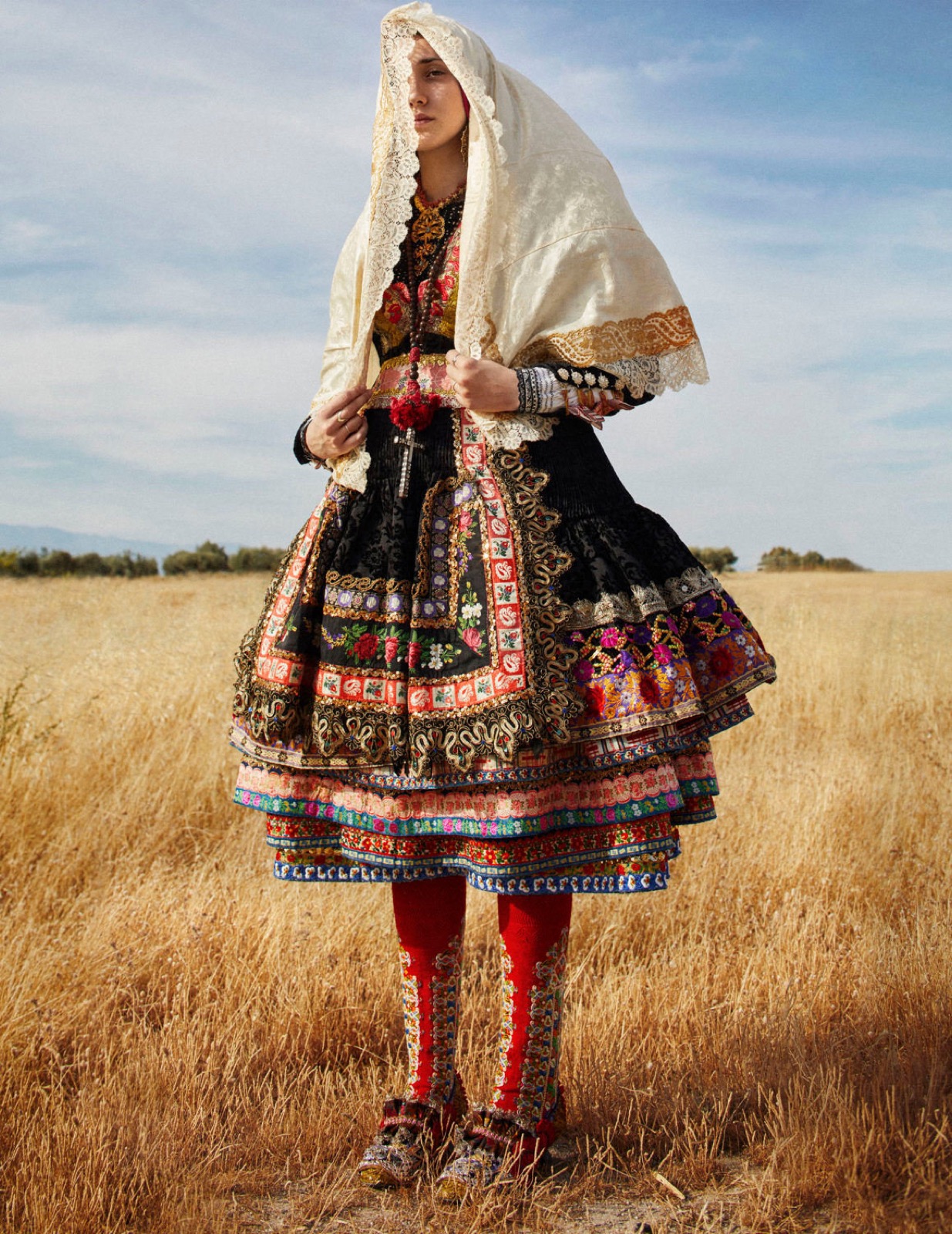

A beat before this, she was still arranging herself: settling the cream shawl over her head, testing the weight of the coral beads at her throat. Now she holds the lace edge open at her hips like a performer parting a curtain, and everything underneath announces itself at once. The gaze goes sideways, unhurried, a little imperious; the wheat has been ready all summer.
The costume is the whole show, and what a show: skirt over skirt, black velvet flocked with damask blooms, panels of embroidered roses boxed in red, tier after tier of pink and blue trim flashing at the hem like a chorus line. Red stockings stitched with flowers climb out of beaded shoes; a crucifix and a scarlet tassel hang at the waist among strands of beads. This is Lagartera needlework, generations deep, out-embellishing any atelier’s fantasy of folk dress. And the setting knows its job: dry gold stubble, a scribble of olive trees on the horizon, a washed blue sky giving all that ornament room to ring.
Yeste built his reputation in the great glossies, Numéro, Harper’s Bazaar, Vogue, and in his Folk Pride pictures he turns that editorial polish toward Spain’s own inherited wardrobes, giving regional dress the full-page reverence usually reserved for couture. The archival pigment print is where the argument lands: reds held at full pitch, gold braid you can almost feel, lace rendered thread by thread against the straw. It’s a fashion photograph with a long memory, and the memory holds the pose beautifully.