A whitewashed end wall carries an enormous painted numeral 4, brushed by hand, its strokes running slightly, its edges chipping away with the render. To the left rises the dark plank flank of a shack; to the right, past the wall, a chain-link fence and the low roofs of the next row. On the bare packed earth in front stands a small spindle-backed chair, and on the chair a white enamel basin, with a cloth folded over the seat's edge. There is no one in the picture.
What Masats found in Somorrostro, the beach settlement Barcelona spent decades denying before it demolished it, was not misery and not the picturesque. It was an arrangement. The numeral turns a shack into an address, evidence of a bureaucracy that had counted these dwellings without acknowledging them; the basin turns a chair into a washstand, an entire domestic economy reduced to two objects standing in the open. The composition is frontal and unhurried, the wall flat as a backdrop, the chair placed almost centrally, and the effect is of a stage set moments before or after the scene.
That is what makes the picture feel contemporary rather than archival. Fifty years before the constructed tableau became the default mode of art photography, this is a still life discovered rather than built, and it holds its meaning in exactly the same way, through the placement of objects and the deliberate withholding of a protagonist. The photographer's decision was where to stand and what to leave out. Everything the image argues about poverty and administration, it argues through a chair.
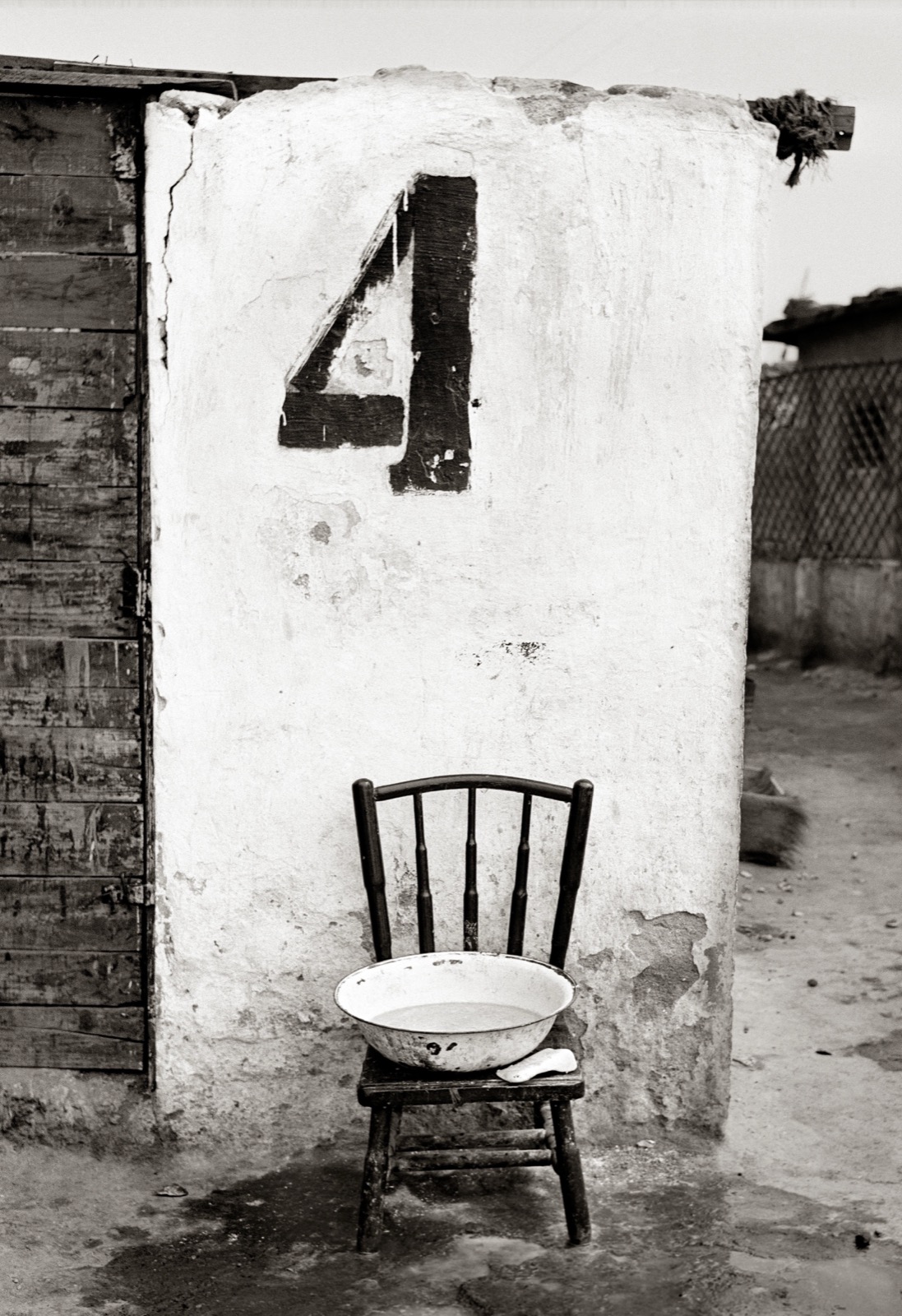

A whitewashed end wall carries an enormous painted numeral 4, brushed by hand, its strokes running slightly, its edges chipping away with the render. To the left rises the dark plank flank of a shack; to the right, past the wall, a chain-link fence and the low roofs of the next row. On the bare packed earth in front stands a small spindle-backed chair, and on the chair a white enamel basin, with a cloth folded over the seat's edge. There is no one in the picture.
What Masats found in Somorrostro, the beach settlement Barcelona spent decades denying before it demolished it, was not misery and not the picturesque. It was an arrangement. The numeral turns a shack into an address, evidence of a bureaucracy that had counted these dwellings without acknowledging them; the basin turns a chair into a washstand, an entire domestic economy reduced to two objects standing in the open. The composition is frontal and unhurried, the wall flat as a backdrop, the chair placed almost centrally, and the effect is of a stage set moments before or after the scene.
That is what makes the picture feel contemporary rather than archival. Fifty years before the constructed tableau became the default mode of art photography, this is a still life discovered rather than built, and it holds its meaning in exactly the same way, through the placement of objects and the deliberate withholding of a protagonist. The photographer's decision was where to stand and what to leave out. Everything the image argues about poverty and administration, it argues through a chair.