What the photograph withholds is the very thing a portrait should deliver: the face. Two hands have arrived to take it away — one laid across the cheek so that only a single eye survives between the fingers, the other bringing a fingertip to the lower lip. The nails are the loud event, long ovals lacquered red and stamped with small black numerals; a second hand’s nails are chalk-white, numbered too. Everything is arranged to keep us out.
The organization is severe and deliberate. Skin this dark reads almost as silhouette, and Yeste sets it against a pale, empty ground so the head becomes a cut shape, an edge before it is a person. Into that near-blackness he admits only three bright incidents: the red nails, the white ones, and the silver zipper of a leather jacket climbing the throat in even metal teeth. The light rakes low and hard, polishing the cheekbone and jaw. It is a picture built by subtraction, powerful for how little it lets through.
The title names a wind off the open sea that never appears; like the face, the horizon it promises is kept back. Yeste, among the front rank of Spanish fashion photographers, works an elemental vein, and here the drama is all surface and refusal. The archival pigment print earns its keep on those transitions — the matte depth of the skin against the wet gloss of the nails — where a lesser print would clog or glare. What it shows, it shows exactly; what it hides, it keeps.
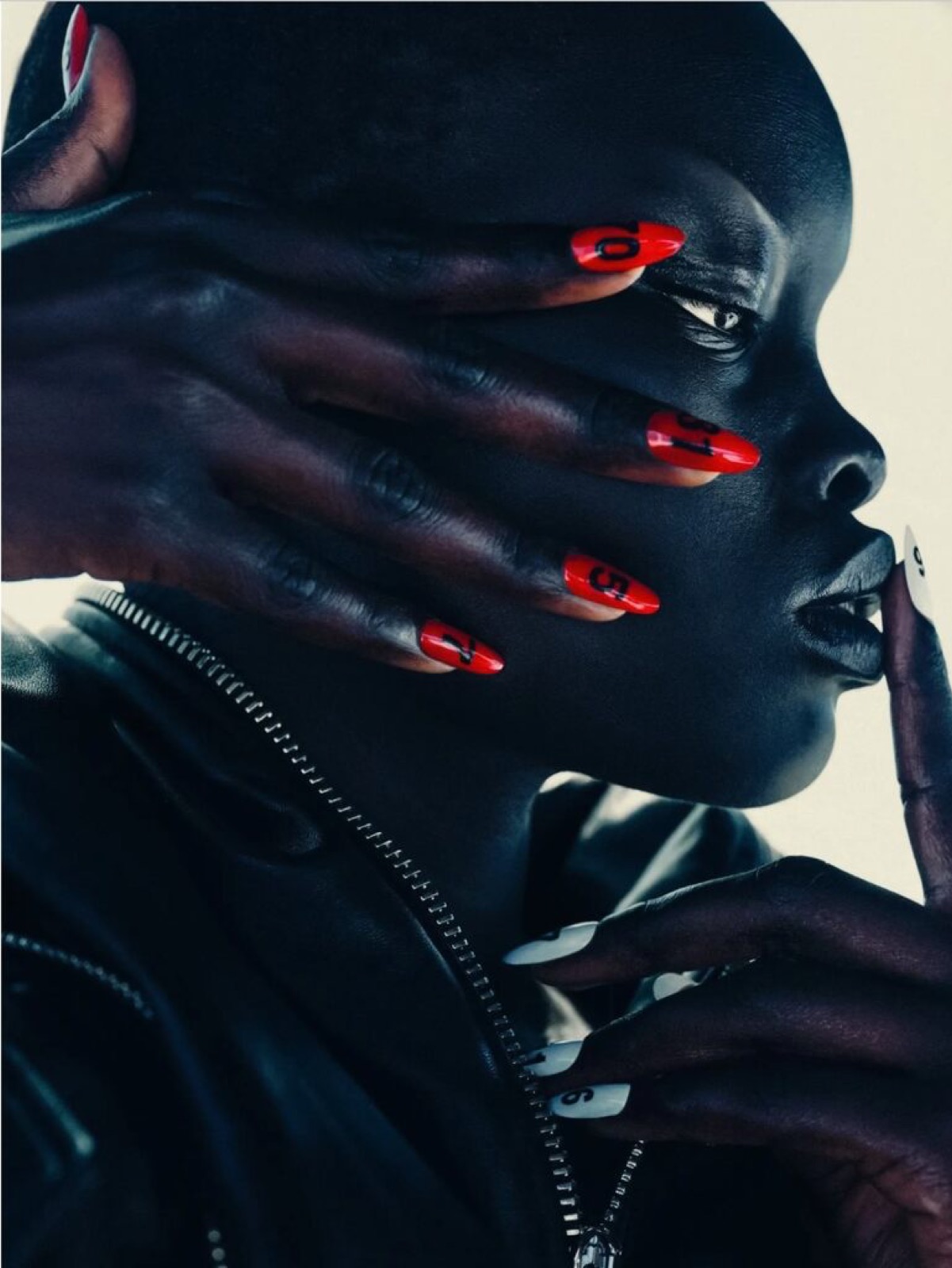

What the photograph withholds is the very thing a portrait should deliver: the face. Two hands have arrived to take it away — one laid across the cheek so that only a single eye survives between the fingers, the other bringing a fingertip to the lower lip. The nails are the loud event, long ovals lacquered red and stamped with small black numerals; a second hand’s nails are chalk-white, numbered too. Everything is arranged to keep us out.
The organization is severe and deliberate. Skin this dark reads almost as silhouette, and Yeste sets it against a pale, empty ground so the head becomes a cut shape, an edge before it is a person. Into that near-blackness he admits only three bright incidents: the red nails, the white ones, and the silver zipper of a leather jacket climbing the throat in even metal teeth. The light rakes low and hard, polishing the cheekbone and jaw. It is a picture built by subtraction, powerful for how little it lets through.
The title names a wind off the open sea that never appears; like the face, the horizon it promises is kept back. Yeste, among the front rank of Spanish fashion photographers, works an elemental vein, and here the drama is all surface and refusal. The archival pigment print earns its keep on those transitions — the matte depth of the skin against the wet gloss of the nails — where a lesser print would clog or glare. What it shows, it shows exactly; what it hides, it keeps.