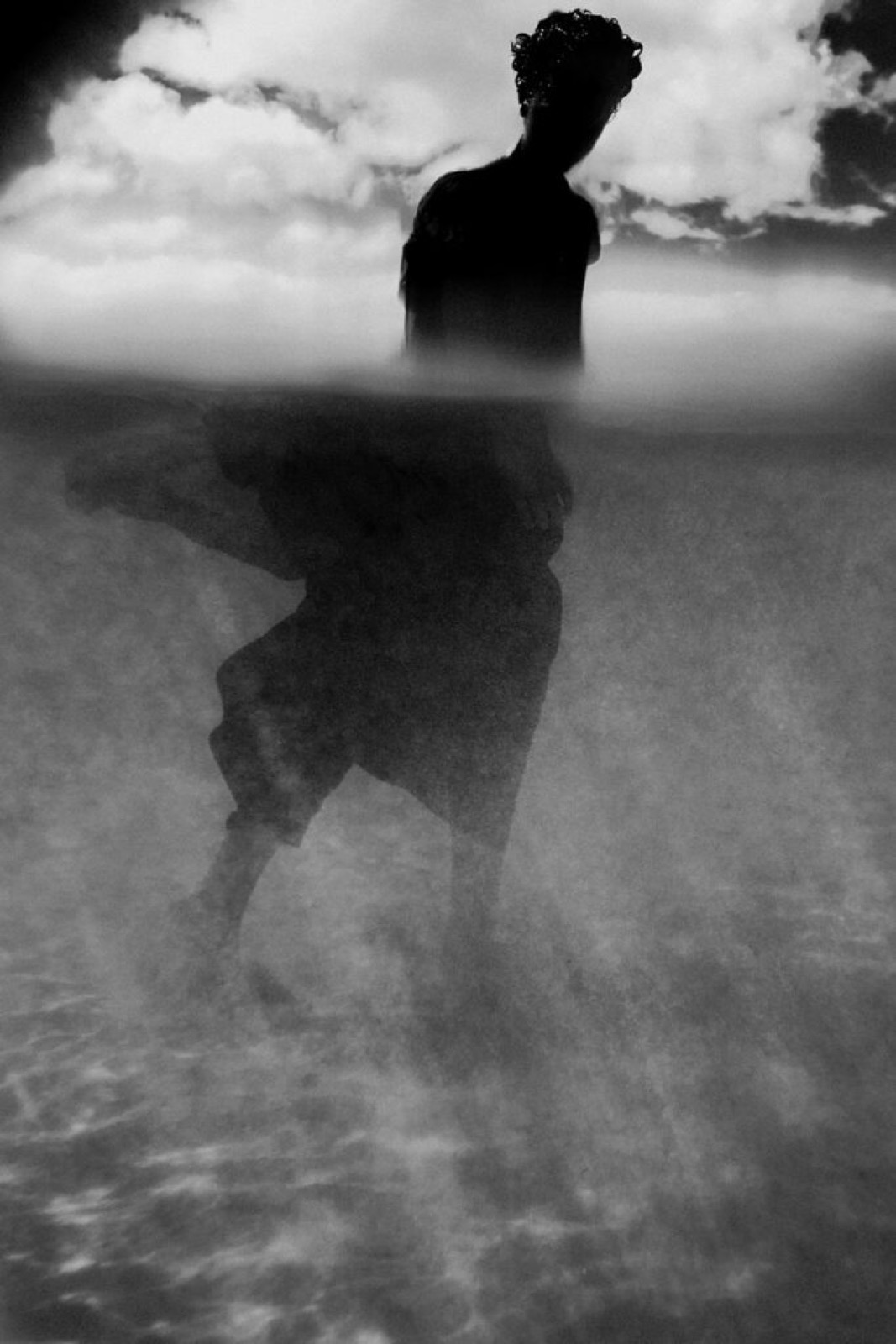
A figure stands in shallow water, cut in two by the picture. Above the line the head and shoulders are a black silhouette against a bank of cumulus; below it the legs and hips appear again, greyed and softened, seen through the water as through a fogged window. The two halves do not quite agree. The upper is hard, graphic, and entirely without detail; the lower is all detail and no edge; and between them runs a band of white haze where the photograph simply stops describing.
Nothing has been withheld out of coyness. The camera was placed low, close to the surface, and the surface did what surfaces do. What one notices is how much information a photograph can lose and still make a picture: we cannot say the age of this person, or the expression, or reliably which way the body is facing, and none of it turns out to be required. The curls at the top of the head and the set of one shoulder are enough to keep the figure human, and the water attends to the rest.
The picture is untitled, and one can see why the alternative would have been worse. Called something, it would become a statement about immersion, or memory, or whatever the word proposed, and the photograph is not making a statement. It reports, quite precisely, that a body standing in water photographs as two different substances. It declines to say what the person was doing there, or whether they were going in or coming out.
A figure stands in shallow water, cut in two by the picture. Above the line the head and shoulders are a black silhouette against a bank of cumulus; below it the legs and hips appear again, greyed and softened, seen through the water as through a fogged window. The two halves do not quite agree. The upper is hard, graphic, and entirely without detail; the lower is all detail and no edge; and between them runs a band of white haze where the photograph simply stops describing.
Nothing has been withheld out of coyness. The camera was placed low, close to the surface, and the surface did what surfaces do. What one notices is how much information a photograph can lose and still make a picture: we cannot say the age of this person, or the expression, or reliably which way the body is facing, and none of it turns out to be required. The curls at the top of the head and the set of one shoulder are enough to keep the figure human, and the water attends to the rest.
The picture is untitled, and one can see why the alternative would have been worse. Called something, it would become a statement about immersion, or memory, or whatever the word proposed, and the photograph is not making a statement. It reports, quite precisely, that a body standing in water photographs as two different substances. It declines to say what the person was doing there, or whether they were going in or coming out.