The dress takes almost the entire frame. Green silk, acres of it, spread across the forest floor in broad folds and embroidered with silver-sequinned leaves and small crimson flowers that climb the fabric on stems, as if trained up a trellis. The woman wearing it lies back at the top of the picture, head turned away and mostly lost to shadow, one arm extended down the slope, her dark skin holding the last of the light. Beyond and above her, the real vegetation: moss, fern, undergrowth going black at the edges.
Two gardens, then, one embroidered and one actual, and the embroidered one wins. The silk is lit and the wood is not, so the flowers on the dress bloom while the living plants recede into a dark green mass. It is the arrangement of a painting rather than a photograph, a body dissolved into landscape and the landscape rendered as fabric, and it carries the memory of every drowned Ophelia and every reclining figure absorbed into foliage that European painting has produced.
Which is what I keep returning to. In that tradition, a Black woman in the wood was rarely the one reclining; she was more often standing at the edge of the canvas, holding something for someone else. Here the whole composition exists to hold her, and yet the picture nearly loses her to the dress, the shadow, the moss. I do not think the photograph resolves that tension, and I am not sure it should. It knows what it is quoting, and the ambivalence is the honest part.
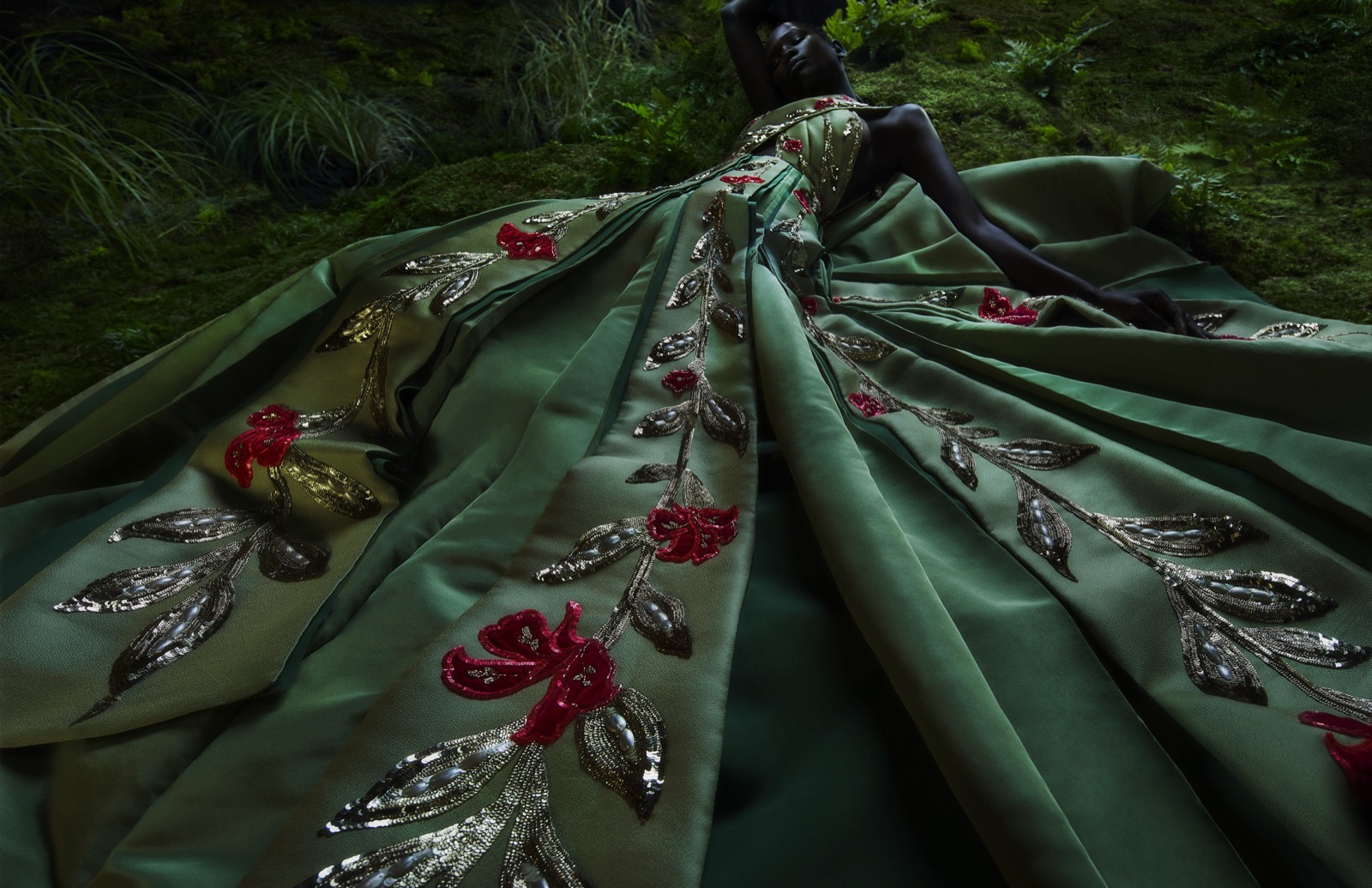

The dress takes almost the entire frame. Green silk, acres of it, spread across the forest floor in broad folds and embroidered with silver-sequinned leaves and small crimson flowers that climb the fabric on stems, as if trained up a trellis. The woman wearing it lies back at the top of the picture, head turned away and mostly lost to shadow, one arm extended down the slope, her dark skin holding the last of the light. Beyond and above her, the real vegetation: moss, fern, undergrowth going black at the edges.
Two gardens, then, one embroidered and one actual, and the embroidered one wins. The silk is lit and the wood is not, so the flowers on the dress bloom while the living plants recede into a dark green mass. It is the arrangement of a painting rather than a photograph, a body dissolved into landscape and the landscape rendered as fabric, and it carries the memory of every drowned Ophelia and every reclining figure absorbed into foliage that European painting has produced.
Which is what I keep returning to. In that tradition, a Black woman in the wood was rarely the one reclining; she was more often standing at the edge of the canvas, holding something for someone else. Here the whole composition exists to hold her, and yet the picture nearly loses her to the dress, the shadow, the moss. I do not think the photograph resolves that tension, and I am not sure it should. It knows what it is quoting, and the ambivalence is the honest part.