Ramón Masats
Spanish, 1931–2024Sanfermines, Pamplona, 1956-60
Gelatin Silver Print. Printed Later.
Image: 37.5 x 24.5 cm / 14 3/4 x 9 5/8 in / Paper: 40 x 30 cm / 15 3/4 x 11 3/4 in
Image: 56.5 x 37.5 cm / 22 1/4 x 14 3/4 in / Paper: 60 x 50 cm / 23 5/8 x 19 3/4 in
Ramón Masats Estate dry stamp, signed and authenticated by Sonia Masats with title and edition number in pencil on label affixed to print verso
Edition of 15 — Image: 37.5 x 24.5 cm / 14 3/4 x 9 5/8 in / Paper: 40 x 30 cm / 15 3/4 x 11 3/4 in
Edition of 5 — Image: 56.5 x 37.5 cm / 22 1/4 x 14 3/4 in / Paper: 60 x 50 cm / 23 5/8 x 19 3/4 in
© The Artist
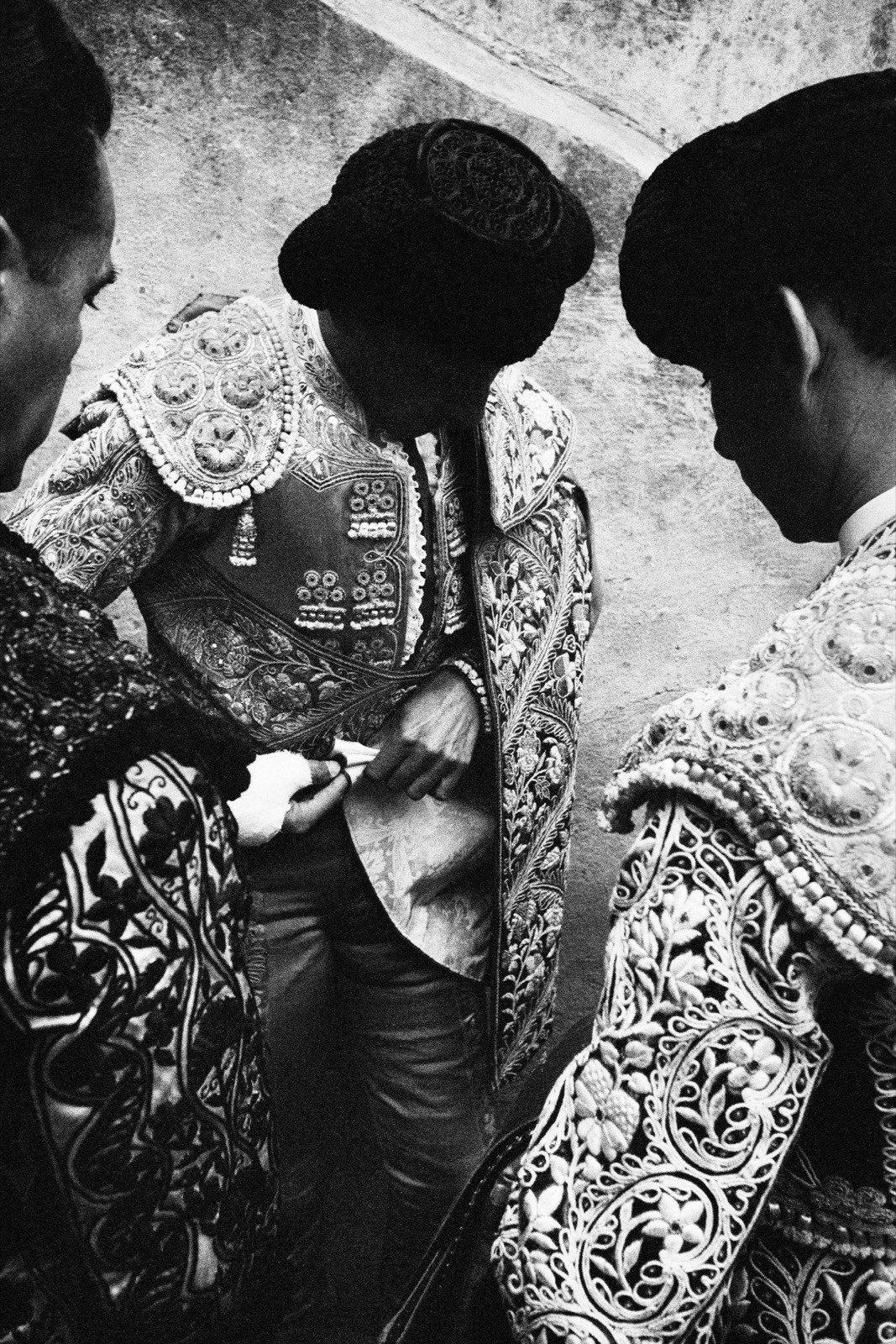
Seen from directly above, three bullfighters bowing their heads in their gold-and-silver suits fall into a lineage older than photography: the Spanish devotional painting of Zurbarán and Murillo, where embroidered vestments and lowered eyes signalled a soul composing itself before a mortal ordeal. The traje de luces is court dress descended into ritual, its scrollwork and sequins as dense as any chasuble. Masats knew the analogy and let the camera assume the vantage of a fresco, looking down as if from a painted, indifferent heaven.
What seduces us is precisely what should give us pause. The eye feasts on the floral bullion, the beaded epaulettes, the black astrakhan montera, and forgets that this finery is worn to face an animal bred to die in public. A single hand reaches in to fasten the costume at the waist, a comrade’s gesture, tender and practical. Beauty here is not innocent; it is the ceremonial casing around an afternoon of blood, and the photograph both knows this and cannot look away.
Masats belonged to the AFAL group that pulled Spanish photography, under Franco, toward a clear-eyed reckoning with its own culture; the Premio Nacional followed in 2004. This gelatin silver print, made later from the negative, gives the embroidery a metallic exactness while keeping the plaster wall behind it soft and worn. The three heads, bowed, form a small dark council. To own it is to keep close a contradiction the eye never resolves: the loveliest surface in the frame is also the most complicit.