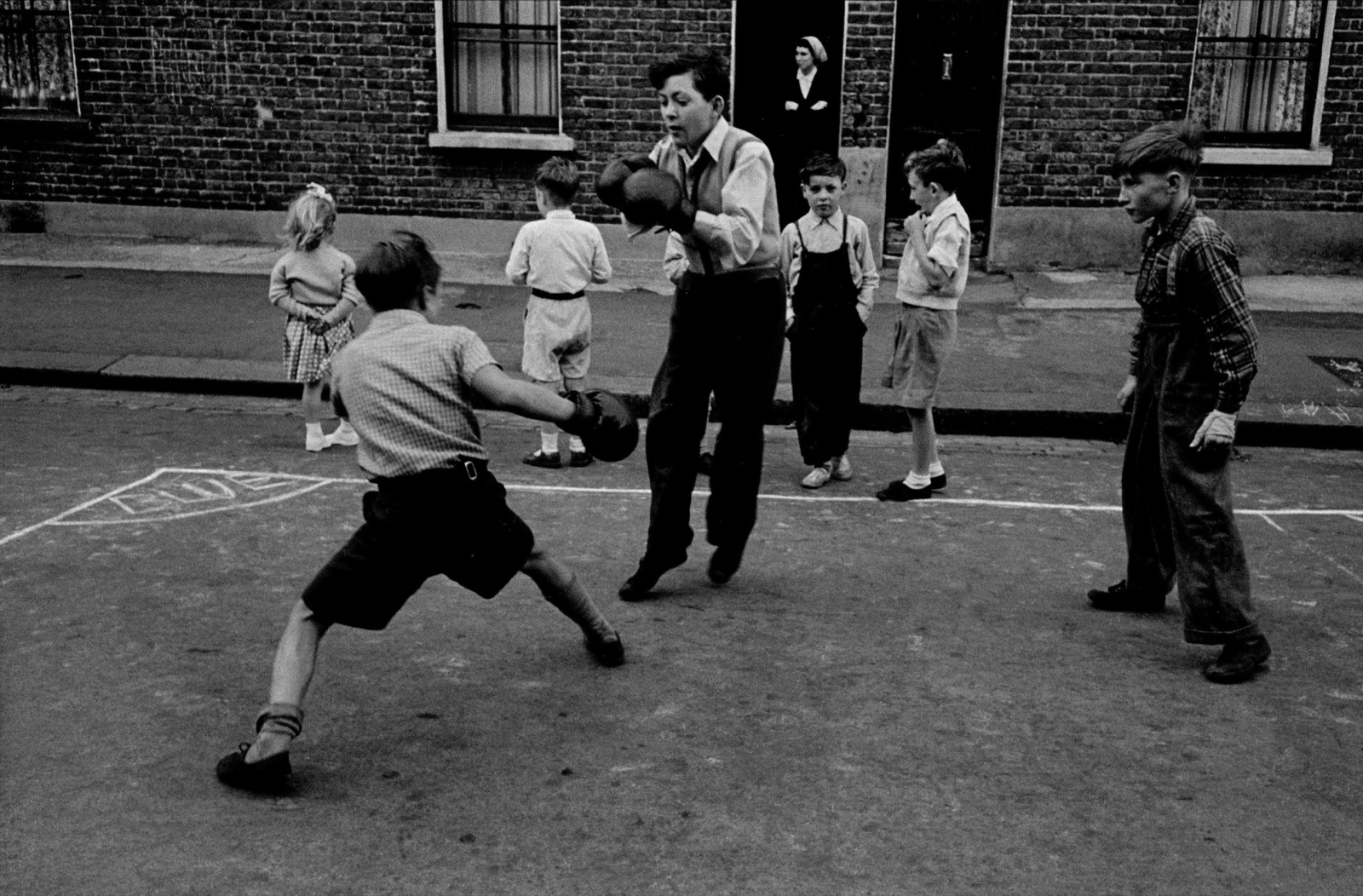
A terraced street in south London, flat evening light, the brick rising at the back like the wall of a yard. On the asphalt someone has chalked a white rectangle, and you can still read the letters BUS along its near edge — a bus stop pressed into service as a prizefight ring. That borrowed boundary is doing the real work of the picture, an improvised order the camera finds already in place.
The two boxers honor the line without quite knowing they do: the boy at left drops into a long, splay-footed lunge that carries his gloved fist forward, while the taller boy back-pedals across the chalk with his own glove cocked and his cheeks puffed. What makes the frame hold is how Horvat lets the other children describe the space the camera cannot. They stand at the edges in a loose arc — a girl in a print dress, boys with hands in pockets, one in plaid at far right watching with a referee's patience — and their scattered attention tells you the fight is real but unimportant, a thing that happens here most evenings. The vantage is low and close enough to feel the lunge yet far enough to keep the whole company in view; nobody performs for the lens. In the dark doorway a woman in an apron leans against the jamb, arms folded, the one adult, and the brick closes the top of the picture.
Horvat made this in Lambeth in 1955, early in the London years that followed his Asian reportage for Life and Picture Post, before fashion claimed him. The reportage instinct is all here: he trusts the gestures and the chalk to carry the meaning, and asks the print only to describe them cleanly. This is the later printing of that negative, returned to deep blacks and a held gray asphalt, the boxers and their borrowed ring as legible now as the day the line was drawn.
A terraced street in south London, flat evening light, the brick rising at the back like the wall of a yard. On the asphalt someone has chalked a white rectangle, and you can still read the letters BUS along its near edge — a bus stop pressed into service as a prizefight ring. That borrowed boundary is doing the real work of the picture, an improvised order the camera finds already in place.
The two boxers honor the line without quite knowing they do: the boy at left drops into a long, splay-footed lunge that carries his gloved fist forward, while the taller boy back-pedals across the chalk with his own glove cocked and his cheeks puffed. What makes the frame hold is how Horvat lets the other children describe the space the camera cannot. They stand at the edges in a loose arc — a girl in a print dress, boys with hands in pockets, one in plaid at far right watching with a referee's patience — and their scattered attention tells you the fight is real but unimportant, a thing that happens here most evenings. The vantage is low and close enough to feel the lunge yet far enough to keep the whole company in view; nobody performs for the lens. In the dark doorway a woman in an apron leans against the jamb, arms folded, the one adult, and the brick closes the top of the picture.
Horvat made this in Lambeth in 1955, early in the London years that followed his Asian reportage for Life and Picture Post, before fashion claimed him. The reportage instinct is all here: he trusts the gestures and the chalk to carry the meaning, and asks the print only to describe them cleanly. This is the later printing of that negative, returned to deep blacks and a held gray asphalt, the boxers and their borrowed ring as legible now as the day the line was drawn.