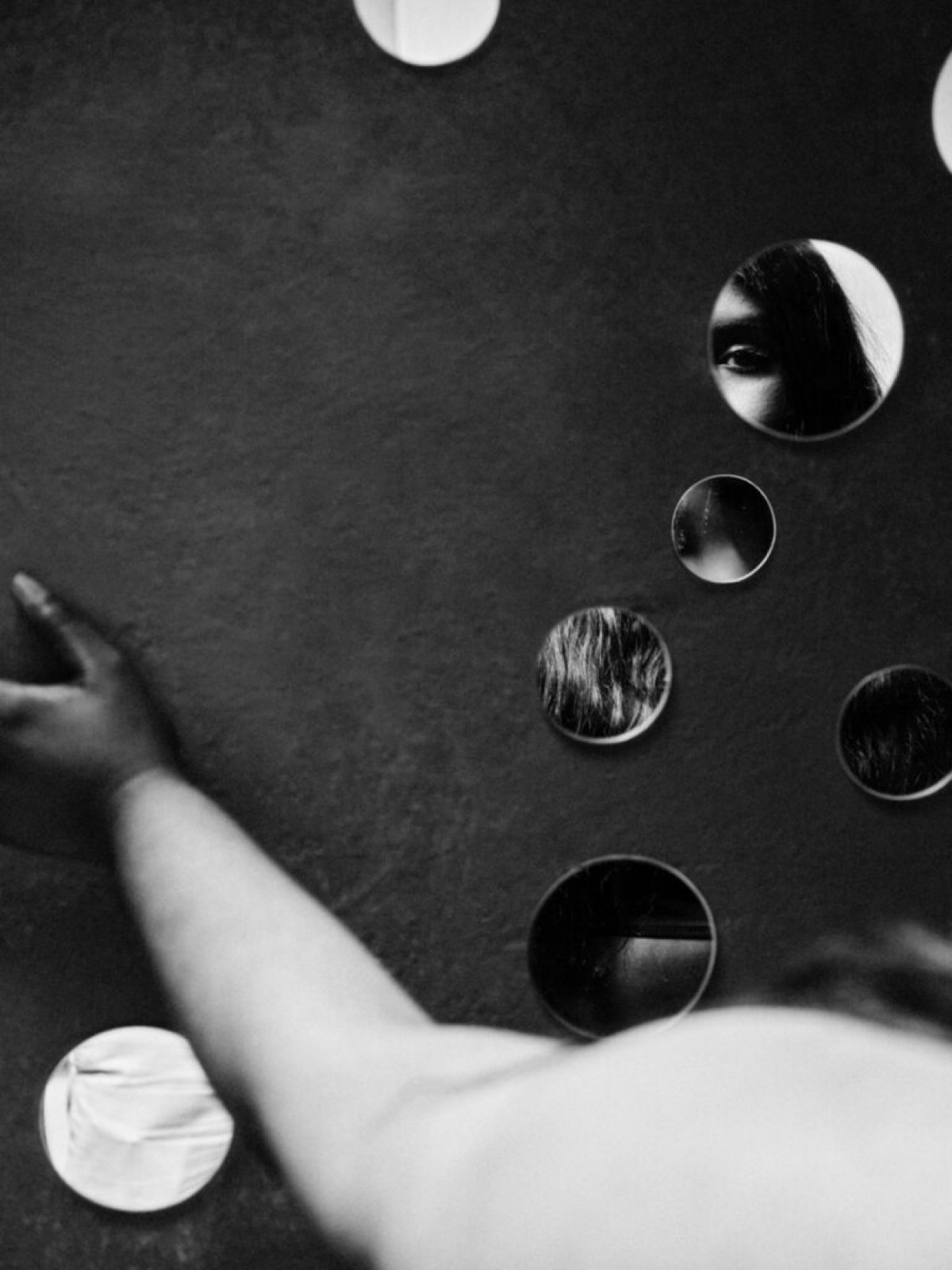
A dark textured surface seen close, punched through with circular openings of different sizes. Through them, pieces of a person: an eye with its brow and a fall of dark hair in the largest disc at upper right; a section of hair in the one below; a smaller aperture holding something soft and pale; a dark curve near the bottom. At the left an arm reaches in from outside the wall entirely, bare, the hand open and pressed flat against the surface. Black and white.
The construction is a screen, and the screen does what screens do: it grants sight in fragments and withholds the whole. But the arm complicates it. The arm is on our side of the barrier, in the same space as the camera, which means the body being shown to us in pieces is also — partly — out here with us, and the wall does not enclose it so much as pass through it.
What this most resembles is an apparatus, and specifically the apparatus at the beginning of the medium: the camera obscura, the small aperture through which the world is admitted in a controlled dose. Every one of these openings is a lens with no glass in it. Yeste has built, in front of his camera, a rank of secondary cameras, and photographed a person through all of them at once. The result is an image about the condition of every photograph — that seeing anything whatever requires first deciding what to leave out.
A dark textured surface seen close, punched through with circular openings of different sizes. Through them, pieces of a person: an eye with its brow and a fall of dark hair in the largest disc at upper right; a section of hair in the one below; a smaller aperture holding something soft and pale; a dark curve near the bottom. At the left an arm reaches in from outside the wall entirely, bare, the hand open and pressed flat against the surface. Black and white.
The construction is a screen, and the screen does what screens do: it grants sight in fragments and withholds the whole. But the arm complicates it. The arm is on our side of the barrier, in the same space as the camera, which means the body being shown to us in pieces is also — partly — out here with us, and the wall does not enclose it so much as pass through it.
What this most resembles is an apparatus, and specifically the apparatus at the beginning of the medium: the camera obscura, the small aperture through which the world is admitted in a controlled dose. Every one of these openings is a lens with no glass in it. Yeste has built, in front of his camera, a rank of secondary cameras, and photographed a person through all of them at once. The result is an image about the condition of every photograph — that seeing anything whatever requires first deciding what to leave out.