Hand-signed by the artist, with title, date, and edition number inscribed in ink on an archival label affixed to the reverse side of the mounted photograph.
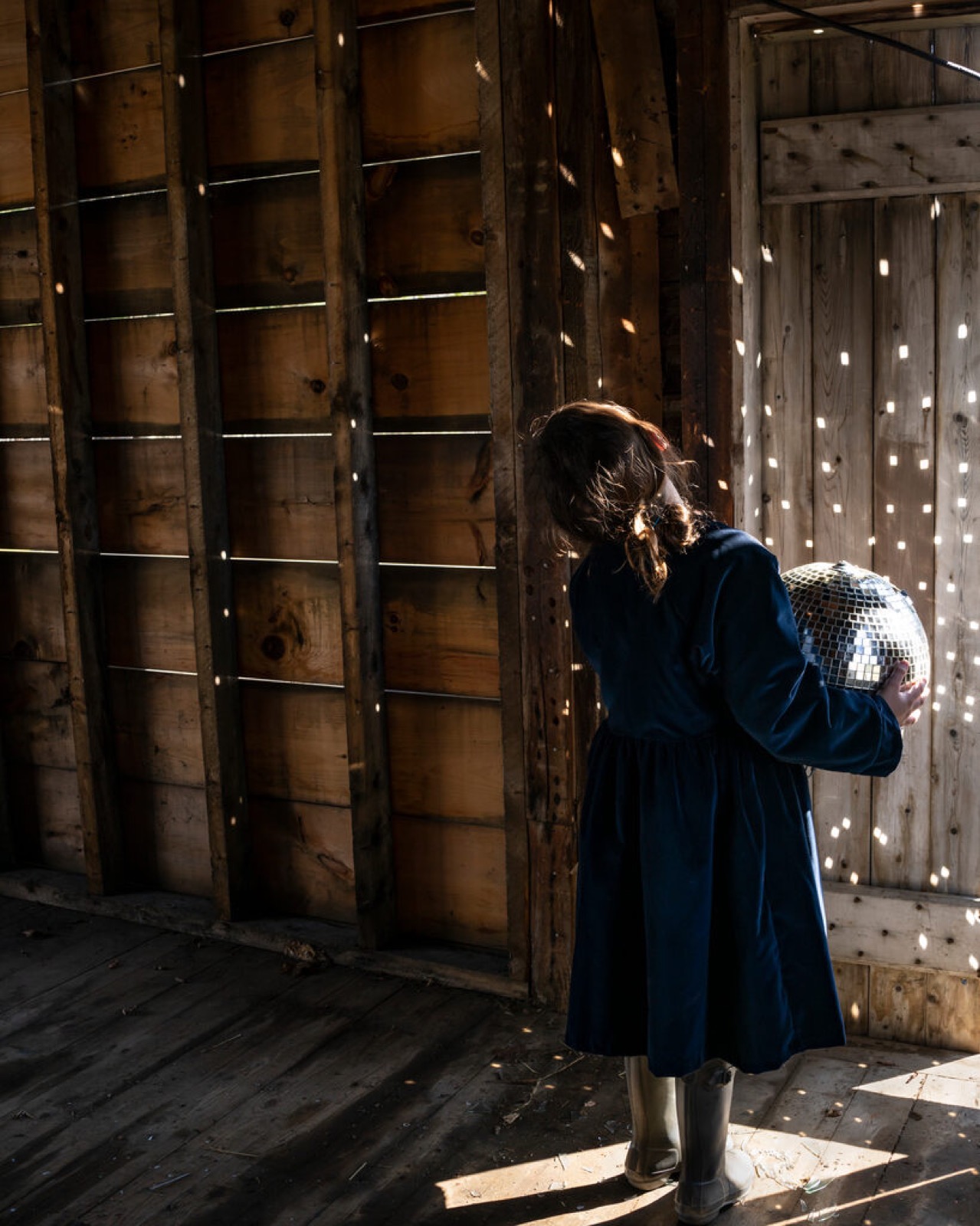
Count the flecks of light and you lose count; one has strayed onto the raw plank floor, far from the others, and it is that stray that gives the game away. The disco ball the child cradles against her hip is throwing the barn full of small bright coins, turning a rough shed of studs and knotholes into something like a night sky at noon. She stands with her back to us, in a navy velvet dress and pale rubber boots, and does not look up.
A disco ball is a machine for making any room glamorous, and Harvey knows it; the picture half distrusts its own enchantment even as it surrenders. The seduction is real and also a trick of angled mirrors. What steadies it is the child’s absorption: she is not performing for the camera but attending to the heavy silvered sphere in her arms, the way children attend to whatever they have decided is precious. The velvet drinks the light the mirrors scatter.
Harvey, British-born and settled in Rockport, Maine, has made a body of work from exactly these collisions: the domestic staged into wonder, ordinary rooms tipped toward the ecstatic, gathered in books such as The Blue Notebook and Blue Violet. The image is an archival pigment print, a medium equal to the wide tonal reach here, from the black of the shadowed studs to the fragile pinpoints riddling the far wall. It leaves you slightly ashamed of how easily you were charmed, and unwilling to look away.
Count the flecks of light and you lose count; one has strayed onto the raw plank floor, far from the others, and it is that stray that gives the game away. The disco ball the child cradles against her hip is throwing the barn full of small bright coins, turning a rough shed of studs and knotholes into something like a night sky at noon. She stands with her back to us, in a navy velvet dress and pale rubber boots, and does not look up.
A disco ball is a machine for making any room glamorous, and Harvey knows it; the picture half distrusts its own enchantment even as it surrenders. The seduction is real and also a trick of angled mirrors. What steadies it is the child’s absorption: she is not performing for the camera but attending to the heavy silvered sphere in her arms, the way children attend to whatever they have decided is precious. The velvet drinks the light the mirrors scatter.
Harvey, British-born and settled in Rockport, Maine, has made a body of work from exactly these collisions: the domestic staged into wonder, ordinary rooms tipped toward the ecstatic, gathered in books such as The Blue Notebook and Blue Violet. The image is an archival pigment print, a medium equal to the wide tonal reach here, from the black of the shadowed studs to the fragile pinpoints riddling the far wall. It leaves you slightly ashamed of how easily you were charmed, and unwilling to look away.