The director’s chair belongs to the iconography of command: canvas, black frame, the seat from which pictures are ordered into being. Wegman sets up two of them, tall ones, and staffs the set entirely with Weimaraners. The title points north, south, east and west, and the picture obliges like a compass rose: one young dog arched between the two chairs, one lying flat on the seamless floor below, and two curled asleep on the seats, flanking the center like the poles of a map.
The organization is nearly heraldic. Two black X-frames answer one another across the middle; the standing pup completes the arch, hind feet on one armrest, forefeet on the other. The palette barely qualifies as color: gray coats, black lacquer, white canvas, a ground the tone of fog. What keeps the diagram alive is its small disobediences. One sleeper lets a forepaw hang into space; the other drops its muzzle over the seat’s edge; the bridging dog turns its pale eyes upward, off the set, awaiting direction from someone who never arrives. Only the dog on the floor faces us squarely, and its eyes are closed.
This is a unique color Polaroid, made with the giant studio camera Wegman turned into his principal instrument: one exposure, developed on the spot, the chemistry leaving its fringed tidemark along the top margin, title and date penciled beneath. No negative stands behind it; the object is the picture. Since the 1970s his deadpan partnership with his dogs has traveled from video into museum collections, and sheets like this one explain the durability: the wit is carried by construction.
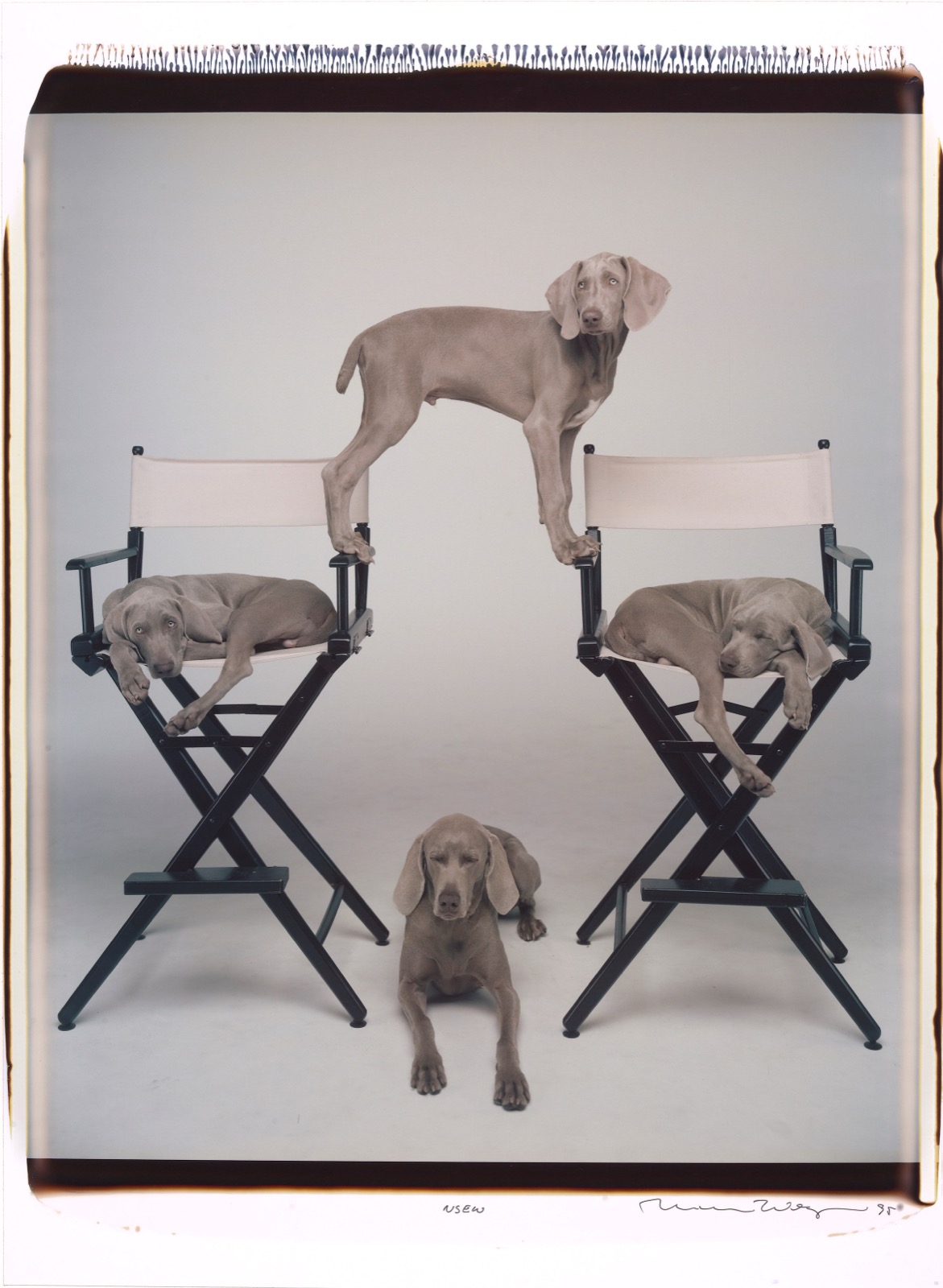

The director’s chair belongs to the iconography of command: canvas, black frame, the seat from which pictures are ordered into being. Wegman sets up two of them, tall ones, and staffs the set entirely with Weimaraners. The title points north, south, east and west, and the picture obliges like a compass rose: one young dog arched between the two chairs, one lying flat on the seamless floor below, and two curled asleep on the seats, flanking the center like the poles of a map.
The organization is nearly heraldic. Two black X-frames answer one another across the middle; the standing pup completes the arch, hind feet on one armrest, forefeet on the other. The palette barely qualifies as color: gray coats, black lacquer, white canvas, a ground the tone of fog. What keeps the diagram alive is its small disobediences. One sleeper lets a forepaw hang into space; the other drops its muzzle over the seat’s edge; the bridging dog turns its pale eyes upward, off the set, awaiting direction from someone who never arrives. Only the dog on the floor faces us squarely, and its eyes are closed.
This is a unique color Polaroid, made with the giant studio camera Wegman turned into his principal instrument: one exposure, developed on the spot, the chemistry leaving its fringed tidemark along the top margin, title and date penciled beneath. No negative stands behind it; the object is the picture. Since the 1970s his deadpan partnership with his dogs has traveled from video into museum collections, and sheets like this one explain the durability: the wit is carried by construction.