Txema Yeste
Spanish, b. 1972Needles, 2019-24
Gelatin silver print mounted on aluminium Dibond.
Image: 63 x 45 cm / 24 3/4 x 17 3/4 in / Paper: 78 x 59 cm / 30 3/4 x 23 1/4 in
Image: 110 x 78 cm / 43 1/4 x 30 3/4 in / Paper: 126 x 95 cm / 49 5/8 x 37 3/8 in
Image: 147 x 90 cm / 57 7/8 x 35 3/8 in / Paper: 162 x 106 cm / 63 3/4 x 41 3/4 in
Hand-signed by the artist, titled, editioned, and dated in ink on a label affixed to the verso of the mount
Edition of 10 — Image: 63 x 45 cm / 24 3/4 x 17 3/4 in / Paper: 78 x 59 cm / 30 3/4 x 23 1/4 in
Edition of 5 — Image: 110 x 78 cm / 43 1/4 x 30 3/4 in / Paper: 126 x 95 cm / 49 5/8 x 37 3/8 in
Edition of 3 — Image: 147 x 90 cm / 57 7/8 x 35 3/8 in / Paper: 162 x 106 cm / 63 3/4 x 41 3/4 in
© The Artist
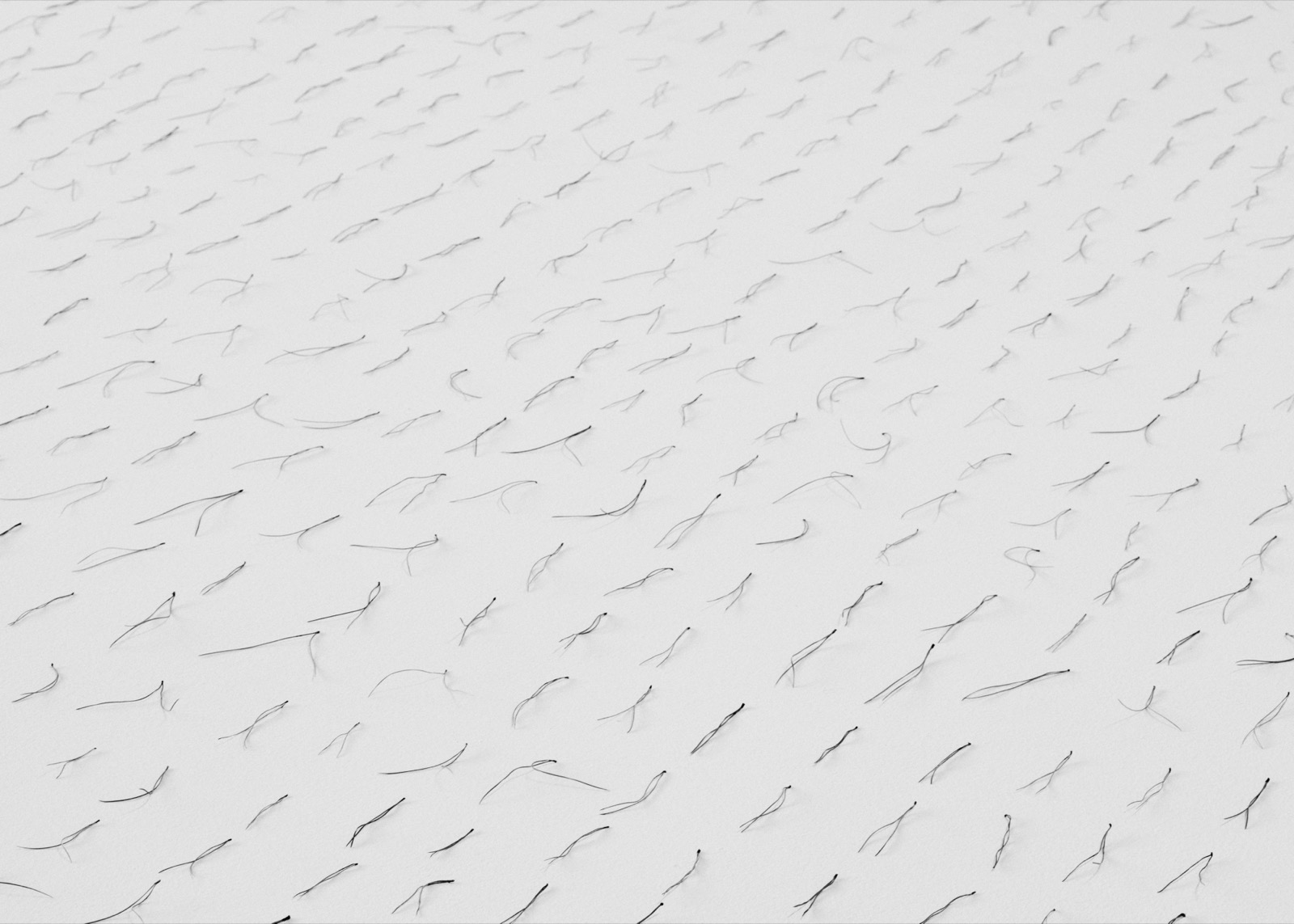
Each dark mark on this white ground trails a shadow no thicker than a hair, and that shadow changes everything. Without it you might take the field for a page: hundreds of pen strokes, a script waiting to be read. With it, the marks become things: pine needles, paired and knotted at the base like tiny wishbones, standing just proud of the surface, each one caught in the same soft daylight. Drawing does not cast shadows. Photography attends to them.
Scale is the second casualty. These could be birds scattering over a pale sea, or stitches worked through linen, or the tracks of something small across late snow. The rows run in loose diagonals toward the top of the frame and soften there into mist, the way any landscape gives out at its horizon, so that a field of pine needles behaves like weather over a plain. Photography has always been good at this: the close-up that forgets to tell you it is one.
Txema Yeste stands in the front rank of Spanish fashion photography, and his editorial work for Numéro, Harper’s Bazaar and Vogue runs on elemental drama: fire, water, sand, cloth alive in wind. The Needles series is the same sensibility with the volume turned almost to zero, patience standing in for spectacle. And it insists on the print. Gelatin silver, mounted on aluminium Dibond, the object holds its long scale of greys perfectly flat, a hard, quiet page for a script no hand actually wrote. You do not decode it; you keep looking, which is the point.