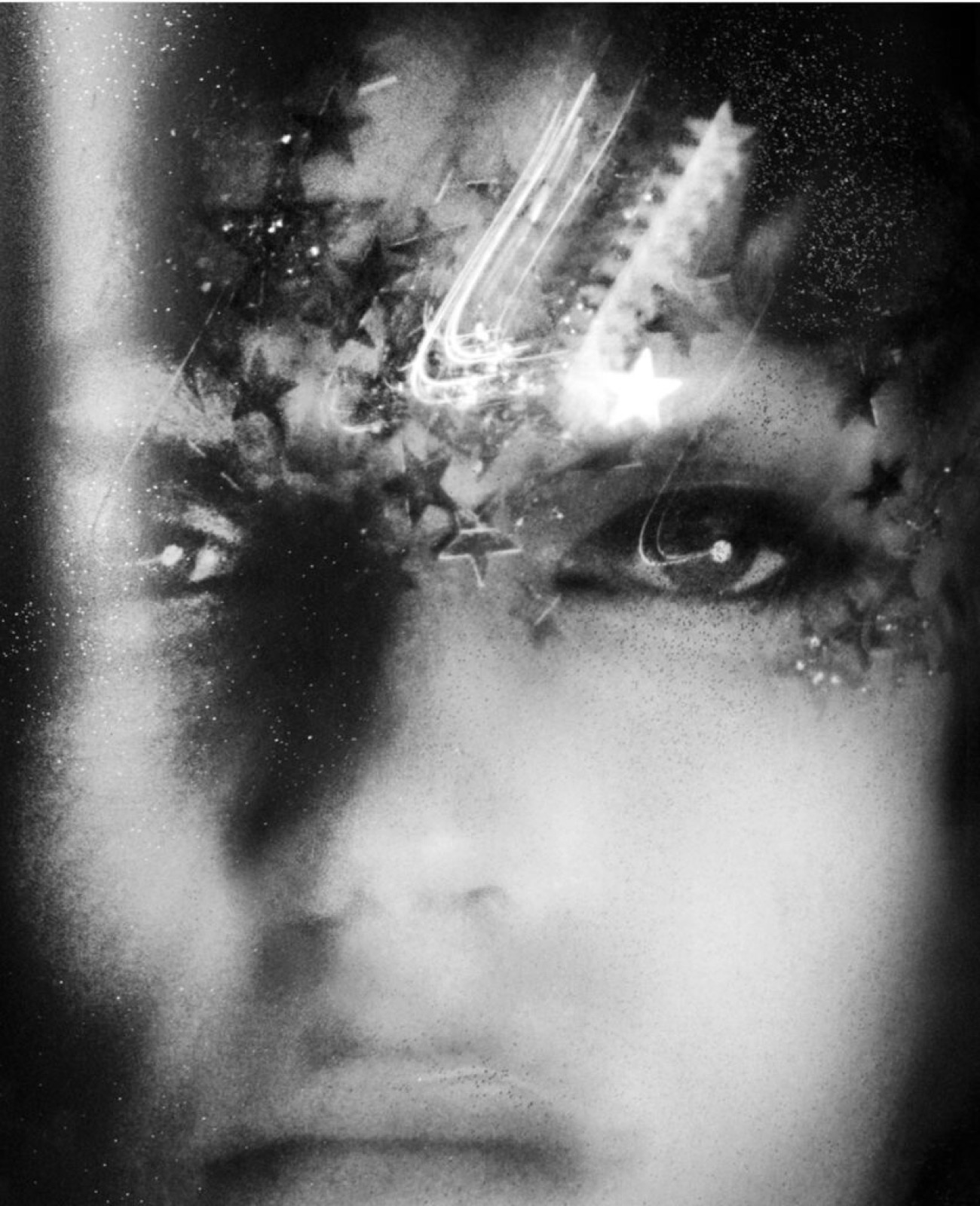
A face seen through some kind of scattering surface — glass, or a screen, or a layer of powder — so that the whole image is granular, silvered and slightly out of reach. Around the eyes and up over the brows someone has stuck a constellation of small stars and glitter, and through them run white streaks of light curving like the trails in a long exposure of a night sky. One eye is legible and looking straight out. The rest of the face dissolves into grain.
The star business should be unbearable. Sticking sequin stars on a face and lighting them so they flare is about two steps from a school photograph, and there is an entire tradition of doing precisely this badly. Yet it holds, largely because of the grain — heavy, dirty, everywhere — which makes the whole thing look found rather than made, a frame recovered from an old fan magazine or a screen test nobody kept.
I have a weakness for photographs that pretend to be older than they are, and I recognise that as a weakness rather than a critical position. But something genuinely odd is going on here: a 2025 photograph, made with equipment capable of resolving a pore at ten metres, which has gone to real trouble to arrive looking like a degraded print of a face nobody can quite place. The stars are the least of it. What the picture is actually wearing is the past.

A face seen through some kind of scattering surface — glass, or a screen, or a layer of powder — so that the whole image is granular, silvered and slightly out of reach. Around the eyes and up over the brows someone has stuck a constellation of small stars and glitter, and through them run white streaks of light curving like the trails in a long exposure of a night sky. One eye is legible and looking straight out. The rest of the face dissolves into grain.
The star business should be unbearable. Sticking sequin stars on a face and lighting them so they flare is about two steps from a school photograph, and there is an entire tradition of doing precisely this badly. Yet it holds, largely because of the grain — heavy, dirty, everywhere — which makes the whole thing look found rather than made, a frame recovered from an old fan magazine or a screen test nobody kept.
I have a weakness for photographs that pretend to be older than they are, and I recognise that as a weakness rather than a critical position. But something genuinely odd is going on here: a 2025 photograph, made with equipment capable of resolving a pore at ten metres, which has gone to real trouble to arrive looking like a degraded print of a face nobody can quite place. The stars are the least of it. What the picture is actually wearing is the past.