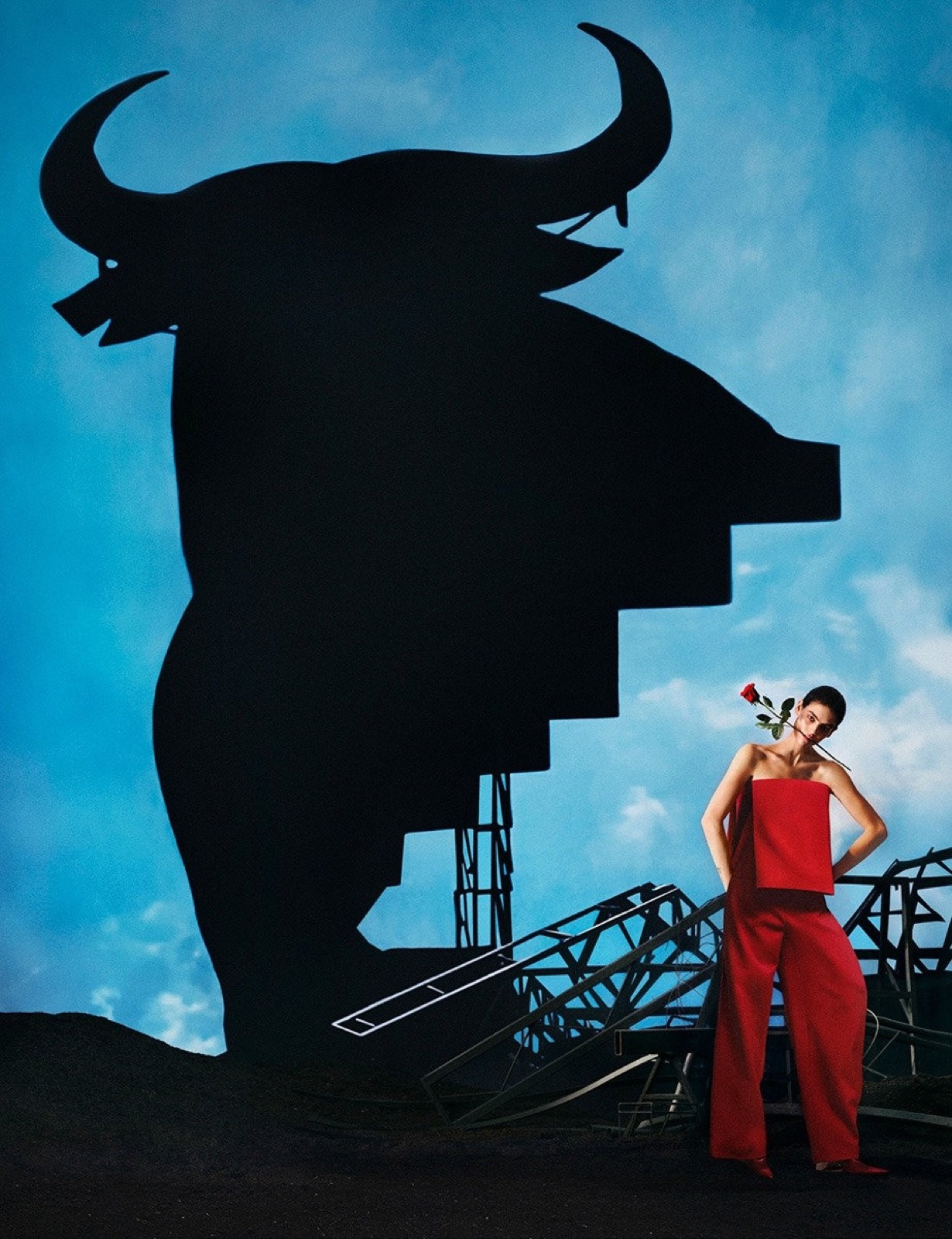
She bites the stem, not the bloom. That single red rose clamped sideways in her teeth is the whole picture's wit—a wink at every flamenco postcard ever sold, delivered with a model's deadpan and a couturier's nerve. Everything below it is engineered red: a strapless column gown with a stiff bib panel that juts from her torso like a matador's flat-folded cape, trousers breaking clean over the heel, hands jammed on hips in the oldest stance of defiance there is. She owns her square meter of black coal and bent scaffolding.
What makes it more than glamour is the thing she refuses to look at. Behind her, vast and cut flat against a too-blue, retouched sky, looms the Osborne bull—Spain's roadside silhouette, the sherry billboard that became a national totem. Txema Yeste shoots it from the wrong side, so we see the gantry, the ladder, the struts holding the myth upright. The bull is a stage flat. The icon is propped, and he wants us to know it.
That's the charge here: heritage as set design. Yeste, the Catalan whose hard, sculptural eye has run through Numéro, Harper's Bazaar and a shelf of monographs, treats the most clichéd image in the culture and rebuilds it as theater—coal underfoot, machinery exposed, the lone red figure refusing the bull's scale by simply standing her ground in front of it. The rose says romance; the scaffolding says construction; she splits the difference and holds it. New for 2025, in an edition across three sizes that scale this standoff from intimate to wall-commanding, it's couture and counter-myth at once, with no apology for enjoying both.
She bites the stem, not the bloom. That single red rose clamped sideways in her teeth is the whole picture's wit—a wink at every flamenco postcard ever sold, delivered with a model's deadpan and a couturier's nerve. Everything below it is engineered red: a strapless column gown with a stiff bib panel that juts from her torso like a matador's flat-folded cape, trousers breaking clean over the heel, hands jammed on hips in the oldest stance of defiance there is. She owns her square meter of black coal and bent scaffolding.
What makes it more than glamour is the thing she refuses to look at. Behind her, vast and cut flat against a too-blue, retouched sky, looms the Osborne bull—Spain's roadside silhouette, the sherry billboard that became a national totem. Txema Yeste shoots it from the wrong side, so we see the gantry, the ladder, the struts holding the myth upright. The bull is a stage flat. The icon is propped, and he wants us to know it.
That's the charge here: heritage as set design. Yeste, the Catalan whose hard, sculptural eye has run through Numéro, Harper's Bazaar and a shelf of monographs, treats the most clichéd image in the culture and rebuilds it as theater—coal underfoot, machinery exposed, the lone red figure refusing the bull's scale by simply standing her ground in front of it. The rose says romance; the scaffolding says construction; she splits the difference and holds it. New for 2025, in an edition across three sizes that scale this standoff from intimate to wall-commanding, it's couture and counter-myth at once, with no apology for enjoying both.