Hand-signed by the artist, with title, date, and edition number inscribed in ink on an archival label affixed to the reverse side of the mounted photograph.
Spilling out of a darkness so total it reads as void, the azalea heaps its coral blossoms into one glowing mound and keeps going, cascading downward until the lowest flowers hang just above unseen grass. The bush seems caught in the act of overflowing. Nothing else in the frame competes: no sky, no horizon, only this single organism straining to release more color than a plant should decently hold, its green leaves buried under the surge.
Such a picture courts the very charge photography most fears: prettiness, the flower as easy pleasure. And it succeeds anyway, precisely by admitting the risk. The lush pinks are not softened but lit against absolute shadow, so that beauty arrives looking almost predatory, a bloom staged like an apparition. We are seduced, and we know we are being seduced; the darkness that flatters the flowers is theatrical, deliberate, a little sinister. To find this much loveliness slightly alarming is exactly the response the image wants from us.
Cig Harvey made the picture in Japan, where the azalea is cultivated as a spring spectacle, and her instinct is to isolate rather than survey. The Maine-based photographer, author of Blue Violet and You an Orchestra a Bomb, treats saturated color as an argument about attention itself. Rendered as an archival pigment print, the image sustains that dense coral without letting it curdle into candy, holding each cluster distinct against the depthless black. Widely collected by American museums, she keeps testing how much sensory pleasure a single frame can carry before it turns strange.
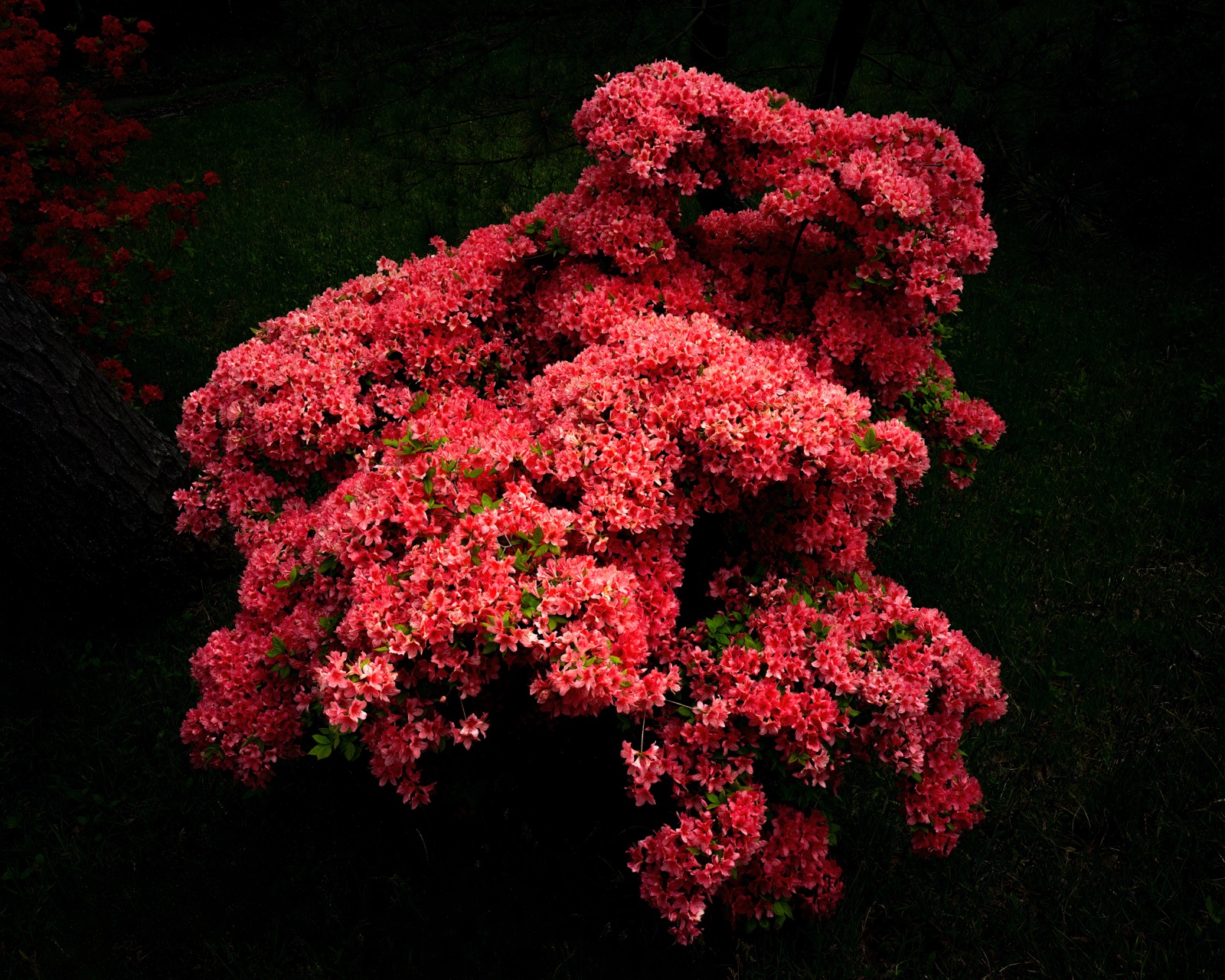

Spilling out of a darkness so total it reads as void, the azalea heaps its coral blossoms into one glowing mound and keeps going, cascading downward until the lowest flowers hang just above unseen grass. The bush seems caught in the act of overflowing. Nothing else in the frame competes: no sky, no horizon, only this single organism straining to release more color than a plant should decently hold, its green leaves buried under the surge.
Such a picture courts the very charge photography most fears: prettiness, the flower as easy pleasure. And it succeeds anyway, precisely by admitting the risk. The lush pinks are not softened but lit against absolute shadow, so that beauty arrives looking almost predatory, a bloom staged like an apparition. We are seduced, and we know we are being seduced; the darkness that flatters the flowers is theatrical, deliberate, a little sinister. To find this much loveliness slightly alarming is exactly the response the image wants from us.
Cig Harvey made the picture in Japan, where the azalea is cultivated as a spring spectacle, and her instinct is to isolate rather than survey. The Maine-based photographer, author of Blue Violet and You an Orchestra a Bomb, treats saturated color as an argument about attention itself. Rendered as an archival pigment print, the image sustains that dense coral without letting it curdle into candy, holding each cluster distinct against the depthless black. Widely collected by American museums, she keeps testing how much sensory pleasure a single frame can carry before it turns strange.