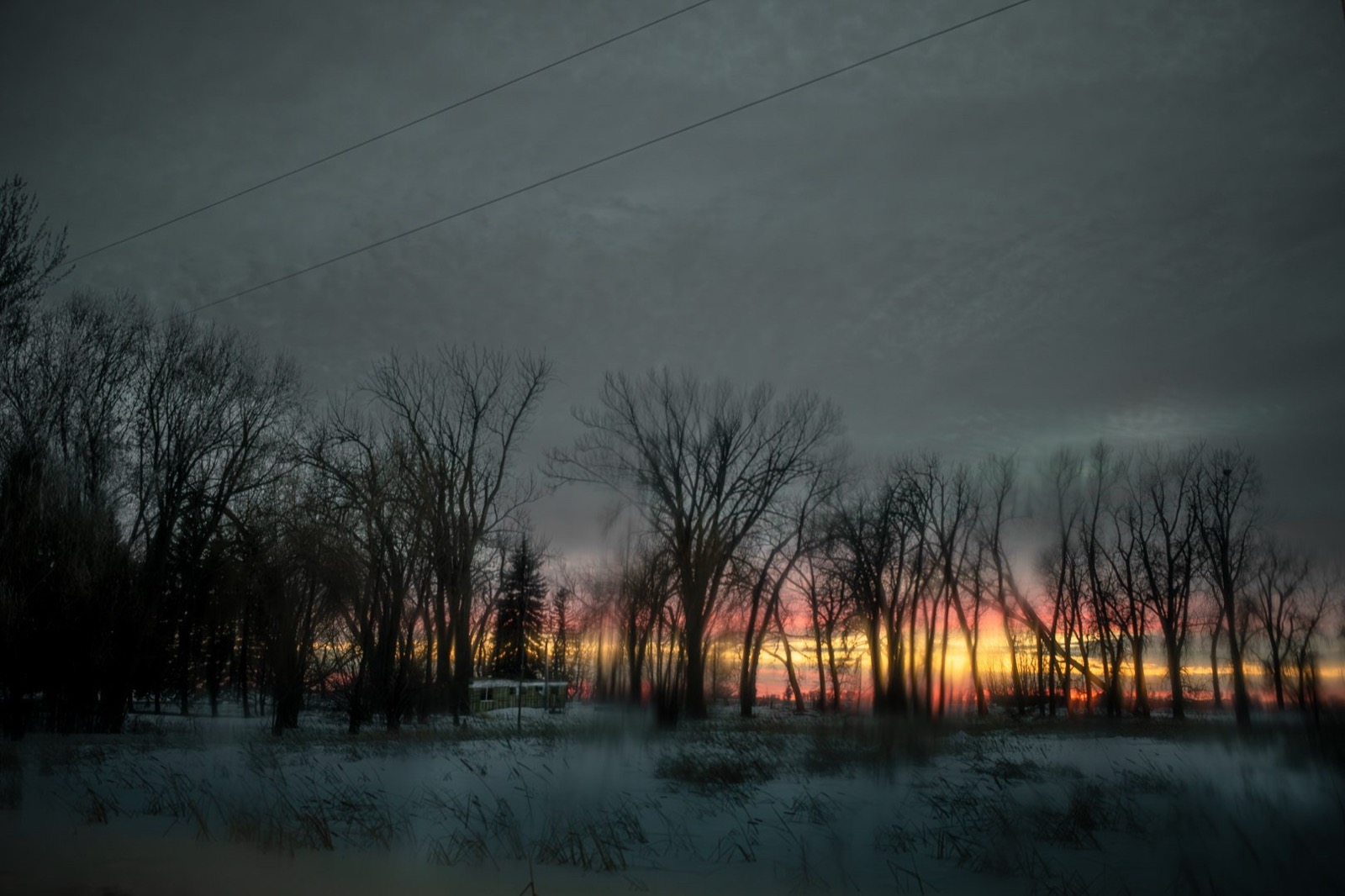
The last light of a winter day weighs nothing; photography’s oldest ambition has been to give it weight. Here that light burns in a narrow band, yellow flaring into red behind a screen of bare trees, and the exposure has been made in motion: trunks smear upward like wet ink, the band of fire going soft and doubled at its edges. A single wire crosses the slate sky. Below, snow lies blue in the dusk, needled with frozen grass.
The series is called End Sends Advance Warning, and this is what a warning looks like when it arrives as scenery: a sky the color of cooling ash, a horizon burning through the gaps. What anchors the omen to the ordinary is the small pale building tucked among the trunks, its windows dark, the kind of roadside dwelling glimpsed from a moving car and forgotten by everyone but the person who lives there. Millions of such views are half-seen every winter evening; photography’s peculiar labor is to keep one, to take an unrepeatable smear of speed and cold and make it hold.
And it holds as a thing. Printed in archival pigment and mounted on aluminium Dibond, the image becomes a rigid object with weight and edge, the sunset bonded to metal, weather you can carry. That transformation, from fugitive light to durable matter, has been Hido’s territory since his night pictures of suburban houses entered the collections of SFMOMA, the Getty, and the Whitney. This one belongs to his colder register: the road, the window, the country going dark.

The last light of a winter day weighs nothing; photography’s oldest ambition has been to give it weight. Here that light burns in a narrow band, yellow flaring into red behind a screen of bare trees, and the exposure has been made in motion: trunks smear upward like wet ink, the band of fire going soft and doubled at its edges. A single wire crosses the slate sky. Below, snow lies blue in the dusk, needled with frozen grass.
The series is called End Sends Advance Warning, and this is what a warning looks like when it arrives as scenery: a sky the color of cooling ash, a horizon burning through the gaps. What anchors the omen to the ordinary is the small pale building tucked among the trunks, its windows dark, the kind of roadside dwelling glimpsed from a moving car and forgotten by everyone but the person who lives there. Millions of such views are half-seen every winter evening; photography’s peculiar labor is to keep one, to take an unrepeatable smear of speed and cold and make it hold.
And it holds as a thing. Printed in archival pigment and mounted on aluminium Dibond, the image becomes a rigid object with weight and edge, the sunset bonded to metal, weather you can carry. That transformation, from fugitive light to durable matter, has been Hido’s territory since his night pictures of suburban houses entered the collections of SFMOMA, the Getty, and the Whitney. This one belongs to his colder register: the road, the window, the country going dark.