Till Death Do Us Part (Diptych), Accra, Ghana, 2022
Archival pigment print mounted on aluminium Dibond.
One Size Only. Each panel: / 71.1 x 50.8 cm / 28 x 20 in
Hand-signed by the artist, with title, date, and edition number inscribed in ink on an archival label affixed to the reverse side of the mounted photograph
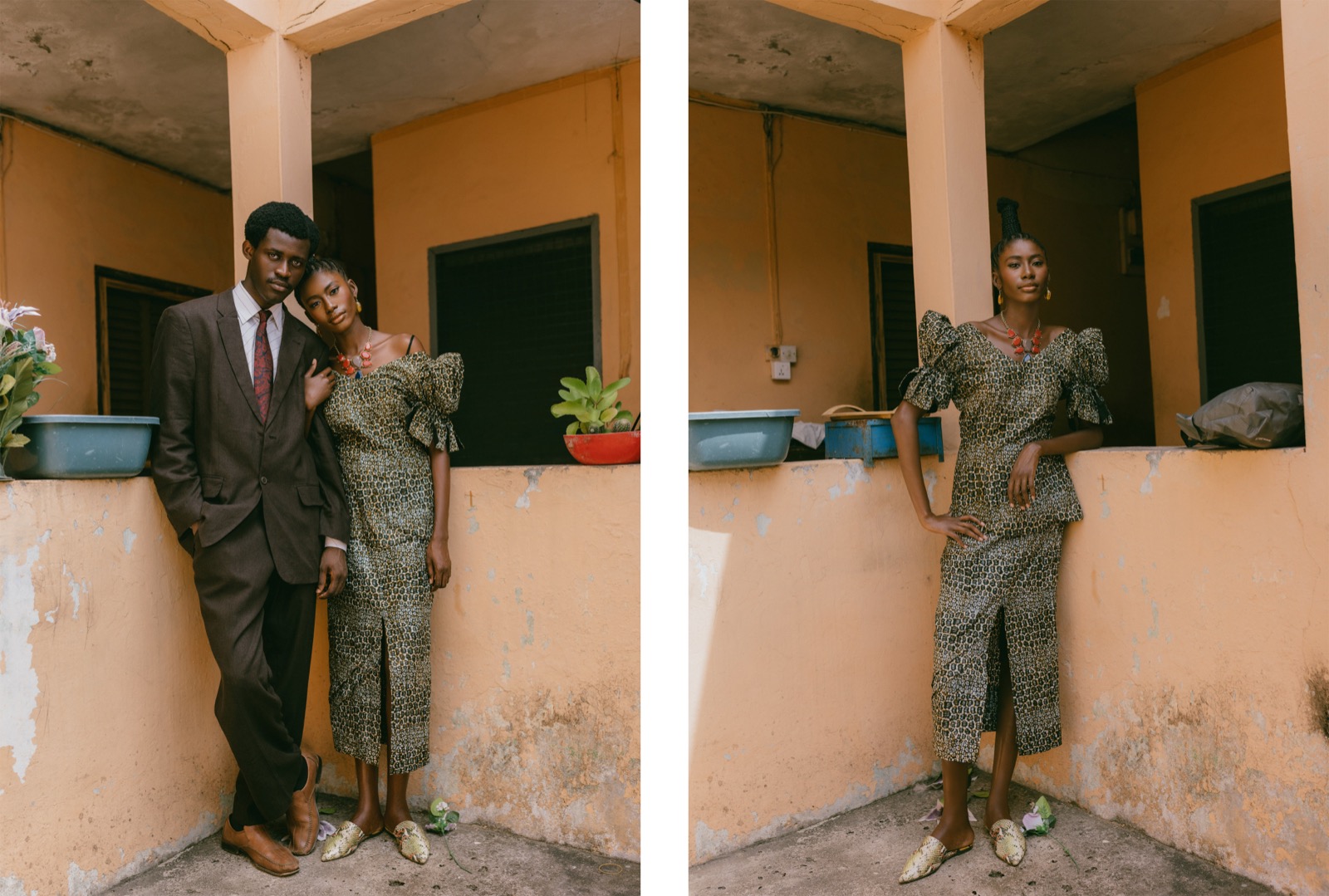
In two frames the same courtyard appears twice, and the difference between them is the whole subject. Carlos Idun-Tawiah has taken the wedding portrait — a form built to fuse two people into one durable image — and split it. On the left, the couple: he in a brown suit, hand pocketed; she folded into his shoulder, leopard-spotted Ankara catching the light, a coral collar at her throat. On the right, the same wall, the same blue enamel basins along the ledge, the same gold slippers on concrete — but the groom is gone and the bride stands alone, hand on hip, chin raised, owning the space she had been leaning into.
What interests me is how the diptych uses photography's stillness against itself. A single frame would have settled the question of union; two frames keep it open. The pairing reads less as before-and-after than as two simultaneous truths held apart by the gutter between them. "Till death do us part" becomes a structure rather than a sentiment: togetherness on one side, an undiminished self on the other, neither cancelling the other out.
The setting matters to the argument. This is not the studio of Sanlé Sory or James Barnor but an ordinary Accra house, plaster flaking, light gone domestic — Idun-Tawiah's generation reworking that West African portrait lineage through a slower, cinematic register. Issued in an edition of three and mounted as a Dibond diptych, the work knows exactly what kind of object it is, and what it is doing with the form it inherits.

In two frames the same courtyard appears twice, and the difference between them is the whole subject. Carlos Idun-Tawiah has taken the wedding portrait — a form built to fuse two people into one durable image — and split it. On the left, the couple: he in a brown suit, hand pocketed; she folded into his shoulder, leopard-spotted Ankara catching the light, a coral collar at her throat. On the right, the same wall, the same blue enamel basins along the ledge, the same gold slippers on concrete — but the groom is gone and the bride stands alone, hand on hip, chin raised, owning the space she had been leaning into.
What interests me is how the diptych uses photography's stillness against itself. A single frame would have settled the question of union; two frames keep it open. The pairing reads less as before-and-after than as two simultaneous truths held apart by the gutter between them. "Till death do us part" becomes a structure rather than a sentiment: togetherness on one side, an undiminished self on the other, neither cancelling the other out.
The setting matters to the argument. This is not the studio of Sanlé Sory or James Barnor but an ordinary Accra house, plaster flaking, light gone domestic — Idun-Tawiah's generation reworking that West African portrait lineage through a slower, cinematic register. Issued in an edition of three and mounted as a Dibond diptych, the work knows exactly what kind of object it is, and what it is doing with the form it inherits.