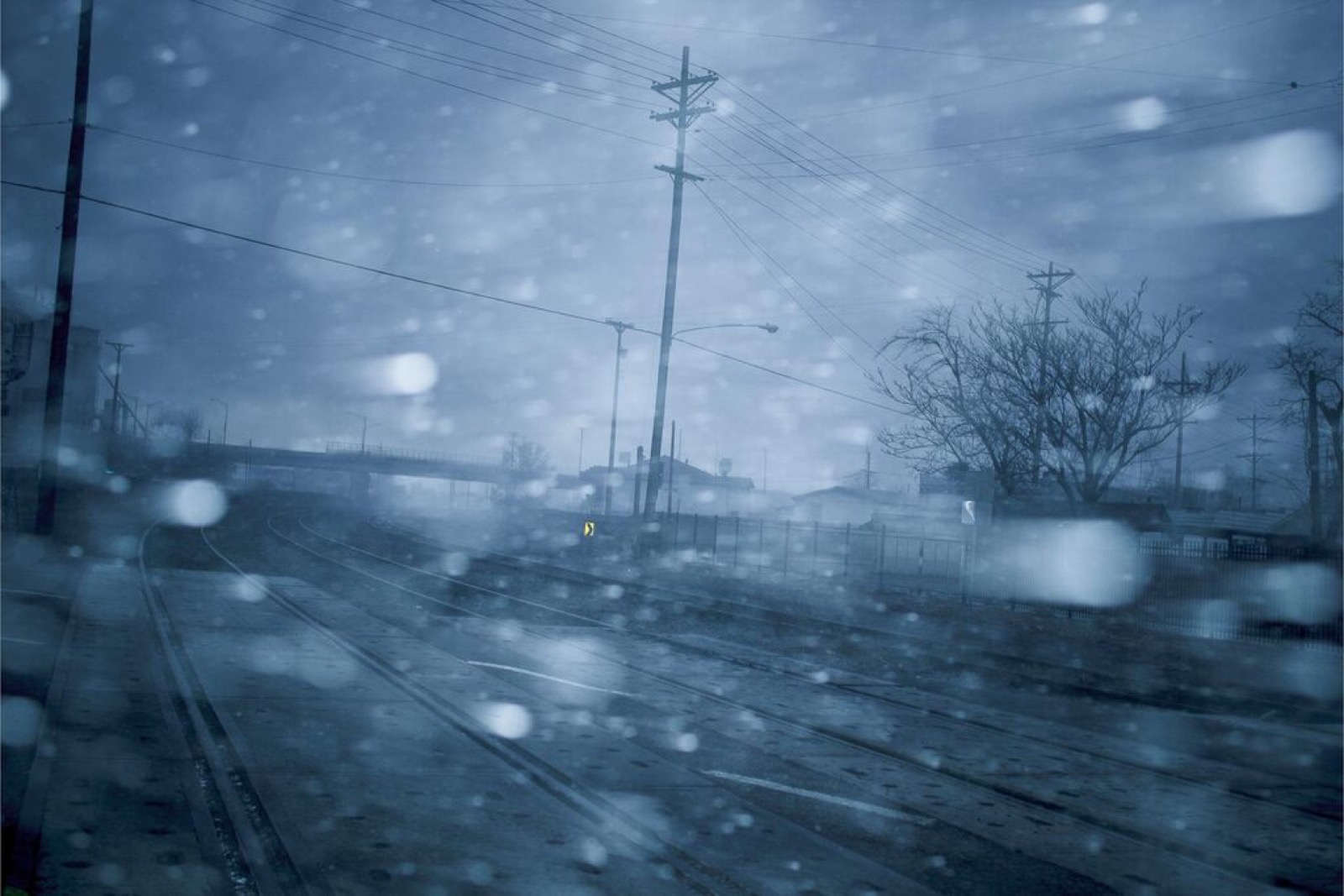
Snow has tested photographers since the medium’s first winters; it dissolves the very descriptions a camera is built to make. Here the storm arrives twice, as weather and as obstruction: flakes falling over a curve of steel rails, and their fat, unfocused doubles clinging to the glass the picture was made through. Between the two, a working landscape assembles itself in blue, utility poles carrying their cat’s cradle of wires, a fence line, one small amber sign the only warmth in sight.
When Stieglitz stood in a Fifth Avenue blizzard in the 1890s, he was arguing that atmosphere itself could be photography’s subject. Hido inherits the argument and relocates it: not the picturesque city but a rail corridor at the town’s industrial edge, seen from inside a car, the windshield standing in for the pictorialist’s softening lens. The tonal discipline is severe, a single register of slate blue graded from the pale road to the darkening sky, and it is precisely this restraint that lets the scene read as elegy rather than report.
Hido’s place in the American landscape tradition is by now a matter of record, with prints held by SFMOMA, the Getty and the Whitney, and this image shows why: he found where the tradition could still feel unresolved. As an archival pigment print, the picture sustains those long blue passages without breaking them into grain, each snow-blur kept as a soft, distinct weight on the surface. The claim the picture makes is quietly large. Weather is not what interrupts the view; some days, it is the view.

Snow has tested photographers since the medium’s first winters; it dissolves the very descriptions a camera is built to make. Here the storm arrives twice, as weather and as obstruction: flakes falling over a curve of steel rails, and their fat, unfocused doubles clinging to the glass the picture was made through. Between the two, a working landscape assembles itself in blue, utility poles carrying their cat’s cradle of wires, a fence line, one small amber sign the only warmth in sight.
When Stieglitz stood in a Fifth Avenue blizzard in the 1890s, he was arguing that atmosphere itself could be photography’s subject. Hido inherits the argument and relocates it: not the picturesque city but a rail corridor at the town’s industrial edge, seen from inside a car, the windshield standing in for the pictorialist’s softening lens. The tonal discipline is severe, a single register of slate blue graded from the pale road to the darkening sky, and it is precisely this restraint that lets the scene read as elegy rather than report.
Hido’s place in the American landscape tradition is by now a matter of record, with prints held by SFMOMA, the Getty and the Whitney, and this image shows why: he found where the tradition could still feel unresolved. As an archival pigment print, the picture sustains those long blue passages without breaking them into grain, each snow-blur kept as a soft, distinct weight on the surface. The claim the picture makes is quietly large. Weather is not what interrupts the view; some days, it is the view.