The same sitter, now in black and white and at full length: a bustier assembled from crushed cans and flattened wrappers — Welch's is readable at the left hip, a row of can-ends forms a kind of embroidery across the front — worn above wide leather trousers, hands pushed into the pockets. Behind her, tall dry grass, and at the left the flank of a modern apartment block rising out of it. Her head is turned down so the pale bob covers most of the face.
Photographed in monochrome and at this distance, the improvised garment behaves exactly like couture: aluminium reads as sequinning or beaten metalwork, wrappers as brocade, and the picture depends on that misreading holding for a second or two before the eye resolves what the material actually is. The pairing with the vertical grid of the housing block is deliberate. Waste, scrub grass and social housing are made to share a frame with a body dressed, in appearance at least, for a couture salon.
The strategy has a lineage — the punk-era fashion photograph and the make-do garment of the late 1970s, absorbed first by the magazines and then, repeatedly, by the houses themselves — and this pair of Elisa pictures from 2024 works knowingly inside it. Yeste has generally made his outdoor work in remote terrain: desert, coast, high snow. Here the landscape is a patch of scrub at the edge of a city and the found material is what a city throws away. Among his recent series it is the one that comes closest to home.
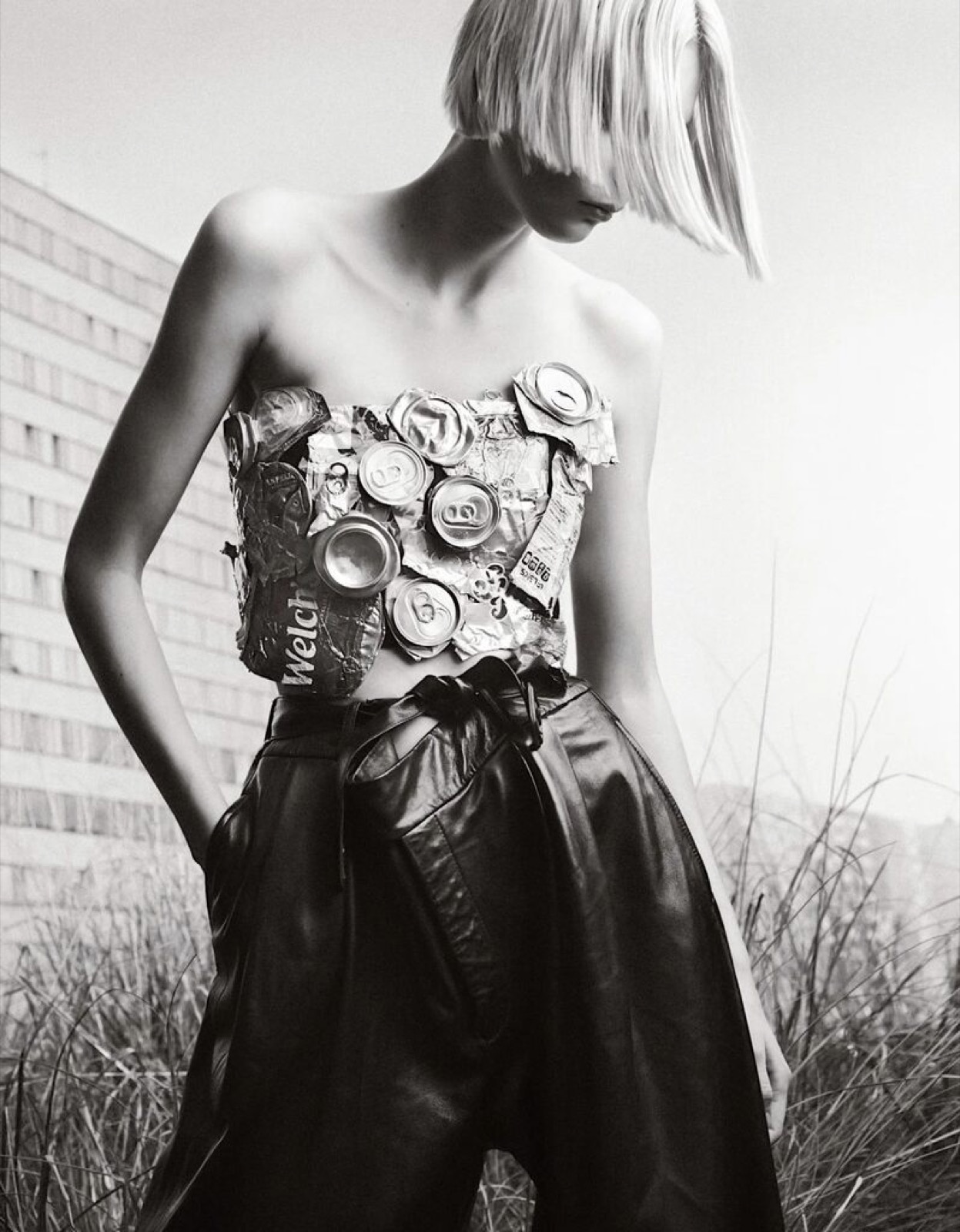

The same sitter, now in black and white and at full length: a bustier assembled from crushed cans and flattened wrappers — Welch's is readable at the left hip, a row of can-ends forms a kind of embroidery across the front — worn above wide leather trousers, hands pushed into the pockets. Behind her, tall dry grass, and at the left the flank of a modern apartment block rising out of it. Her head is turned down so the pale bob covers most of the face.
Photographed in monochrome and at this distance, the improvised garment behaves exactly like couture: aluminium reads as sequinning or beaten metalwork, wrappers as brocade, and the picture depends on that misreading holding for a second or two before the eye resolves what the material actually is. The pairing with the vertical grid of the housing block is deliberate. Waste, scrub grass and social housing are made to share a frame with a body dressed, in appearance at least, for a couture salon.
The strategy has a lineage — the punk-era fashion photograph and the make-do garment of the late 1970s, absorbed first by the magazines and then, repeatedly, by the houses themselves — and this pair of Elisa pictures from 2024 works knowingly inside it. Yeste has generally made his outdoor work in remote terrain: desert, coast, high snow. Here the landscape is a patch of scrub at the edge of a city and the found material is what a city throws away. Among his recent series it is the one that comes closest to home.