Hand-signed by the artist, with title, date, and edition number inscribed in ink on an archival label affixed to the reverse side of the mounted photograph.
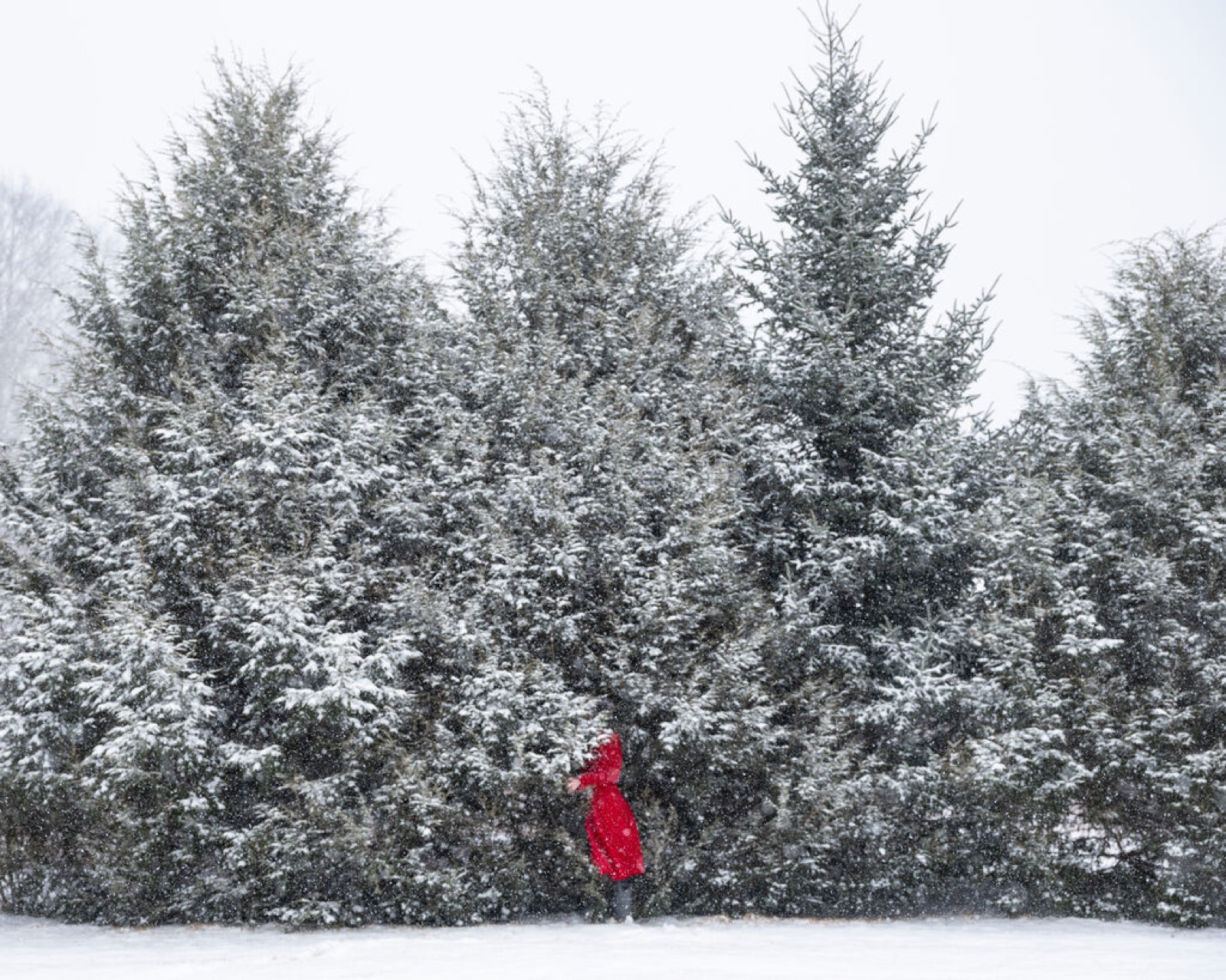
We stand at the white edge of a field in Maine while the snow comes down, and across from us rises a wall of firs so tall they close off the sky. The trees are dusted rather than buried, their green still legible under the falling flakes. At the base of all this, small enough to miss, is a child in a red hooded coat, turned toward the forest, her back to us. She is the only warm color for a hundred feet around.
Everything in the picture is a lesson in scale, and scale here is a form of tenderness. The firs are indifferent; the snow is indifferent; the red coat is not, and neither are we, watching. There is an old story folded into this arrangement, the girl and the woods, though Harvey lets it stay a suggestion rather than a caption. What holds me is the ethics of the distance: we are near enough to worry for her, far enough to know she is fine, held inside a weather that neither threatens nor comforts her.
Harvey, born in England and long resident in Rockport, on the Maine coast, has built book after book on the charged encounter between a body and a landscape, among them Blue Violet and You an Orchestra a Bomb, and shows in American museums. As an archival pigment print the image keeps its most difficult passage intact: the near-white sky and the near-white ground, separated only by the trees and by that single, insistent red. It is a photograph that makes winter feel like a place one could choose to enter.
We stand at the white edge of a field in Maine while the snow comes down, and across from us rises a wall of firs so tall they close off the sky. The trees are dusted rather than buried, their green still legible under the falling flakes. At the base of all this, small enough to miss, is a child in a red hooded coat, turned toward the forest, her back to us. She is the only warm color for a hundred feet around.
Everything in the picture is a lesson in scale, and scale here is a form of tenderness. The firs are indifferent; the snow is indifferent; the red coat is not, and neither are we, watching. There is an old story folded into this arrangement, the girl and the woods, though Harvey lets it stay a suggestion rather than a caption. What holds me is the ethics of the distance: we are near enough to worry for her, far enough to know she is fine, held inside a weather that neither threatens nor comforts her.
Harvey, born in England and long resident in Rockport, on the Maine coast, has built book after book on the charged encounter between a body and a landscape, among them Blue Violet and You an Orchestra a Bomb, and shows in American museums. As an archival pigment print the image keeps its most difficult passage intact: the near-white sky and the near-white ground, separated only by the trees and by that single, insistent red. It is a photograph that makes winter feel like a place one could choose to enter.