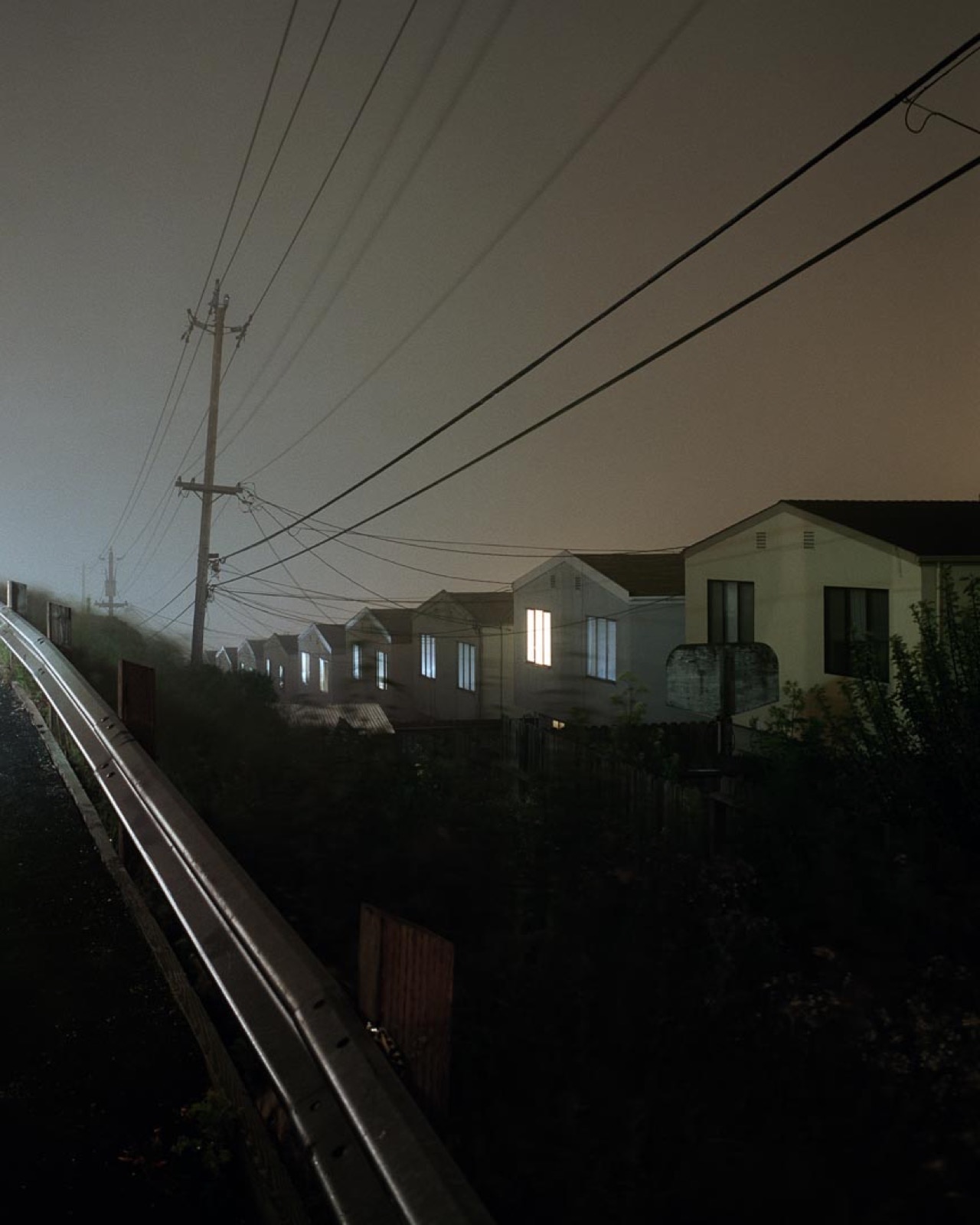
The houses never show us their faces. We’re on the wrong side, the road side, behind a guardrail with a silver gleam run down its length like a stocking seam, looking across dark gardens into a line of gabled rears that repeat into the fog until the fog stops saying anything at all. Somebody’s window burns amber; the others give off a colder, TV-blue glow. Whatever is going on in there, and it is surely nothing much, the picture refuses to confirm.
It’s a chorus line, really: one gable after another stepping away into the wings, fog standing in for stage smoke, the power lines strung overhead like rigging. Hido shoots the suburbs the way a fan shoots a star, patient at the barricade, waiting out the long exposure until the sodium haze warms like light through a scrim. And still the glamour is withheld: no doorways, no faces, no marquee, just wires, back fences, and that one amber window holding its note.
Hido has been the poet of this hour since the nineties, the Bay Area’s laureate of the almost-asleep, and pictures like this walked him into SFMOMA, the Getty and the Whitney, which is where pictures go when they stop needing anyone’s permission. As an archival pigment print the thing itself is quietly gorgeous: blacks you fall into, a sky the color of weak tea, and that guardrail streaking the dark like a signature nobody meant to leave. What’s behind the houses stays behind the houses. That’s the tease, and the point.
The houses never show us their faces. We’re on the wrong side, the road side, behind a guardrail with a silver gleam run down its length like a stocking seam, looking across dark gardens into a line of gabled rears that repeat into the fog until the fog stops saying anything at all. Somebody’s window burns amber; the others give off a colder, TV-blue glow. Whatever is going on in there, and it is surely nothing much, the picture refuses to confirm.
It’s a chorus line, really: one gable after another stepping away into the wings, fog standing in for stage smoke, the power lines strung overhead like rigging. Hido shoots the suburbs the way a fan shoots a star, patient at the barricade, waiting out the long exposure until the sodium haze warms like light through a scrim. And still the glamour is withheld: no doorways, no faces, no marquee, just wires, back fences, and that one amber window holding its note.
Hido has been the poet of this hour since the nineties, the Bay Area’s laureate of the almost-asleep, and pictures like this walked him into SFMOMA, the Getty and the Whitney, which is where pictures go when they stop needing anyone’s permission. As an archival pigment print the thing itself is quietly gorgeous: blacks you fall into, a sky the color of weak tea, and that guardrail streaking the dark like a signature nobody meant to leave. What’s behind the houses stays behind the houses. That’s the tease, and the point.