
Steven Meisel
American, b. 1954Pulling Face, Linda Evangelista, 1989
Archival Pigment Print.
One Size Only: / 42 x 35 in / 106.7 x 88.9 cm
Titled, numbered and print date in ink label affixed to mount verso.
Edition of 7 — Image: 40.6 x 50.8 cm / 16 x 20 in / Sheet: 50.8 x 61 cm / 20 x 24 in
Edition of 6 — Image: 76.2 x 101.6 cm / 30 x 40 in / Sheet: 81.3 x 106.7 cm / 32 x 42 in
Edition of 3 — Image: 101.6 x 127 cm / 40 x 50 in / Sheet: 106.7 x 132.1 cm / 42 x 52 in
Edition of 1 — Image: 147.3 x 177.8 cm / 58 x 70 in / Sheet: 152.4 x 182.9 cm / 60 x 72 in
© The Artist
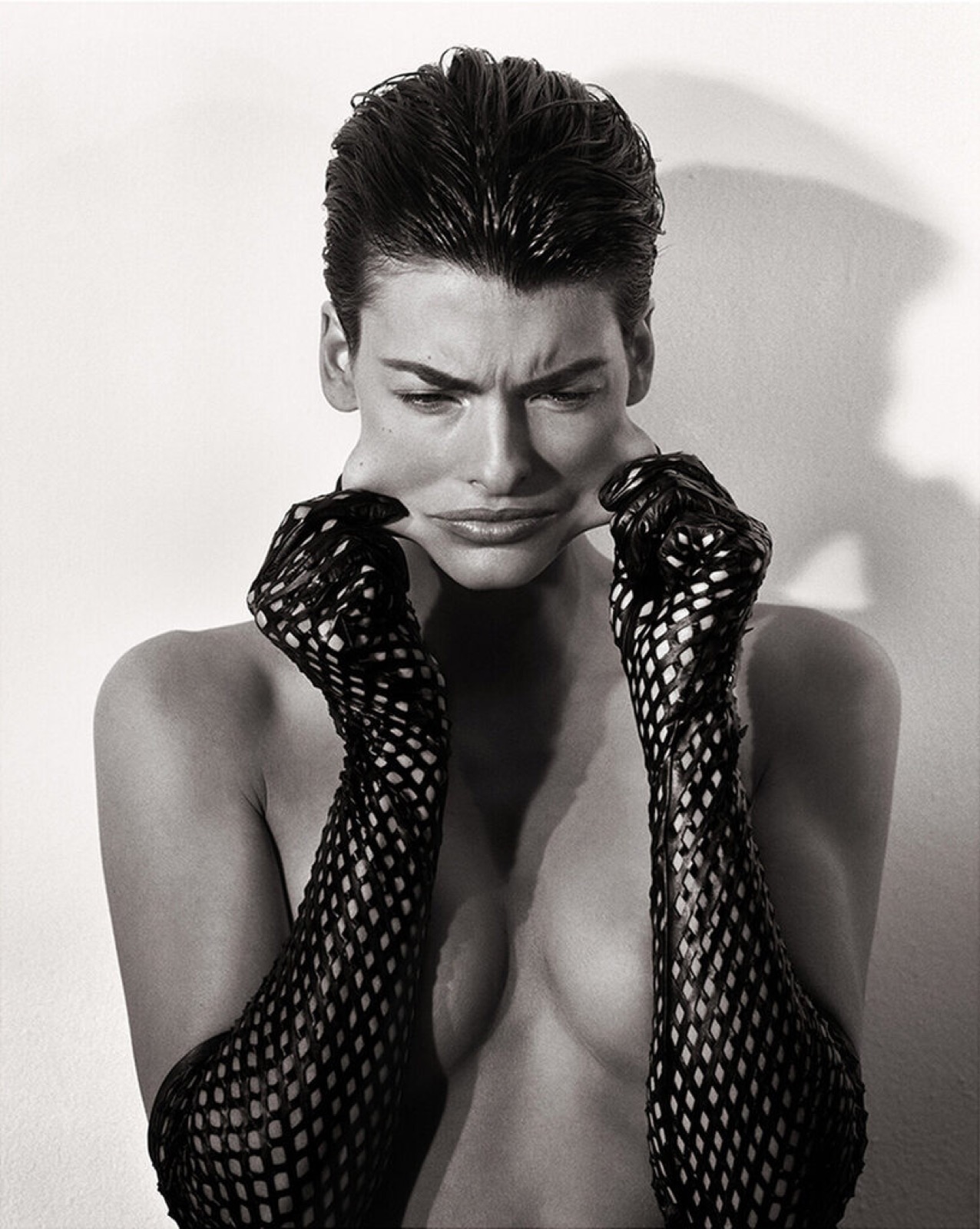
One moment before, the face was a model’s blank; one moment after, it will be again. Meisel has caught Linda Evangelista in the brief interval when she pulls a face: brows knotted, mouth clamped into a downturned pout, the whole composed mask deliberately wrecked. Two hands in long black fishnet gloves press up against the cheeks and hold the grimace in place, as if to keep it from collapsing back into beauty.
The picture is plainly built. The slicked hair combs straight up and back into a dark vertical that anchors the top; the two gloved arms fall as symmetrical diagonals, their open mesh printing a grid of small white lozenges across the arms and the pale torso beneath. Behind, on a bleached wall, the studio light throws a single soft gray shadow, large and slightly comic, doubling the head at a remove. Everything is frontal, centered, lit hard from the front, and the symmetry is what makes the joke land.
For all its bare skin, the photograph is really about performance: a supermodel refusing, for one exposure, to be beautiful, and being funnier and more human for it. Meisel, who would shoot every Vogue Italia cover from 1988 to 2015 and largely invent the public faces of his supermodels, understood that the greatest of them could act. Printed later as an archival pigment print, the image keeps its full range, from the wet black of the hair to the near-white of the wall, and the grimace loses none of its snap.