In a second the red will be gone. The child, mostly swallowed already by the dark oval mouth of the snow cave, is at the tipping point where a body commits to a hole, boots still out in the daylight, torso and head in the grey interior. A moment more and there will be nothing but white, the tunnel, and the memory of a scarlet coat. Disappearances are rarely photographed; they tend not to wait around for it. Harvey has caught one at its hinge.
Everything else in the frame is snow, which is to say almost nothing, a whiteness so total it stops being background and becomes condition. Against it the coat blares like a warning, or a valentine, or the one wrong answer on an otherwise blank exam. The black boots have gone comically vertical, soles patterned with what might be snowflakes, as if the manufacturer had anticipated this indignity. Real winter, flakes still falling; and the childish logic that a hole in the snow is a house, and a house is somewhere you go in.
Harvey lives where this snow falls, on the Maine coast, and much of her work is exactly this: the household turned briefly mythic, a season doing something ordinary the camera makes strange. She is a colorist first, and her books trade in this shock of one saturated note inside a muted world. The archival pigment print is the right body for it, holding the red at full voltage and the snow’s whites apart, grain by grain, so the whole picture rests on a single disappearing coat. Look away and she is gone.
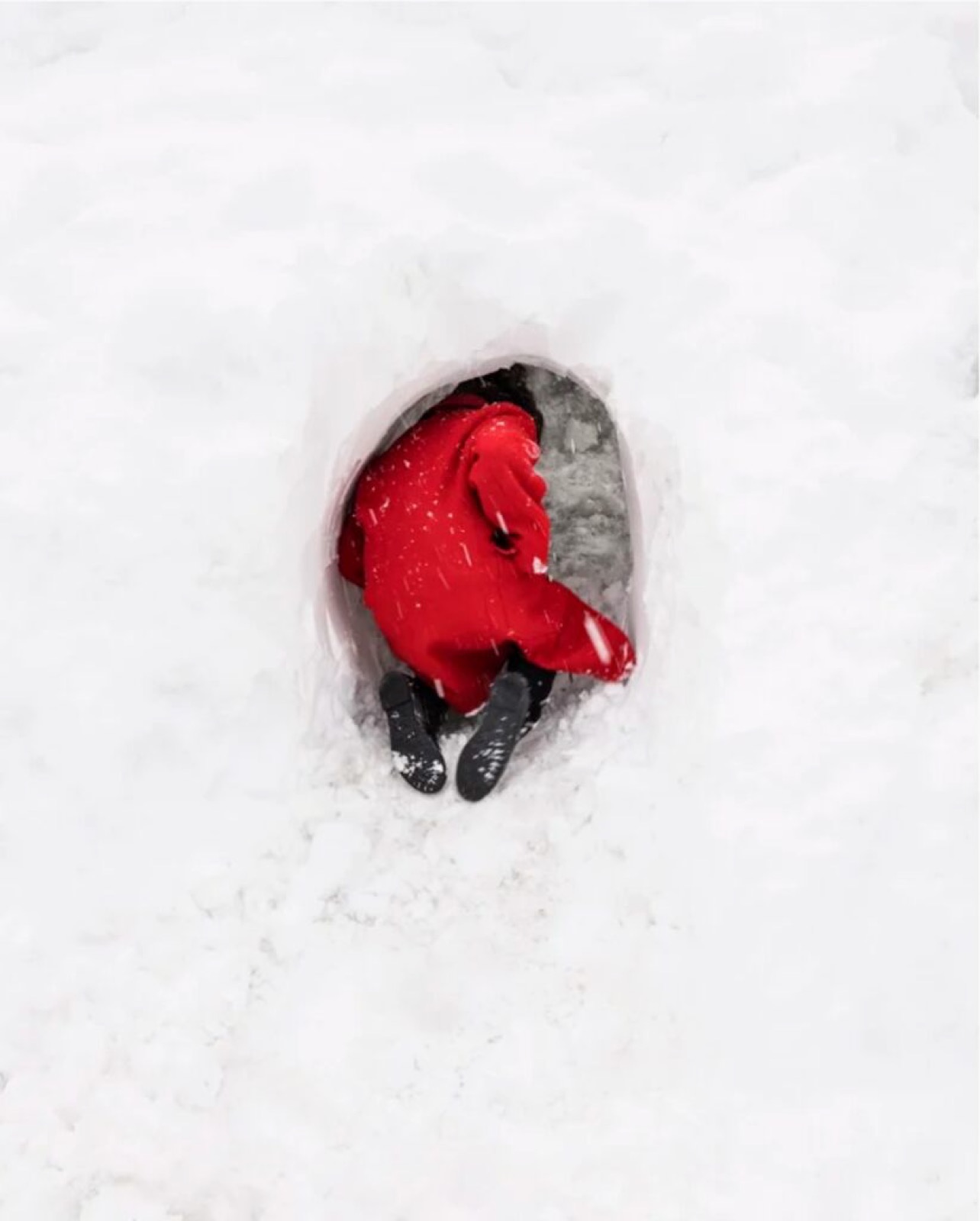
In a second the red will be gone. The child, mostly swallowed already by the dark oval mouth of the snow cave, is at the tipping point where a body commits to a hole, boots still out in the daylight, torso and head in the grey interior. A moment more and there will be nothing but white, the tunnel, and the memory of a scarlet coat. Disappearances are rarely photographed; they tend not to wait around for it. Harvey has caught one at its hinge.
Everything else in the frame is snow, which is to say almost nothing, a whiteness so total it stops being background and becomes condition. Against it the coat blares like a warning, or a valentine, or the one wrong answer on an otherwise blank exam. The black boots have gone comically vertical, soles patterned with what might be snowflakes, as if the manufacturer had anticipated this indignity. Real winter, flakes still falling; and the childish logic that a hole in the snow is a house, and a house is somewhere you go in.
Harvey lives where this snow falls, on the Maine coast, and much of her work is exactly this: the household turned briefly mythic, a season doing something ordinary the camera makes strange. She is a colorist first, and her books trade in this shock of one saturated note inside a muted world. The archival pigment print is the right body for it, holding the red at full voltage and the snow’s whites apart, grain by grain, so the whole picture rests on a single disappearing coat. Look away and she is gone.