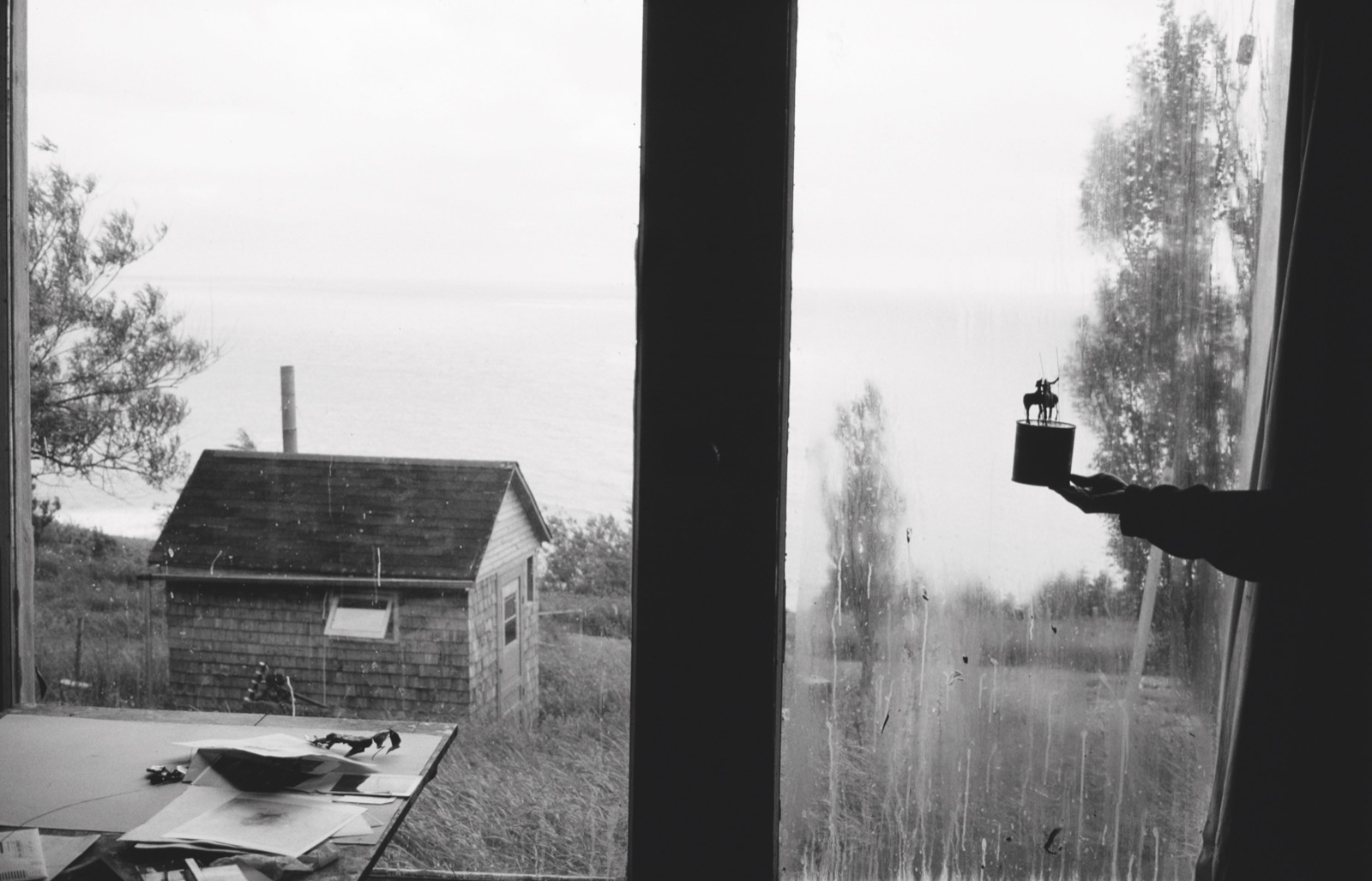
Photography was born at a window: in 1826 Niépce set his pewter plate before an upstairs casement and let the view outside burn its way slowly into bitumen. A hundred and seventy-two years later, Clark Winter stands at another window, and the world offered to it is this: a shingled cabin with its stovepipe, tall grass, the sea lying flat and pale to the horizon, and on the table inside, a litter of papers and prints. Between room and world, only a rain-streaked pane.
Then the right edge. From behind a dark curtain an arm enters the frame and holds up a small tin, and on its lid stand minute figures — a horse, a rider, a raised lance — a toy procession lifted against the drowned light. This is what arrests me: not the cabin, not the sea (they are scenery, the studium of a gray coastal day), but the absurd tenderness of the gesture, a hand presenting its miniature to no one, to the weather itself.
The title says June's Forge, and I cannot open it; the photograph declines to tell me who June is or what was forged. I know only that the hand was once warm, that the tin once held something ordinary, and that for the length of one exposure the little rider was offered to the sea. The selenium deepens the blacks the way memory deepens a room. The scene has been. The toy horse is still climbing nowhere.
Photography was born at a window: in 1826 Niépce set his pewter plate before an upstairs casement and let the view outside burn its way slowly into bitumen. A hundred and seventy-two years later, Clark Winter stands at another window, and the world offered to it is this: a shingled cabin with its stovepipe, tall grass, the sea lying flat and pale to the horizon, and on the table inside, a litter of papers and prints. Between room and world, only a rain-streaked pane.
Then the right edge. From behind a dark curtain an arm enters the frame and holds up a small tin, and on its lid stand minute figures — a horse, a rider, a raised lance — a toy procession lifted against the drowned light. This is what arrests me: not the cabin, not the sea (they are scenery, the studium of a gray coastal day), but the absurd tenderness of the gesture, a hand presenting its miniature to no one, to the weather itself.
The title says June's Forge, and I cannot open it; the photograph declines to tell me who June is or what was forged. I know only that the hand was once warm, that the tin once held something ordinary, and that for the length of one exposure the little rider was offered to the sea. The selenium deepens the blacks the way memory deepens a room. The scene has been. The toy horse is still climbing nowhere.