Whatever broke these trees is not in the picture. The tall snag on the right has been torn open at the crown, its splintered spars still pointing at the sky, one dead limb crooked downward like an elbow; its neighbors stand equally maimed in the tawny grass, their finer branches gone to smoke-grey lace. Fire, wind, flood, disease: the photograph withholds the verdict and hands us only the aftermath, sealed under a sepia haze that closes off the distance like a drawn blind.
What it shows instead is its own making. Snow is falling, but none of it lands sharply: the flakes drift close to the lens and blur into pale streaks and blooms, marking the depth of air the camera had to look through. In an archival pigment print, each of those flakes is a place where the ink thins toward nothing and the paper very nearly shows, weather rendered as a withholding of pigment. Even the picture’s color behaves like memory: this brown-cream tint is borrowed from photography’s earliest albums, a digital object dressed in the tones of old chemistry.
Notice, too, what else is absent: no house, no window, no road, the shelters and vantage points on which Hido built his reputation. Stripped of them, the trees themselves become the figures, upright, damaged, enduring the snow. He numbers his pictures rather than naming them, filing each one like evidence, and museums have accepted the file: SFMOMA, the Getty and the Whitney all hold his prints. This sheet keeps the case open.
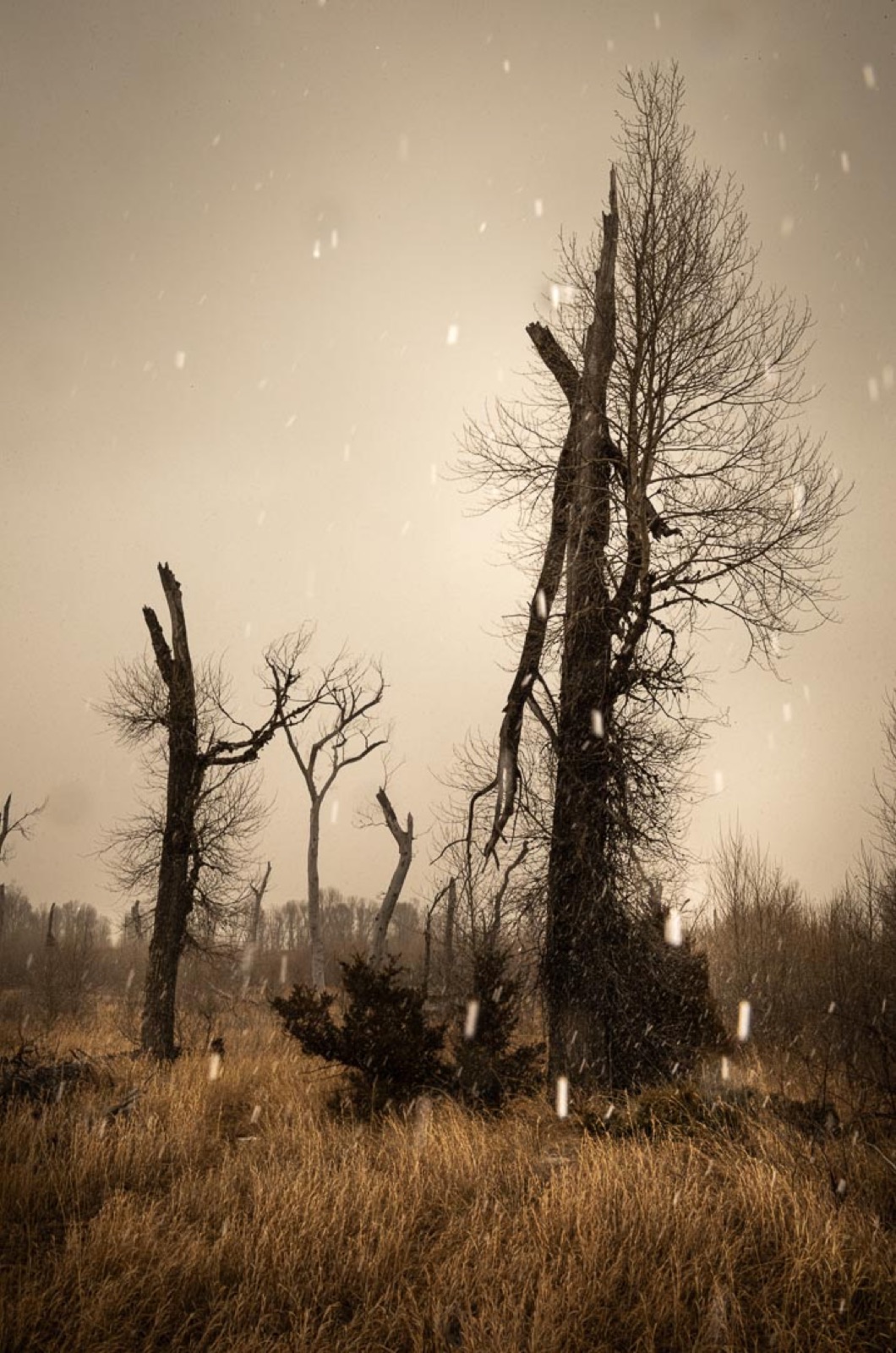

Whatever broke these trees is not in the picture. The tall snag on the right has been torn open at the crown, its splintered spars still pointing at the sky, one dead limb crooked downward like an elbow; its neighbors stand equally maimed in the tawny grass, their finer branches gone to smoke-grey lace. Fire, wind, flood, disease: the photograph withholds the verdict and hands us only the aftermath, sealed under a sepia haze that closes off the distance like a drawn blind.
What it shows instead is its own making. Snow is falling, but none of it lands sharply: the flakes drift close to the lens and blur into pale streaks and blooms, marking the depth of air the camera had to look through. In an archival pigment print, each of those flakes is a place where the ink thins toward nothing and the paper very nearly shows, weather rendered as a withholding of pigment. Even the picture’s color behaves like memory: this brown-cream tint is borrowed from photography’s earliest albums, a digital object dressed in the tones of old chemistry.
Notice, too, what else is absent: no house, no window, no road, the shelters and vantage points on which Hido built his reputation. Stripped of them, the trees themselves become the figures, upright, damaged, enduring the snow. He numbers his pictures rather than naming them, filing each one like evidence, and museums have accepted the file: SFMOMA, the Getty and the Whitney all hold his prints. This sheet keeps the case open.