Nothing in photography is harder to win back than a gold sunset over water. Hido drives straight at the problem, literally: this flooded field is seen from the road, through glass that carries its own weather, and the sun does not set so much as detonate, throwing rings of flare into the dark cloud and a long white blaze across the flood. The picture takes the most exhausted image in the medium and runs it through an apparatus that refuses to stay invisible.
Every device is declared. Soft discs of bokeh drift up the foreground like ghosts on a projection screen; a wind-blurred tree smears the left edge; curtains of rain hang beneath the storm cloud like theatrical gauze. Meanwhile the found set is immaculately organized: a fence line paces the curve of the bank into the hills, a second wire crosses the water in the near field, and the flood doubles the light it cannot absorb. The diffusion here is not an accident of travel but a finish, chosen in-camera, closer to cinematography than to documentation.
This is how Hido has always worked: he directs locations he did not build, treating the American roadside as a set that needs only the right hour and the right pane of glass. SFMOMA, the Getty and the Whitney hold his prints. As an archival pigment print, the image sustains all this vapor: the ambers hold their saturation, the shadow stays deep, and the flare rings read as drawn rather than burned. The sunset comes back usable, wearing its own artifice.
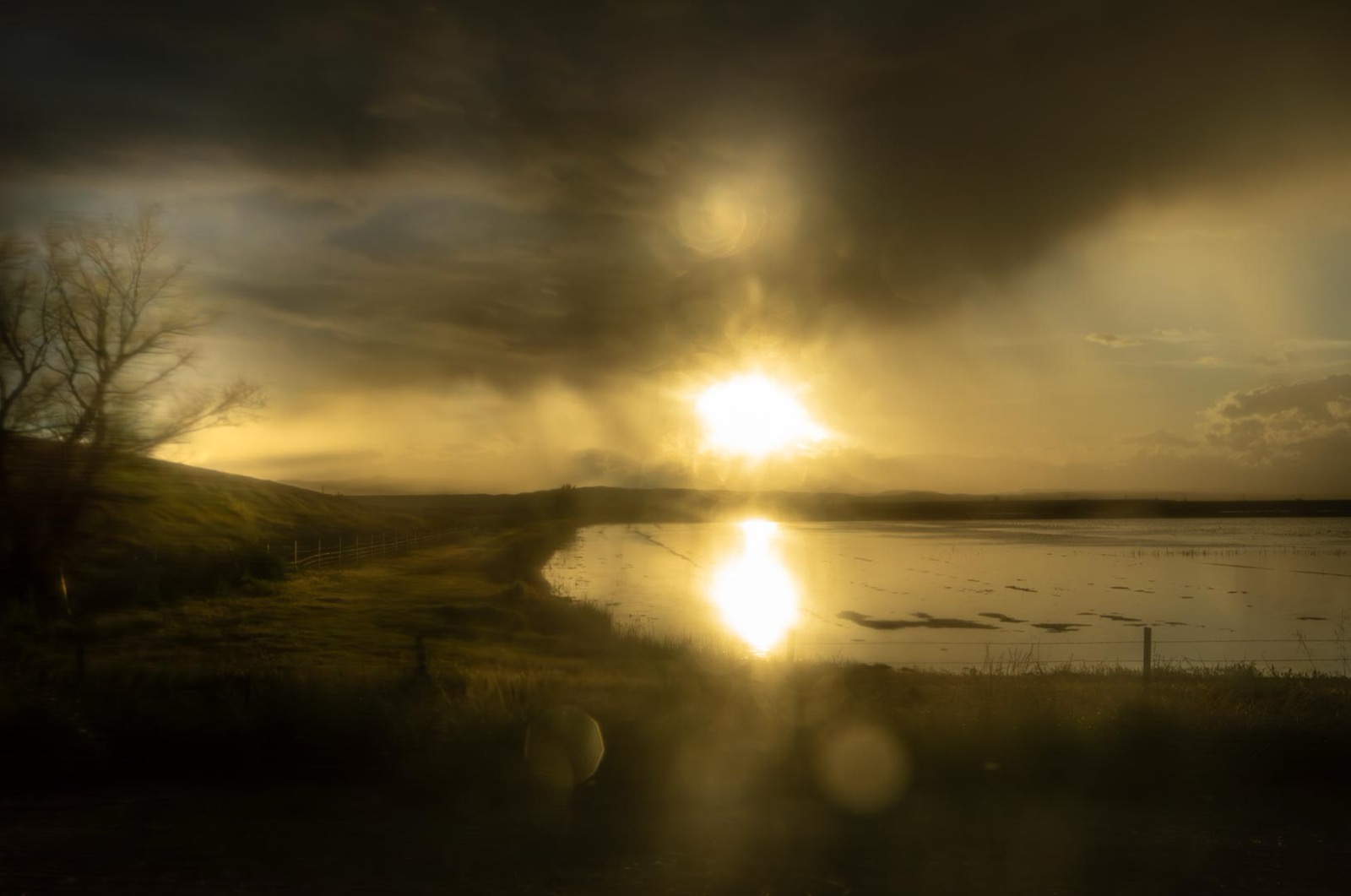

Nothing in photography is harder to win back than a gold sunset over water. Hido drives straight at the problem, literally: this flooded field is seen from the road, through glass that carries its own weather, and the sun does not set so much as detonate, throwing rings of flare into the dark cloud and a long white blaze across the flood. The picture takes the most exhausted image in the medium and runs it through an apparatus that refuses to stay invisible.
Every device is declared. Soft discs of bokeh drift up the foreground like ghosts on a projection screen; a wind-blurred tree smears the left edge; curtains of rain hang beneath the storm cloud like theatrical gauze. Meanwhile the found set is immaculately organized: a fence line paces the curve of the bank into the hills, a second wire crosses the water in the near field, and the flood doubles the light it cannot absorb. The diffusion here is not an accident of travel but a finish, chosen in-camera, closer to cinematography than to documentation.
This is how Hido has always worked: he directs locations he did not build, treating the American roadside as a set that needs only the right hour and the right pane of glass. SFMOMA, the Getty and the Whitney hold his prints. As an archival pigment print, the image sustains all this vapor: the ambers hold their saturation, the shadow stays deep, and the flare rings read as drawn rather than burned. The sunset comes back usable, wearing its own artifice.