Hand-signed by the artist, with title, date, and edition number inscribed in ink on an archival label affixed to the reverse side of the mounted photograph.
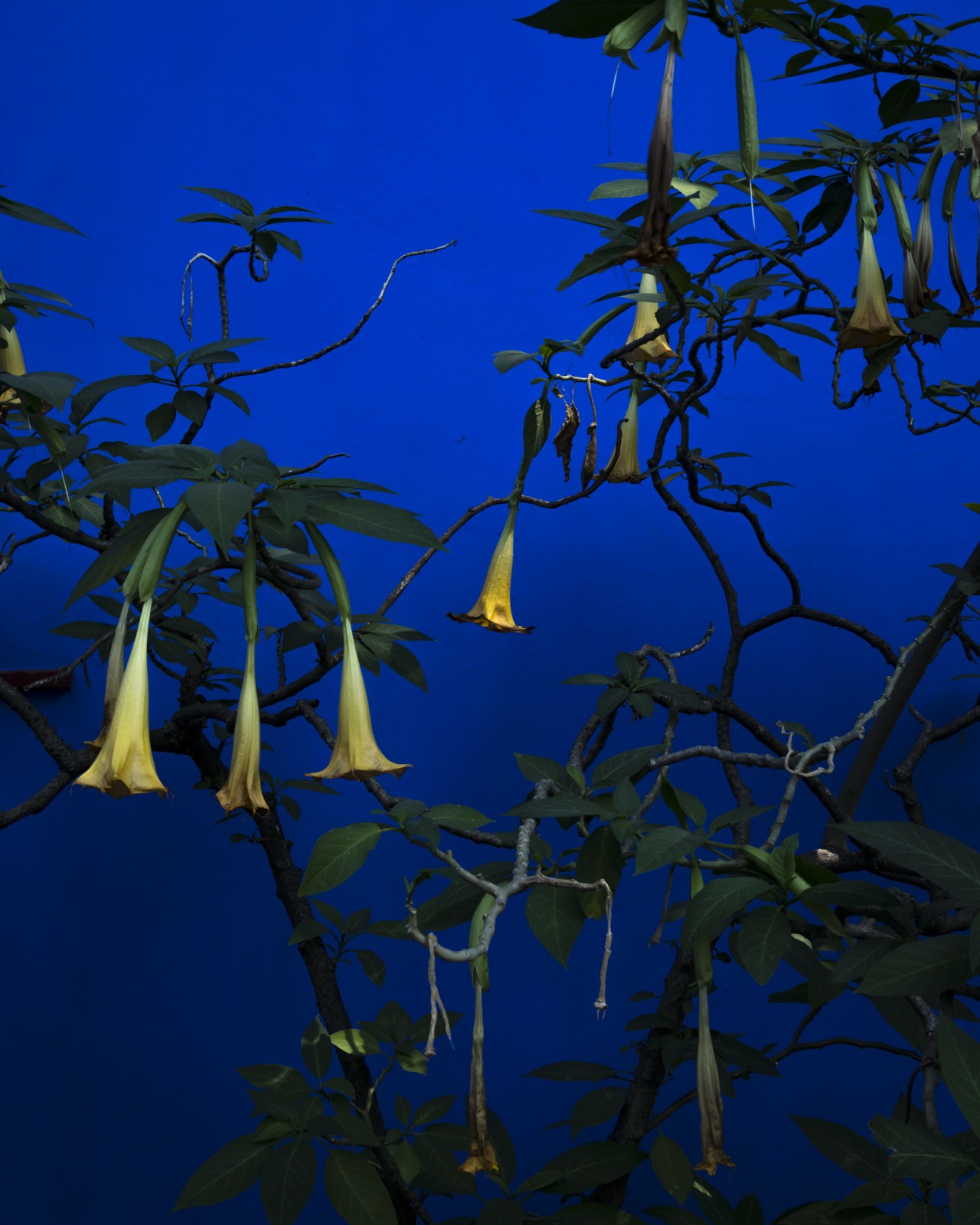
Hanging head-down from a snarl of grey branches, a dozen angel’s trumpets droop toward the ground as if listening for something underfoot. Cig Harvey has caught the plant in this pendant slump against a wall of pure, electric cobalt, the kind of blue that in Mexico means a courtyard rather than a sky. The flowers are long pale funnels, yellow going to cream, a few of them already browning at the mouth, one or two shriveled to a twist of rust. The whole shrub seems paused mid-gesture, bowing.
They are lovely and faintly sinister at once, which is the angel’s trumpet’s whole reputation: every part of the plant is poisonous, a narcotic packed into a shape borrowed from church brass. Harvey plays the joke straight. Against the flat blue the branches turn baroque, corkscrewing and doubling back, some tipped pale as bone where the bark has gone grey, others still dark and leafed. It could be a chandelier assembled by someone who had only ever heard chandeliers described. Nothing here is arranged, and everything looks composed.
Made in Mexico on Harvey’s travels, the picture belongs to a body of work that treats color as a form of feeling, saturated to the pitch of a book like Blue Violet, which is largely an argument about that hue. She has shown and been collected across American museums, and her plants tend to behave like people, caught in moods. The archival pigment print is the right instrument for this collision, holding the yellows of the trumpets and the deep, unbroken blue without letting either flare or muddy. It stays lit from within.

Hanging head-down from a snarl of grey branches, a dozen angel’s trumpets droop toward the ground as if listening for something underfoot. Cig Harvey has caught the plant in this pendant slump against a wall of pure, electric cobalt, the kind of blue that in Mexico means a courtyard rather than a sky. The flowers are long pale funnels, yellow going to cream, a few of them already browning at the mouth, one or two shriveled to a twist of rust. The whole shrub seems paused mid-gesture, bowing.
They are lovely and faintly sinister at once, which is the angel’s trumpet’s whole reputation: every part of the plant is poisonous, a narcotic packed into a shape borrowed from church brass. Harvey plays the joke straight. Against the flat blue the branches turn baroque, corkscrewing and doubling back, some tipped pale as bone where the bark has gone grey, others still dark and leafed. It could be a chandelier assembled by someone who had only ever heard chandeliers described. Nothing here is arranged, and everything looks composed.
Made in Mexico on Harvey’s travels, the picture belongs to a body of work that treats color as a form of feeling, saturated to the pitch of a book like Blue Violet, which is largely an argument about that hue. She has shown and been collected across American museums, and her plants tend to behave like people, caught in moods. The archival pigment print is the right instrument for this collision, holding the yellows of the trumpets and the deep, unbroken blue without letting either flare or muddy. It stays lit from within.