The face is asleep, or was never awake. The eyes are closed beneath a single dark stroke of lash, the mouth slightly open, the nose held in profile against a blackness that presses in from every side. What the light finds is not skin but a pitted surface, cratered and speckled, and above the eye a spray of black flecks where the emulsion has been eaten away. Sarah Moon keeps the edge of the film in the picture: the ragged rebate, the blots running down the right margin, a row of perforations along the bottom. She shows us the face and the material carrying it in the same breath.
A statue is already a likeness made to outlive its model. To photograph one is to make a copy of a copy, and Moon does not disguise the fact so much as compound it. The corrosion on the stone and the corrosion on the negative are indistinguishable here; both read as damage, both as time. This is not the classical photography of sculpture, which flatters marble with even light and pretends the object is exempt. It is closer to an exhumation. The camera does not arrest the erosion, it adds a second one, and lets the two settle into the same grey.
Photography's oldest business is the manufacture of relics. What is consecrated here is not a woman — none is named, the title says only La Statue — but the condition of having been looked at for a very long time. Whoever the sculptor had in mind is gone twice over: once into stone, once into silver. What remains is an object still capable of an expression, closed and patient, and steadily less able to say whose it was. The photograph does not mourn this. It records the exchange: identity surrendered, image kept.
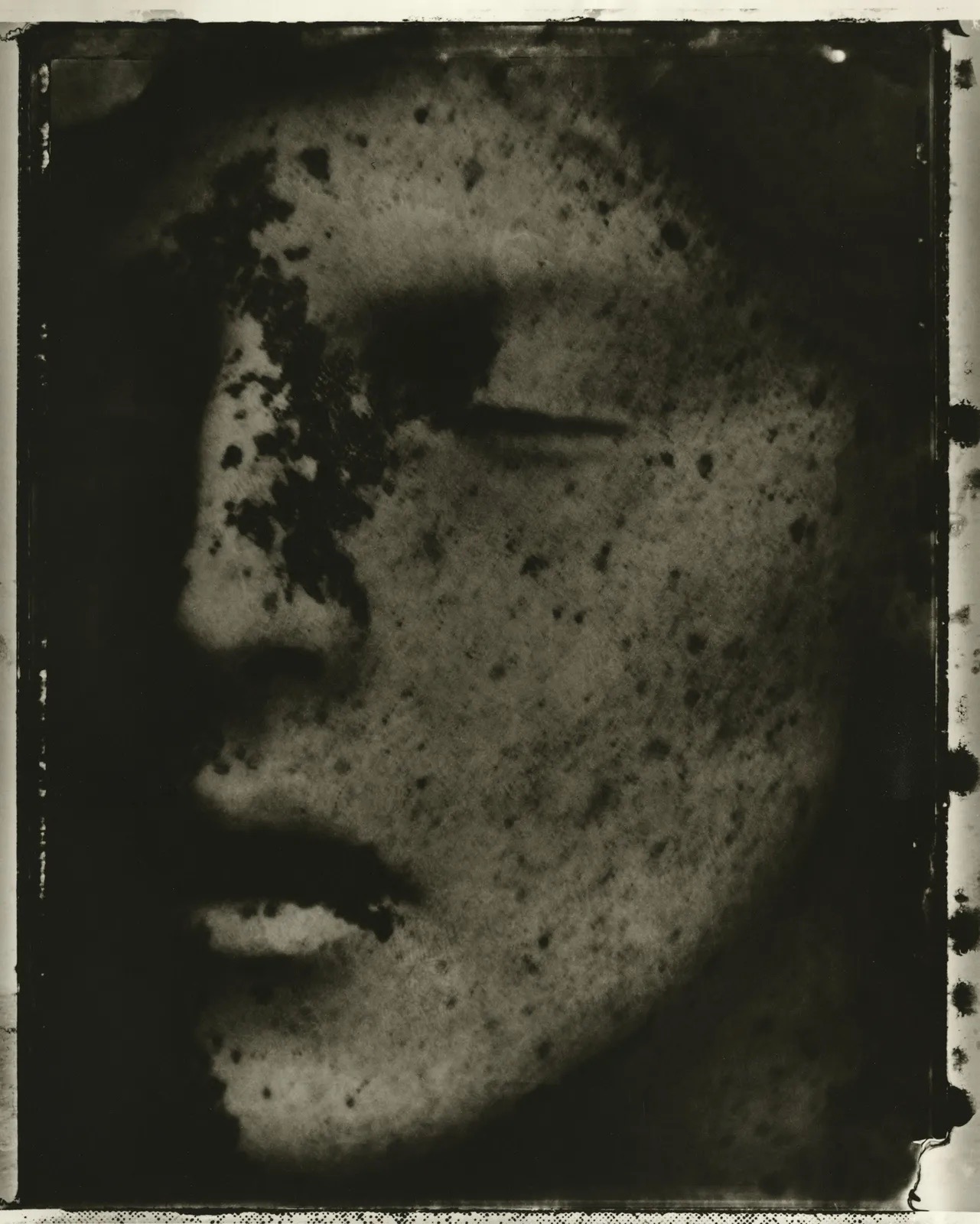

The face is asleep, or was never awake. The eyes are closed beneath a single dark stroke of lash, the mouth slightly open, the nose held in profile against a blackness that presses in from every side. What the light finds is not skin but a pitted surface, cratered and speckled, and above the eye a spray of black flecks where the emulsion has been eaten away. Sarah Moon keeps the edge of the film in the picture: the ragged rebate, the blots running down the right margin, a row of perforations along the bottom. She shows us the face and the material carrying it in the same breath.
A statue is already a likeness made to outlive its model. To photograph one is to make a copy of a copy, and Moon does not disguise the fact so much as compound it. The corrosion on the stone and the corrosion on the negative are indistinguishable here; both read as damage, both as time. This is not the classical photography of sculpture, which flatters marble with even light and pretends the object is exempt. It is closer to an exhumation. The camera does not arrest the erosion, it adds a second one, and lets the two settle into the same grey.
Photography's oldest business is the manufacture of relics. What is consecrated here is not a woman — none is named, the title says only La Statue — but the condition of having been looked at for a very long time. Whoever the sculptor had in mind is gone twice over: once into stone, once into silver. What remains is an object still capable of an expression, closed and patient, and steadily less able to say whose it was. The photograph does not mourn this. It records the exchange: identity surrendered, image kept.