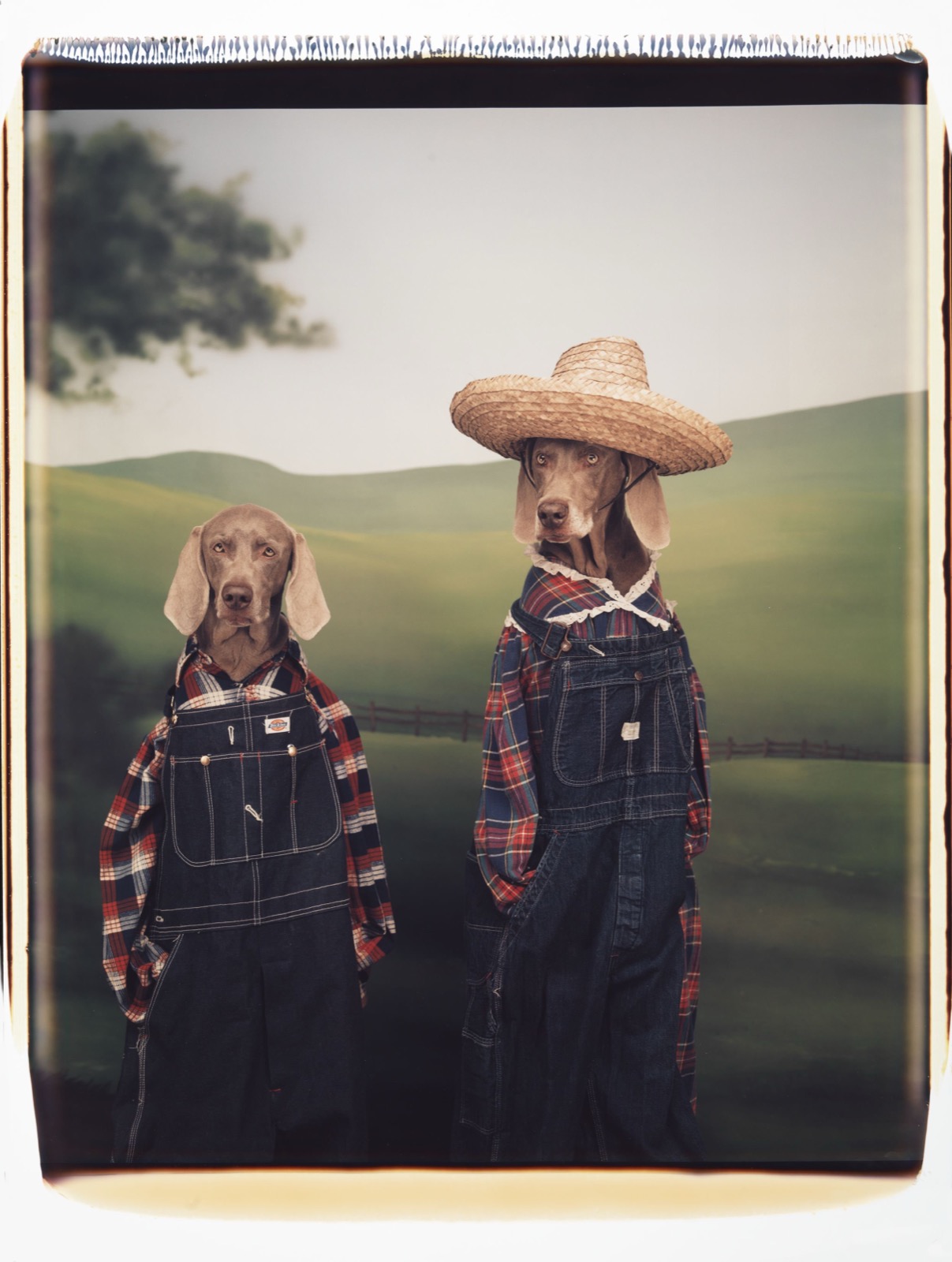
The hills behind them never existed as hills. They are paint on a hung backdrop, a soft band of green that the studio lights have flattened into a stage flat, with one storybook tree drifting at the upper left and a split-rail fence receding toward a horizon that stops at the seamless paper's edge. This is the deep theatre of the dye-diffusion Polaroid: a fiction of countryside built indoors, then fixed in a single sheet by the chemistry rolling between positive and receiving layers. No farm was visited. The farm is a surface, and the surface is the work.
Against it stand two Weimaraners costumed as field hands, the taller in a straw hat and bib overalls, paws sunk into the front pockets exactly where a man would rest his thumbs; the smaller bare-headed, ears hanging like soft collars over the same red plaid and denim. What holds the eye is less the gentle absurdity than the registration of fact the camera cannot help performing — the gleam on a tin overall button, the worn nap of corduroy-blue cotton, the amber wet of an actual animal's eye looking back. The apparatus describes hide and cloth with equal, indifferent fidelity.
This is one of the large-format Polaroids made on the rented 20-by-24 camera, the instrument behind the work that carried Wegman's Weimaraners from the studio into the public imagination. There is no negative. Each exposure yields a single object, unrepeatable, and you can read that singularity at the borders: the ragged emulsion skin along the top, the warm flare of unfixed chemistry bleeding up from the lower edge. The picture's joke about rural costume rests on a print that is itself wholly handmade, a one-off skin of color that will never be struck again.
The hills behind them never existed as hills. They are paint on a hung backdrop, a soft band of green that the studio lights have flattened into a stage flat, with one storybook tree drifting at the upper left and a split-rail fence receding toward a horizon that stops at the seamless paper's edge. This is the deep theatre of the dye-diffusion Polaroid: a fiction of countryside built indoors, then fixed in a single sheet by the chemistry rolling between positive and receiving layers. No farm was visited. The farm is a surface, and the surface is the work.
Against it stand two Weimaraners costumed as field hands, the taller in a straw hat and bib overalls, paws sunk into the front pockets exactly where a man would rest his thumbs; the smaller bare-headed, ears hanging like soft collars over the same red plaid and denim. What holds the eye is less the gentle absurdity than the registration of fact the camera cannot help performing — the gleam on a tin overall button, the worn nap of corduroy-blue cotton, the amber wet of an actual animal's eye looking back. The apparatus describes hide and cloth with equal, indifferent fidelity.
This is one of the large-format Polaroids made on the rented 20-by-24 camera, the instrument behind the work that carried Wegman's Weimaraners from the studio into the public imagination. There is no negative. Each exposure yields a single object, unrepeatable, and you can read that singularity at the borders: the ragged emulsion skin along the top, the warm flare of unfixed chemistry bleeding up from the lower edge. The picture's joke about rural costume rests on a print that is itself wholly handmade, a one-off skin of color that will never be struck again.