The color is that of old paper, an olive and sepia haze in which a single tree stands bent by winds long past. Its bare limbs reach and twist; grasses smear green at its feet; a wet road slides in from the lower right; far off, telephone poles fade into the general dun. Everything is slightly in motion, the softness of something seen from a car that did not stop.
Bright Black World took Hido north, into Scandinavian winters and a colder register, and the light here is that of a sun that never fully rises, a permanent almost-dusk. I find myself thinking of the tree as a survivor, one of those lone roadside trees that outlast the fields around them, keeping a patient vigil that no one asked for. The blur does not diminish it. If anything it lends the tree the quality of an apparition.
There is a lineage of the solitary tree in landscape art, from Romantic painting onward, the tree as figure, as stand-in for the human alone before weather and time. Hido knows this and lets it resonate quietly. The archival pigment print holds the muted gold-grey without brightening it, and the overlooked tree at the edge of an ordinary road becomes, briefly, the whole of what there is to feel.
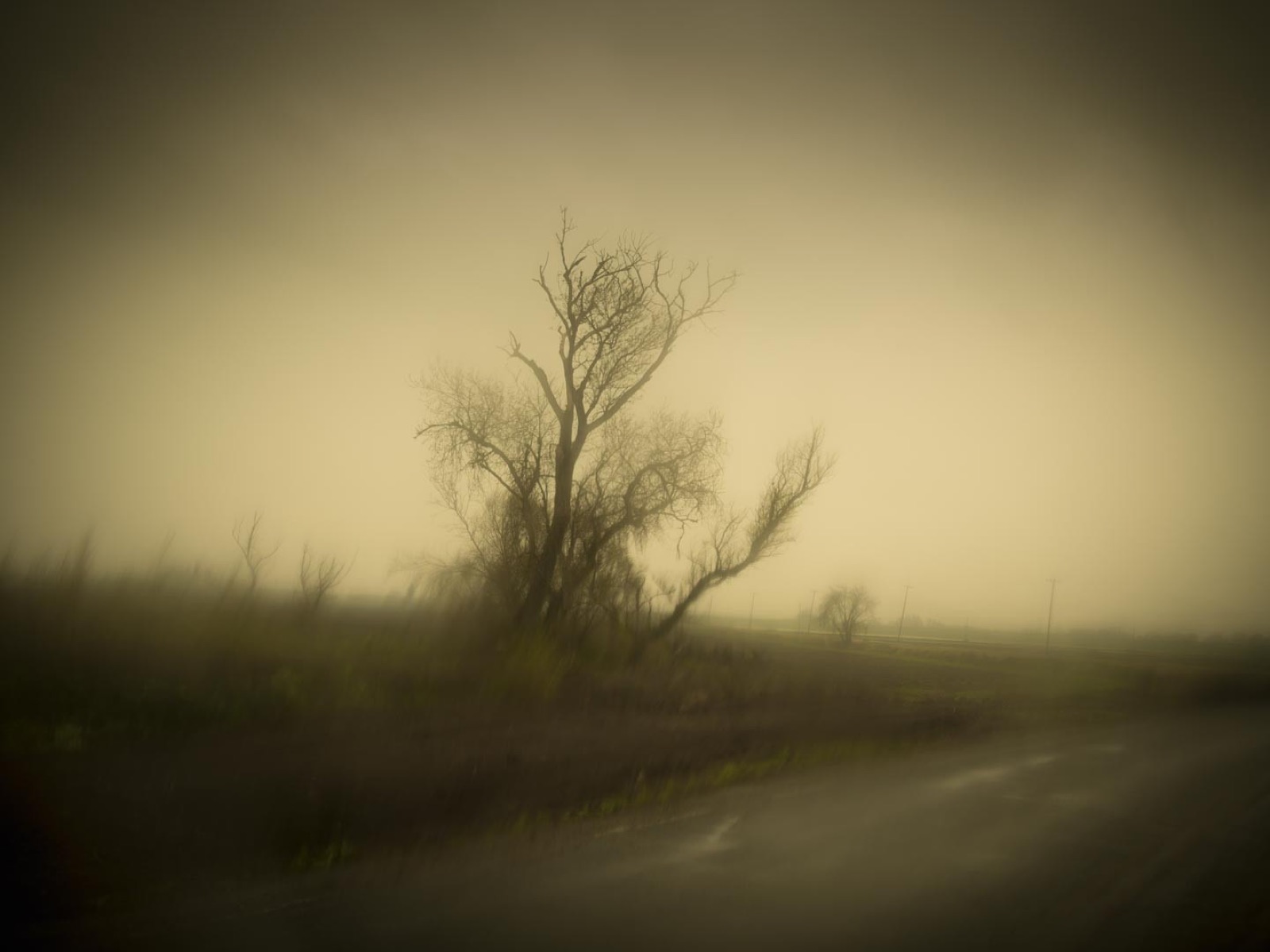

The color is that of old paper, an olive and sepia haze in which a single tree stands bent by winds long past. Its bare limbs reach and twist; grasses smear green at its feet; a wet road slides in from the lower right; far off, telephone poles fade into the general dun. Everything is slightly in motion, the softness of something seen from a car that did not stop.
Bright Black World took Hido north, into Scandinavian winters and a colder register, and the light here is that of a sun that never fully rises, a permanent almost-dusk. I find myself thinking of the tree as a survivor, one of those lone roadside trees that outlast the fields around them, keeping a patient vigil that no one asked for. The blur does not diminish it. If anything it lends the tree the quality of an apparition.
There is a lineage of the solitary tree in landscape art, from Romantic painting onward, the tree as figure, as stand-in for the human alone before weather and time. Hido knows this and lets it resonate quietly. The archival pigment print holds the muted gold-grey without brightening it, and the overlooked tree at the edge of an ordinary road becomes, briefly, the whole of what there is to feel.