Gelatin Silver Print. Printed by Willy Ronis in 1982.
Image: 29.8 x 23.7 cm / 11 3/4 x 9 3/8 in / Paper: 41 x 30 cm / 16 1/8 x 11 3/4 in
Signed in ink in the bottom right margin recto, "Photo - Willy - Ronis - 8, rue Ledru-Rollin" stamp, signature, title, negative and print dates, negative number on the verso
The studium is legible at once: three faces around a plank table after the harvest, the codes of rural pleasure all in place. A heavy man in shirtsleeves and suspenders laughs open-mouthed beneath a thick moustache, his glass of dark wine lifted to the light. Behind him a young woman smiles, hands at her sides; an older man in a beret, half in shadow, tips the bottle. There is a country loaf gone matte and grey in the print, a soiled plate, a fork abandoned mid-meal. One reads contentment, the South-West, a war just ended.
But something pierces, and it is small. Behind the woman's ear, a single white daisy. It explains nothing; it sells nothing; it is not required by the meal or the wine. Yet I cannot leave it. That flower, placed by a hand we will never see, in a morning we will never enter, wounds me precisely because it is so casual, so soon to wilt. It is the detail that was not arranged for me and arrives anyway, a stab of tenderness in the grain. The chevroned shutter, the empty glass tipped on its rim — these too refuse to stay decorative.
Here is the paradox the medium alone permits: this gesture happened once, in a courtyard at Cavignac, and goes on happening. The photographer, a humanist now held by the Centre Pompidou and the Bibliothèque nationale, did not invent the joy; he was present, and pressed. A vintage print carries that presence in its silver, the object nearest the instant itself — proof that someone, then, found this worth keeping. The daisy keeps wilting. It never finishes.
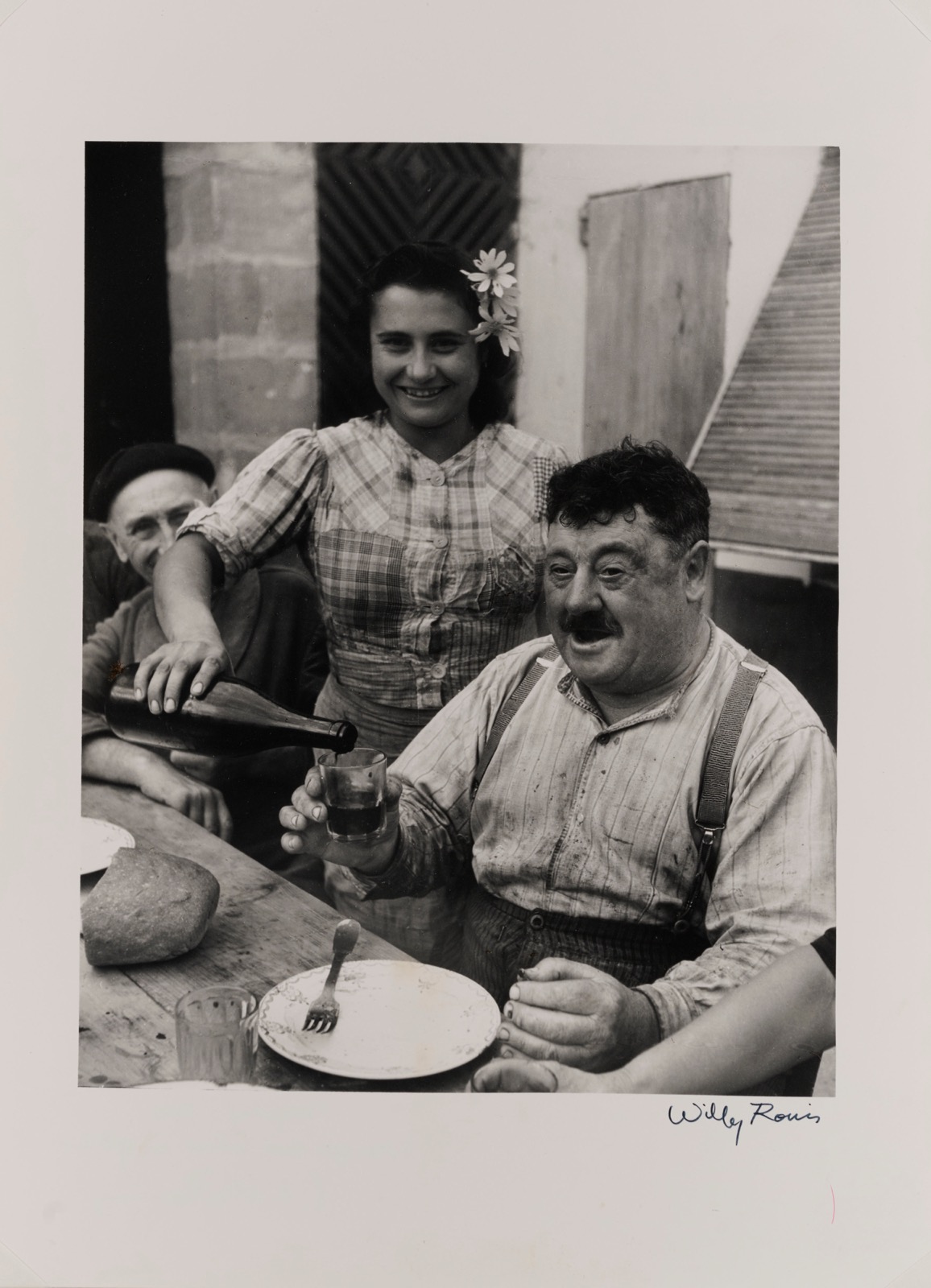

The studium is legible at once: three faces around a plank table after the harvest, the codes of rural pleasure all in place. A heavy man in shirtsleeves and suspenders laughs open-mouthed beneath a thick moustache, his glass of dark wine lifted to the light. Behind him a young woman smiles, hands at her sides; an older man in a beret, half in shadow, tips the bottle. There is a country loaf gone matte and grey in the print, a soiled plate, a fork abandoned mid-meal. One reads contentment, the South-West, a war just ended.
But something pierces, and it is small. Behind the woman's ear, a single white daisy. It explains nothing; it sells nothing; it is not required by the meal or the wine. Yet I cannot leave it. That flower, placed by a hand we will never see, in a morning we will never enter, wounds me precisely because it is so casual, so soon to wilt. It is the detail that was not arranged for me and arrives anyway, a stab of tenderness in the grain. The chevroned shutter, the empty glass tipped on its rim — these too refuse to stay decorative.
Here is the paradox the medium alone permits: this gesture happened once, in a courtyard at Cavignac, and goes on happening. The photographer, a humanist now held by the Centre Pompidou and the Bibliothèque nationale, did not invent the joy; he was present, and pressed. A vintage print carries that presence in its silver, the object nearest the instant itself — proof that someone, then, found this worth keeping. The daisy keeps wilting. It never finishes.