She lifts two fencing foils overhead and crosses them in her white-gloved fists while he leans in, dark head against her jaw, to press a kiss just short of her mouth. Everything in the frame is caught mid-lean, mid-cross, mid-kiss: the wet dark curls falling forward, the white fencing jackets brushing, the blades forming their brief X against a gilt-framed mirror. Below them a carved marble mantel and an embroidered peacock screen hold perfectly still, as if the room were bracing for the touch.
What a photograph does with a gesture like this is peculiar: it arrests the very thing that gives the gesture meaning, its passing. The kiss will never land or lift; the crossed blades will neither fall nor part. And yet the picture is not cold, because the print itself is a made thing, a sheet coated in silver that received this instant and held it. Touch is its subject and touch is its method, the light having pressed the scene into an emulsion once, and for good.
Weber built a career on exactly this collision, the athletic body dressed in sport yet posed for tenderness, sensuality wrapped in the manners of an old European room. The fencing whites let him work in a near-monochrome that the gelatin silver process turns luminous, whites separating into a dozen greys against the deep shadow of the mirror. Held in the hand, the print is a small physical fact standing in for a vanished second, the odd bargain every silver photograph strikes with the one who keeps it.
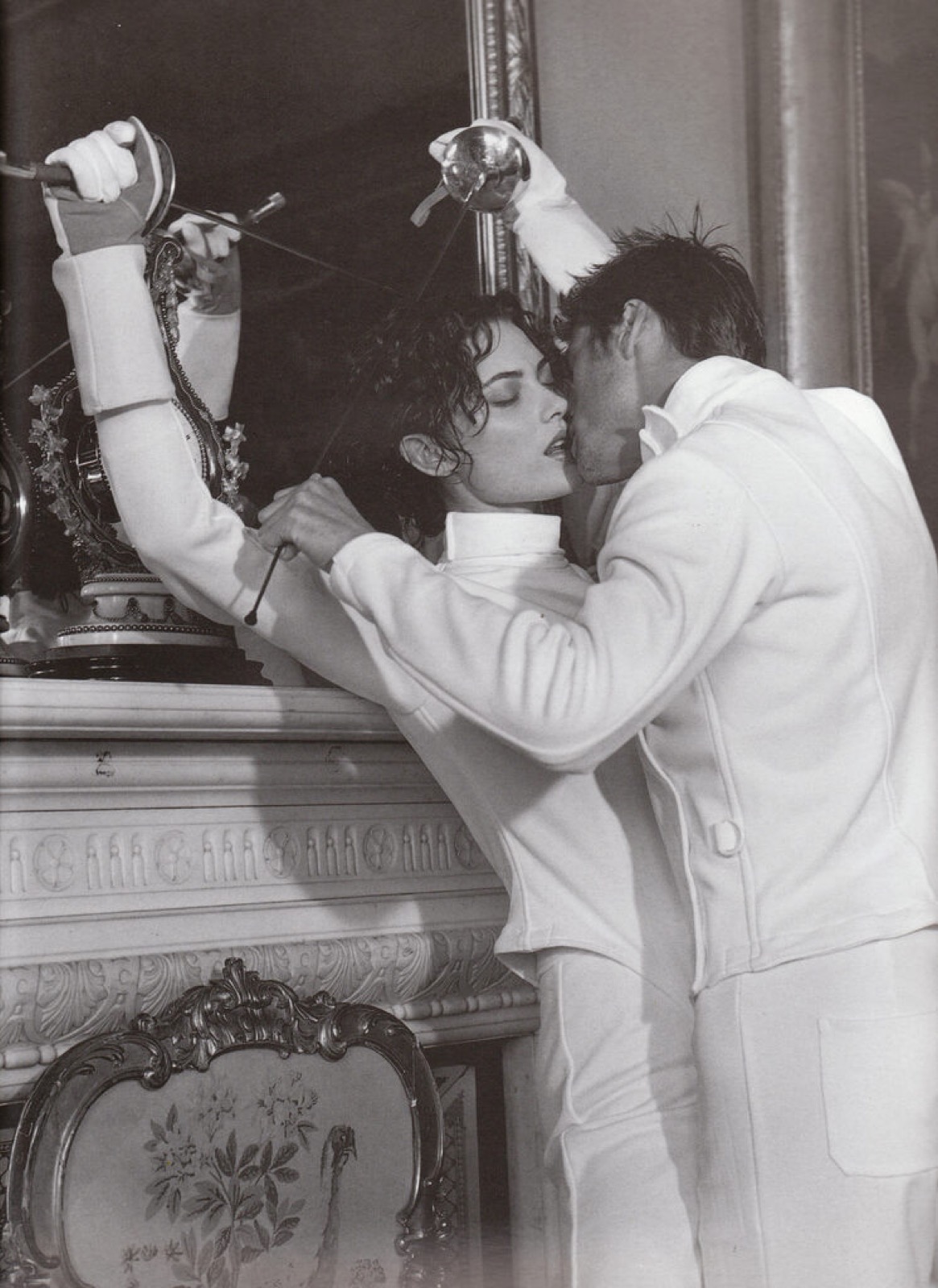

She lifts two fencing foils overhead and crosses them in her white-gloved fists while he leans in, dark head against her jaw, to press a kiss just short of her mouth. Everything in the frame is caught mid-lean, mid-cross, mid-kiss: the wet dark curls falling forward, the white fencing jackets brushing, the blades forming their brief X against a gilt-framed mirror. Below them a carved marble mantel and an embroidered peacock screen hold perfectly still, as if the room were bracing for the touch.
What a photograph does with a gesture like this is peculiar: it arrests the very thing that gives the gesture meaning, its passing. The kiss will never land or lift; the crossed blades will neither fall nor part. And yet the picture is not cold, because the print itself is a made thing, a sheet coated in silver that received this instant and held it. Touch is its subject and touch is its method, the light having pressed the scene into an emulsion once, and for good.
Weber built a career on exactly this collision, the athletic body dressed in sport yet posed for tenderness, sensuality wrapped in the manners of an old European room. The fencing whites let him work in a near-monochrome that the gelatin silver process turns luminous, whites separating into a dozen greys against the deep shadow of the mirror. Held in the hand, the print is a small physical fact standing in for a vanished second, the odd bargain every silver photograph strikes with the one who keeps it.