Red and blue arrive first, and they arrive as opposites: the striped scarlet gown falling to the rocks, the cobalt skin and painted arms of the figure who wears it. Everything else in the frame is the color of the dry season — the tan of granite boulders, the bleached haze over the water, the saffron of three holy men strung along the bank. Yeste lets the two invented colors stand against a landscape that would never produce them.
The composition is a long horizontal, read left to right like a sentence. The costumed figure anchors the left margin, tall and frontal; the sadhus recede into the mist at center, one with arms flung open in what could be blessing or greeting; a garlanded red motorcycle, flag flying, closes the right edge on its rock. The eye travels the diagonal of stones from the theatrical to the devotional to the mechanical, and finds no seam between them.
That refusal of a seam is the picture’s argument. Yeste, among the front rank of Spanish fashion photography, has built much of his editorial work on elemental things — sand, water, wind, the rock underfoot here — and he stages fashion where it has no business being, trusting the light to reconcile it. The morning haze does the reconciling, flattening distances until masquerade and pilgrimage share one atmosphere. Printed as an archival pigment print, the surface holds that haze without gloss, the reds deep, the pale sky continuous. It is a made photograph that looks found, which is the harder of the two.
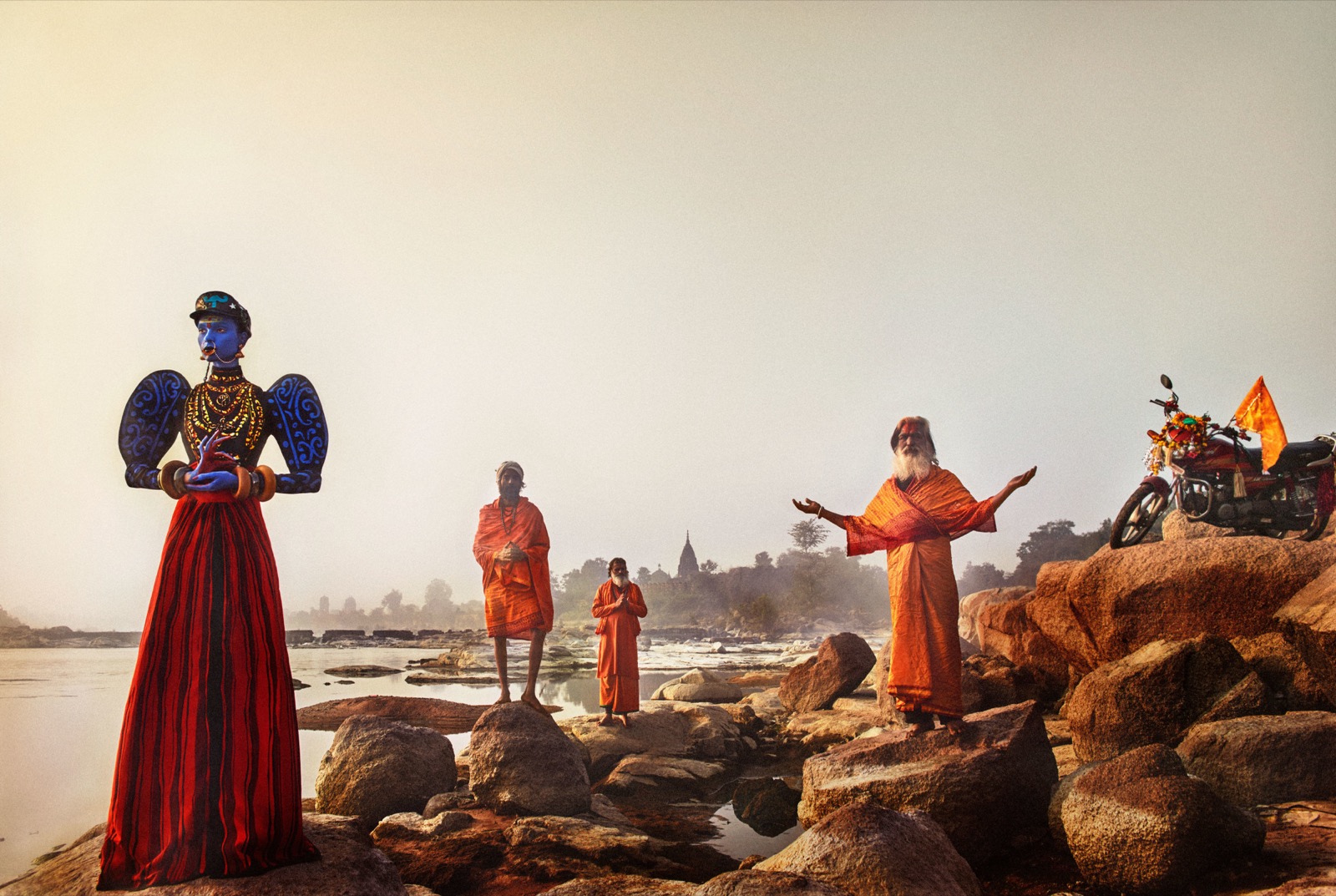

Red and blue arrive first, and they arrive as opposites: the striped scarlet gown falling to the rocks, the cobalt skin and painted arms of the figure who wears it. Everything else in the frame is the color of the dry season — the tan of granite boulders, the bleached haze over the water, the saffron of three holy men strung along the bank. Yeste lets the two invented colors stand against a landscape that would never produce them.
The composition is a long horizontal, read left to right like a sentence. The costumed figure anchors the left margin, tall and frontal; the sadhus recede into the mist at center, one with arms flung open in what could be blessing or greeting; a garlanded red motorcycle, flag flying, closes the right edge on its rock. The eye travels the diagonal of stones from the theatrical to the devotional to the mechanical, and finds no seam between them.
That refusal of a seam is the picture’s argument. Yeste, among the front rank of Spanish fashion photography, has built much of his editorial work on elemental things — sand, water, wind, the rock underfoot here — and he stages fashion where it has no business being, trusting the light to reconcile it. The morning haze does the reconciling, flattening distances until masquerade and pilgrimage share one atmosphere. Printed as an archival pigment print, the surface holds that haze without gloss, the reds deep, the pale sky continuous. It is a made photograph that looks found, which is the harder of the two.