You could stand at this corner all afternoon and nothing would happen, which is, I suspect, exactly the reason to stop the car. The house turns its blunt shoulder toward us, two floors of stucco and cinder block, a downstairs window catching a plank of late sun while the sky above stays flat and unbothered. Everything useful has already been done: the fence hung, the wires strung, the sedan left at an angle no one will bother to correct.
Those wires are the giveaway. They loop off the pole in a nervous tangle, far too many for one small building, as if the house were quietly rigged for a life more eventful than the one it got. This is a black-and-white picture from Between the Two, and the absence of colour reads less like a choice than an admission: there was no colour to speak of anyway, only grades of grey light and the long shadow the eaves throw down the wall.
What stays with me is the ordinariness, the refusal to be more than it is. The archival pigment print, mounted on aluminium, holds the scene at a slight, cool remove, the way memory holds a street you once drove past and never entered. Someone lives here. Someone parked that car. The picture doesn't ask you to care, and somehow that is precisely what makes you linger at the fence a moment longer than you meant to.
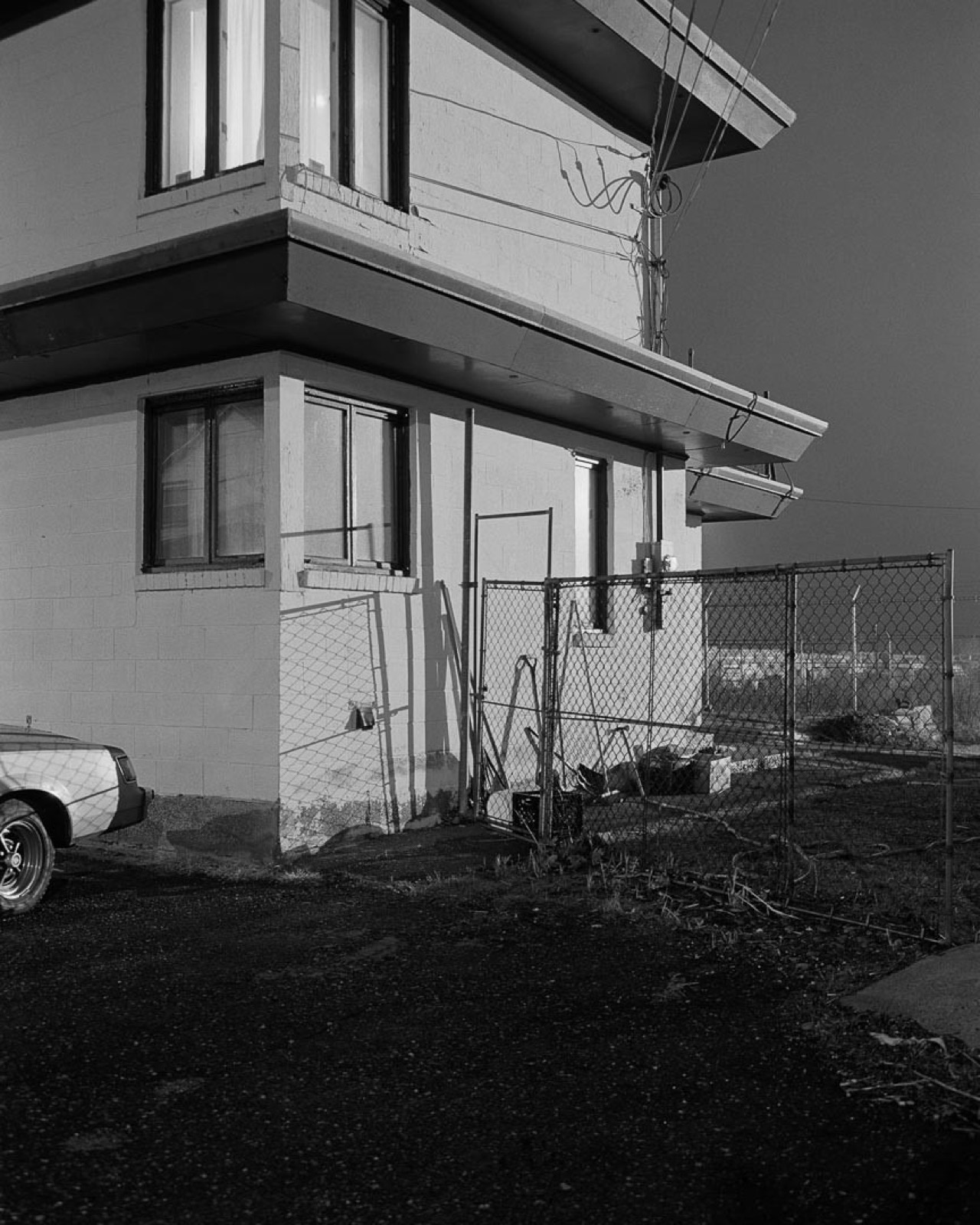

You could stand at this corner all afternoon and nothing would happen, which is, I suspect, exactly the reason to stop the car. The house turns its blunt shoulder toward us, two floors of stucco and cinder block, a downstairs window catching a plank of late sun while the sky above stays flat and unbothered. Everything useful has already been done: the fence hung, the wires strung, the sedan left at an angle no one will bother to correct.
Those wires are the giveaway. They loop off the pole in a nervous tangle, far too many for one small building, as if the house were quietly rigged for a life more eventful than the one it got. This is a black-and-white picture from Between the Two, and the absence of colour reads less like a choice than an admission: there was no colour to speak of anyway, only grades of grey light and the long shadow the eaves throw down the wall.
What stays with me is the ordinariness, the refusal to be more than it is. The archival pigment print, mounted on aluminium, holds the scene at a slight, cool remove, the way memory holds a street you once drove past and never entered. Someone lives here. Someone parked that car. The picture doesn't ask you to care, and somehow that is precisely what makes you linger at the fence a moment longer than you meant to.