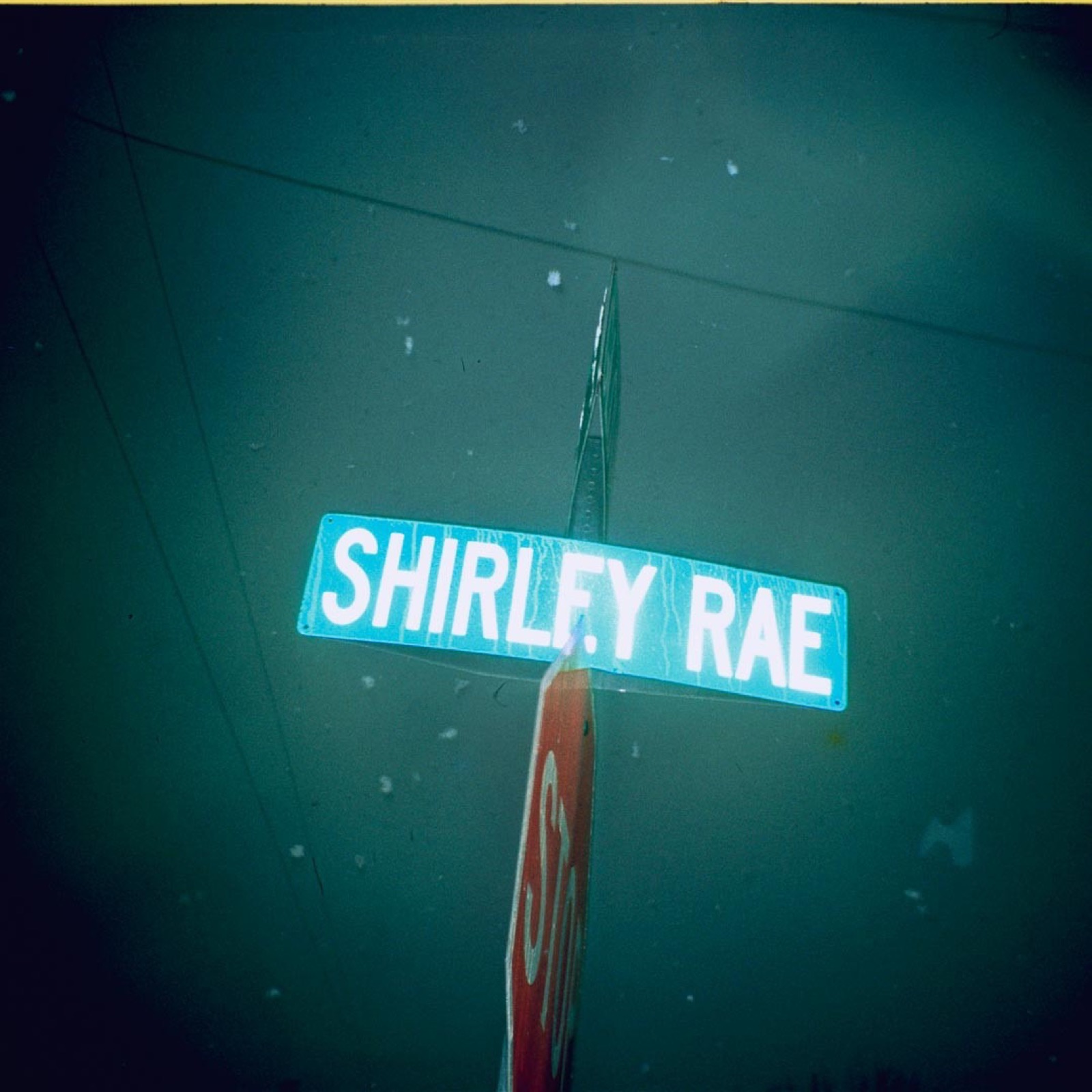
Shirley Rae. Not a street I would have gone looking for, but there it is, a blue municipal sign lettered in white and shot from directly below, so that the pole rises like a mast into a sky gone deep aquamarine. Behind it, edge-on and half-guessed, the red blade of a stop sign turns away. Dust and scratches float across the frame; the picture wears its analogue origins like freckles.
The names of American streets are a genre unto themselves, and Shirley Rae is pure suburban pastoral: somebody's wife, somebody's daughter, a developer's small immortality bestowed on a strip of asphalt in a place called Silver Meadows. Hido, sifting that half-invented territory, finds in the sign a readymade portrait, a woman evoked entirely by two words bolted to a post. I find myself wondering about her, which is presumably the trap, and I walk into it happily.
The teal cast, the vignetting, the swimming grain all point to a found slide or a toy camera, and the archival pigment print on aluminium preserves every accident faithfully. It is the least Hido-looking Hido imaginable, no house, no dusk, no window, and yet the mood is unmistakable, the sense of a name outliving whatever it named, keeping its small nocturnal watch over a corner nobody photographs but him.

Shirley Rae. Not a street I would have gone looking for, but there it is, a blue municipal sign lettered in white and shot from directly below, so that the pole rises like a mast into a sky gone deep aquamarine. Behind it, edge-on and half-guessed, the red blade of a stop sign turns away. Dust and scratches float across the frame; the picture wears its analogue origins like freckles.
The names of American streets are a genre unto themselves, and Shirley Rae is pure suburban pastoral: somebody's wife, somebody's daughter, a developer's small immortality bestowed on a strip of asphalt in a place called Silver Meadows. Hido, sifting that half-invented territory, finds in the sign a readymade portrait, a woman evoked entirely by two words bolted to a post. I find myself wondering about her, which is presumably the trap, and I walk into it happily.
The teal cast, the vignetting, the swimming grain all point to a found slide or a toy camera, and the archival pigment print on aluminium preserves every accident faithfully. It is the least Hido-looking Hido imaginable, no house, no dusk, no window, and yet the mood is unmistakable, the sense of a name outliving whatever it named, keeping its small nocturnal watch over a corner nobody photographs but him.