One evergreen stands at the center of a bare field, dark and dense against a colorless sky. It is nearly symmetrical, broad at the base, tapering unevenly at the crown where the wind has bent it. Behind it a low line of leafless trees marks the field's far edge. In front, snow lies thin over dead grass, the whole ground the color of weak tea.
The picture is built on a single decision: put the tree in the middle and let it carry everything. Centered composition is supposed to be naive, and Hido uses that naivety deliberately, turning the lone tree into a figure, almost a portrait. A small dark mark near the trunk—a painted zero, perhaps—interrupts the field like a caption no one can read. Otherwise the frame is emptied of incident.
Printed as archival pigment on Dibond and belonging to Excerpts from Silver Meadows, the photograph describes a familiar American emptiness: the vacant lot, the edge of town, the field between one place and another. The tree survives its surroundings by being denser and greener than anything near it—the one live thing standing in a field gone dormant. The picture asks only that we look at it plainly, which is the hardest kind of looking, and the kind Hido keeps demanding.
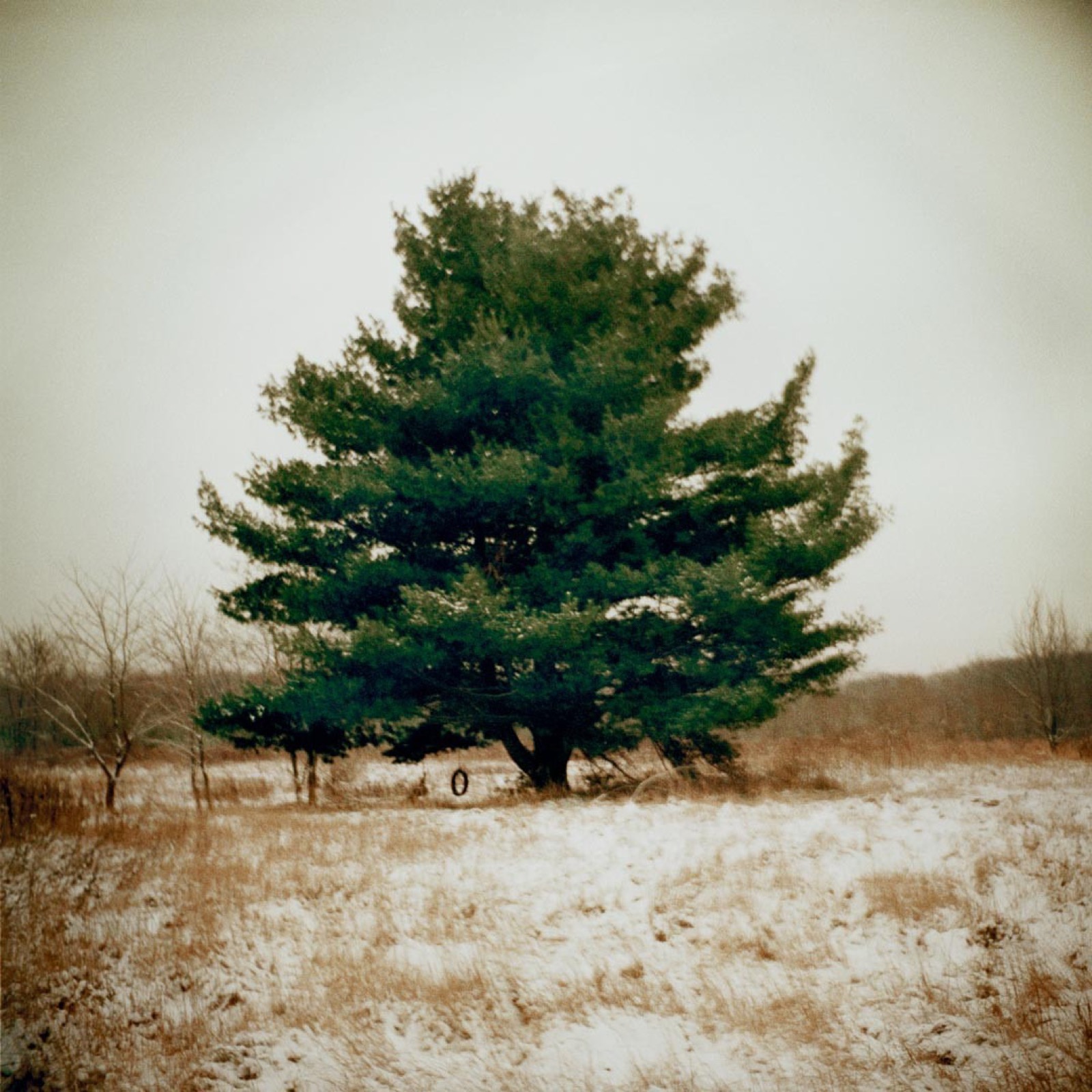

One evergreen stands at the center of a bare field, dark and dense against a colorless sky. It is nearly symmetrical, broad at the base, tapering unevenly at the crown where the wind has bent it. Behind it a low line of leafless trees marks the field's far edge. In front, snow lies thin over dead grass, the whole ground the color of weak tea.
The picture is built on a single decision: put the tree in the middle and let it carry everything. Centered composition is supposed to be naive, and Hido uses that naivety deliberately, turning the lone tree into a figure, almost a portrait. A small dark mark near the trunk—a painted zero, perhaps—interrupts the field like a caption no one can read. Otherwise the frame is emptied of incident.
Printed as archival pigment on Dibond and belonging to Excerpts from Silver Meadows, the photograph describes a familiar American emptiness: the vacant lot, the edge of town, the field between one place and another. The tree survives its surroundings by being denser and greener than anything near it—the one live thing standing in a field gone dormant. The picture asks only that we look at it plainly, which is the hardest kind of looking, and the kind Hido keeps demanding.