A loop of chalk on the pavement turns the 1952 street into a stage where everyone is both spectator and cast, and Louis Faurer's "Accident" holds exactly that confusion. A crowd has gathered along the kerb; a finned sedan and a darker car frame the scene; on the pavement a loop of rope or chalk marks out an oval, the kind of perimeter authority draws around something gone wrong. At the centre a girl in a striped jersey stands alone, arms crossed, looking off to the side with the wary alertness of someone who has been told to stay back.
The picture's foreground dissolves into blur — a pale, out-of-focus mass swelling up from below, a head, a shoulder, something passing too near the lens — so that we seem to be watching from inside the press of bodies rather than outside it. To the right, oddly serene, a couple in formal clothes hold flowers near a doorway, a wedding party stranded at the same corner as the calamity. The ordinary and the catastrophic share one block, one frame, one afternoon's light.
What an accident gathers is a sudden, involuntary public — strangers made briefly into neighbours by their shared looking. Faurer is interested less in the mishap, which he keeps offstage, than in the faces it summons: the girl's guarded stillness, the bride's flowers, the men talking by the cars. The city absorbs its small disasters and keeps moving; the photograph holds the gathering one instant longer, before the crowd remembers it has somewhere else to be.
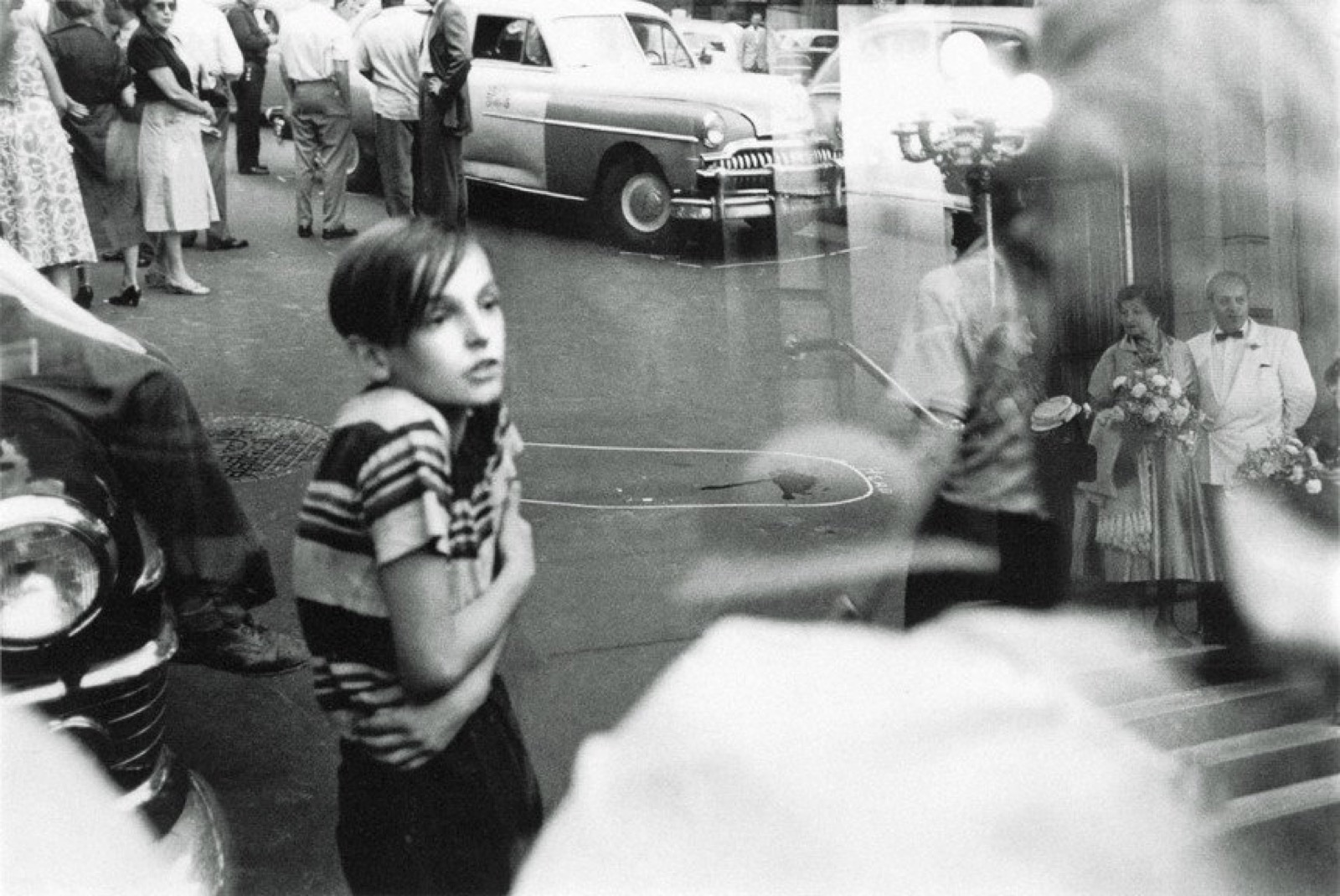

A loop of chalk on the pavement turns the 1952 street into a stage where everyone is both spectator and cast, and Louis Faurer's "Accident" holds exactly that confusion. A crowd has gathered along the kerb; a finned sedan and a darker car frame the scene; on the pavement a loop of rope or chalk marks out an oval, the kind of perimeter authority draws around something gone wrong. At the centre a girl in a striped jersey stands alone, arms crossed, looking off to the side with the wary alertness of someone who has been told to stay back.
The picture's foreground dissolves into blur — a pale, out-of-focus mass swelling up from below, a head, a shoulder, something passing too near the lens — so that we seem to be watching from inside the press of bodies rather than outside it. To the right, oddly serene, a couple in formal clothes hold flowers near a doorway, a wedding party stranded at the same corner as the calamity. The ordinary and the catastrophic share one block, one frame, one afternoon's light.
What an accident gathers is a sudden, involuntary public — strangers made briefly into neighbours by their shared looking. Faurer is interested less in the mishap, which he keeps offstage, than in the faces it summons: the girl's guarded stillness, the bride's flowers, the men talking by the cars. The city absorbs its small disasters and keeps moving; the photograph holds the gathering one instant longer, before the crowd remembers it has somewhere else to be.