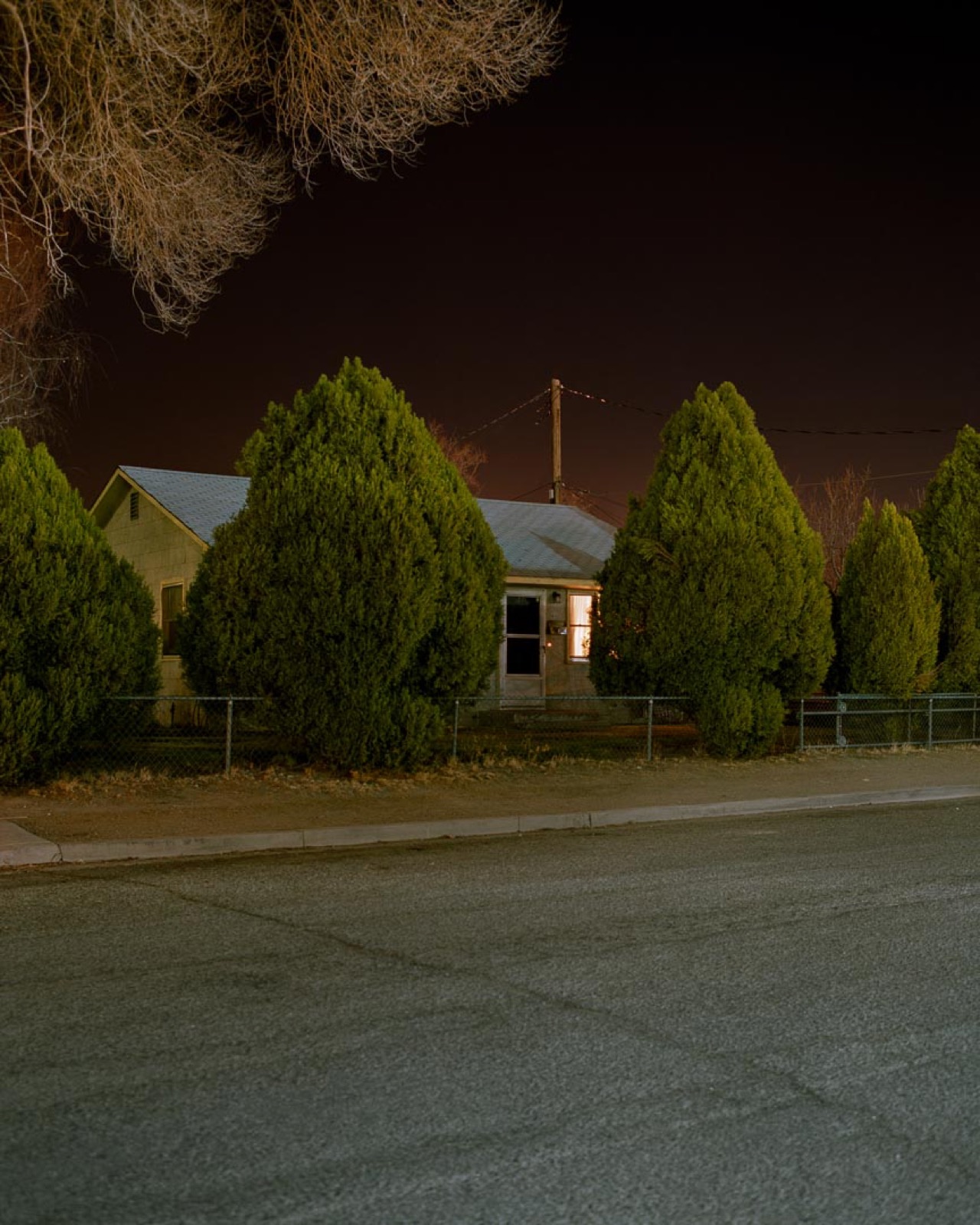
From where I stand, in the middle of an asphalt street that no one crosses at this hour, the house barely consents to be seen. Junipers have grown into dark teardrops taller than its windows; a chain-link fence draws its thin geometry across the yard; overhead, the bare branches of some winter tree intrude on the frame like a thought I cannot finish. The sky is not black. It is oxblood, a red-brown breath hanging over the roofline, and against it a utility pole holds up its wires with the patience of a mast.
What undoes the scene’s composure is small: the screen door lit from within, an amber rectangle, and beside it a window warmed by little lights, as if a modest festivity had been forgotten and left burning. This detail is not for me; that is why it reaches me. Someone inside is awake, or was; the door glows whether or not I stand here. All the rest — hedge, fence, curb — is the coded language of the suburb, legible, general. The lit door is a particular. It says: a life, this one, not another.
The photographer numbers his houses rather than naming them, as though tenderness required discretion; number 1536 belongs to that nocturnal census of the American suburb. His prints are held by SFMOMA, the Getty and the Whitney, and this archival pigment print carries the night’s difficult colors — the reds that are almost brown, the greens that are almost black — with an exactness the eye alone could not keep.
From where I stand, in the middle of an asphalt street that no one crosses at this hour, the house barely consents to be seen. Junipers have grown into dark teardrops taller than its windows; a chain-link fence draws its thin geometry across the yard; overhead, the bare branches of some winter tree intrude on the frame like a thought I cannot finish. The sky is not black. It is oxblood, a red-brown breath hanging over the roofline, and against it a utility pole holds up its wires with the patience of a mast.
What undoes the scene’s composure is small: the screen door lit from within, an amber rectangle, and beside it a window warmed by little lights, as if a modest festivity had been forgotten and left burning. This detail is not for me; that is why it reaches me. Someone inside is awake, or was; the door glows whether or not I stand here. All the rest — hedge, fence, curb — is the coded language of the suburb, legible, general. The lit door is a particular. It says: a life, this one, not another.
The photographer numbers his houses rather than naming them, as though tenderness required discretion; number 1536 belongs to that nocturnal census of the American suburb. His prints are held by SFMOMA, the Getty and the Whitney, and this archival pigment print carries the night’s difficult colors — the reds that are almost brown, the greens that are almost black — with an exactness the eye alone could not keep.