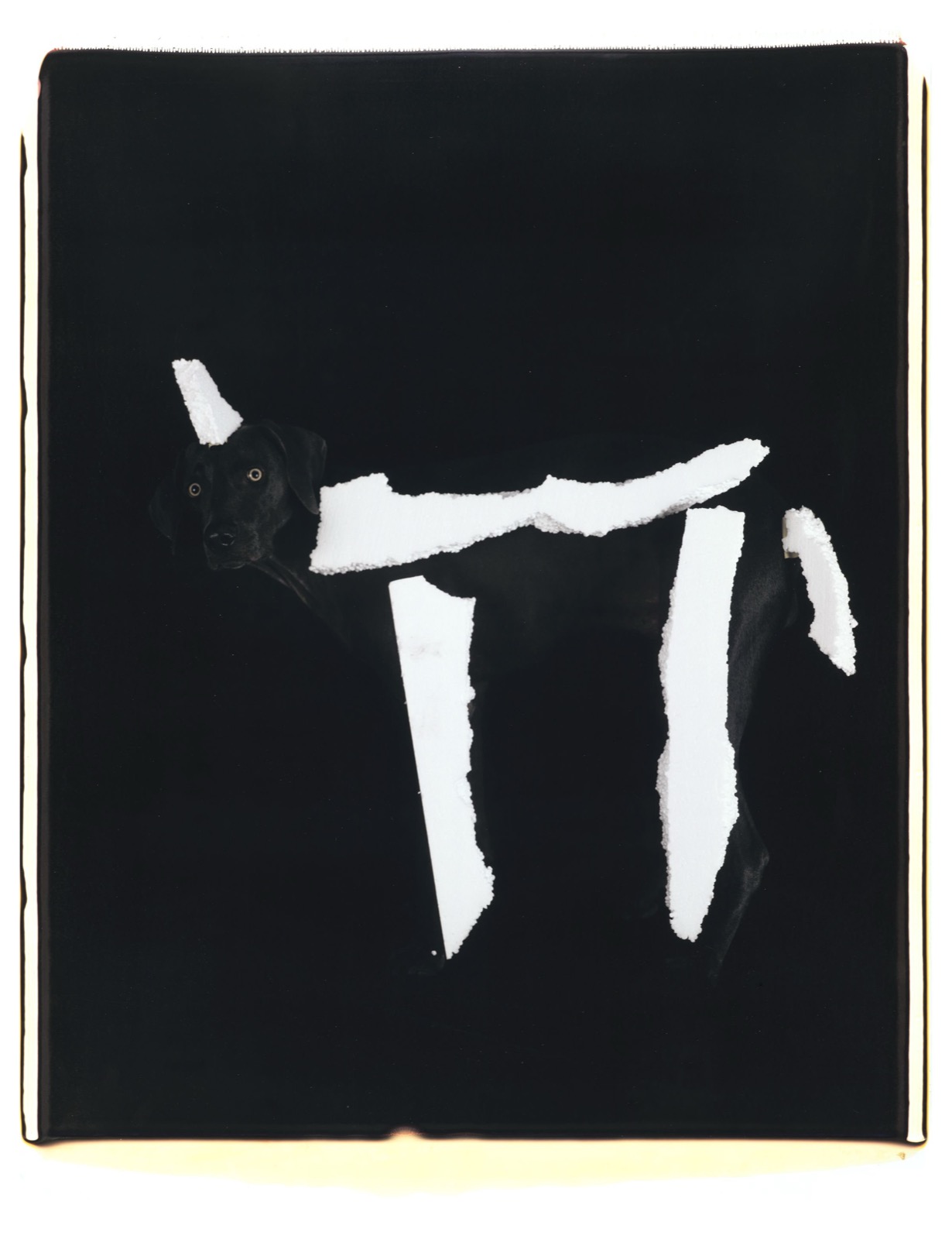
A dog reduced to a sign: that is what survives here. Against a near-total black, a Weimaraner the colour of the void it sits in becomes legible only through a few rough marks of white styrofoam — one perched like a horn on the ear, a bar laid along the spine, two struts dropped down the legs. They draw a dog rather than clothe one. The title says Early Dog, and the picture obeys, receding past portraiture toward the first idea of an animal, a figure scratched on a cave wall.
What Wegman has made is less a photograph of a dog than a photograph of the sign for one. The white fragments do not describe the body; they diagram it, the way a child or an archaeologist reconstructs a creature from too few bones. The eyes, catching the light, are the one thing that refuses the scheme — proof of the living animal beneath the notation, insisting on presence where the marks propose only structure.
A unique 20 x 24 Polaroid from 2004, it carries the strange authority of the once-only: this arrangement of chalk-bright shards on black existed for a single exposure and can never be repeated. The result reads as both very old and very new — a modern abstraction and a prehistoric memory at once — and it leaves us assembling, from a handful of white lines, the idea of a dog.
A dog reduced to a sign: that is what survives here. Against a near-total black, a Weimaraner the colour of the void it sits in becomes legible only through a few rough marks of white styrofoam — one perched like a horn on the ear, a bar laid along the spine, two struts dropped down the legs. They draw a dog rather than clothe one. The title says Early Dog, and the picture obeys, receding past portraiture toward the first idea of an animal, a figure scratched on a cave wall.
What Wegman has made is less a photograph of a dog than a photograph of the sign for one. The white fragments do not describe the body; they diagram it, the way a child or an archaeologist reconstructs a creature from too few bones. The eyes, catching the light, are the one thing that refuses the scheme — proof of the living animal beneath the notation, insisting on presence where the marks propose only structure.
A unique 20 x 24 Polaroid from 2004, it carries the strange authority of the once-only: this arrangement of chalk-bright shards on black existed for a single exposure and can never be repeated. The result reads as both very old and very new — a modern abstraction and a prehistoric memory at once — and it leaves us assembling, from a handful of white lines, the idea of a dog.