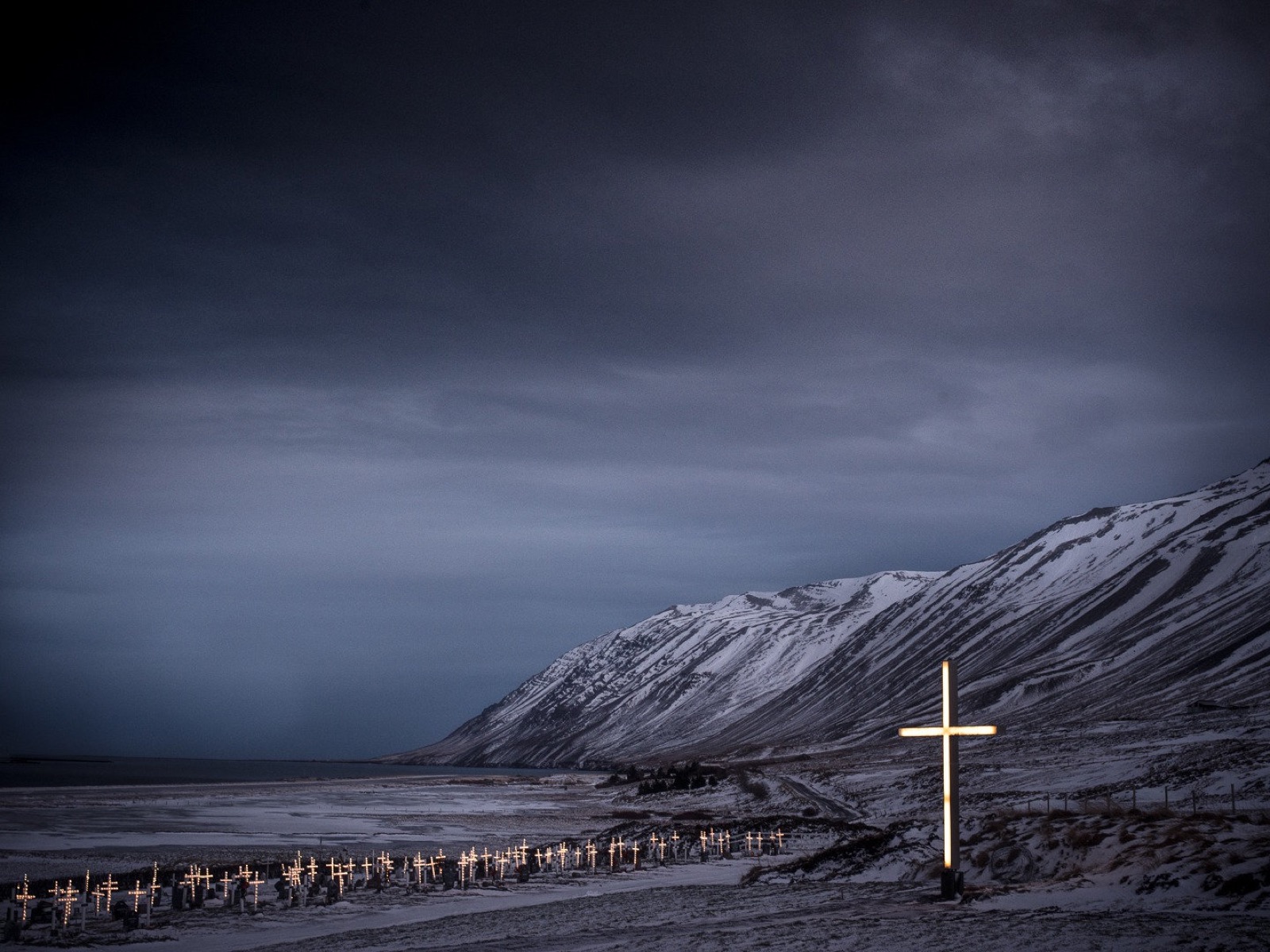
Someone, at some point, decided the dead in this fjord should be lit. Not floodlit, not crucifix-by-crucifix illuminated for the tourists, but wired so that each grave-cross glows from within, a little filament of remembrance against the long dark. That's the thing I can't get past here — that these are electric crosses, plugged into a grid, drawing power from somewhere down the valley so that nobody up on the snowfield is ever entirely alone. The big one near the right edge is the brightest, a vertical of warm light planted on the rise, and behind it the mountain heaves up half-white, half-shadow, indifferent as mountains are.
I keep wanting to call it eerie and then thinking, no, it's the opposite of eerie. It's tender, in the way a nightlight left on for a child is tender. The whole field of small lit crosses runs left across the frozen ground like a sentence you can almost read, each one a soul someone still pays the bill for. Above it all the sky does that Hido thing, that bruised navy that isn't quite night and isn't day either, the hour when colour drains and you start thinking about endings.
Which is the point, I suppose. This belongs to Bright Black World, his Nordic reckoning with Fimbulvetr — the killing winter the old myths put before the end of everything. You feel the cold as weather and as forecast, the planet itself going quiet. Printed large on Dibond and mounted in editions, it carries that doubled charge: a real cemetery on a real fjord, and a warning dressed as a landscape. The crosses stay lit. We keep the lights on for the dead because we are, all of us, rehearsing.
Someone, at some point, decided the dead in this fjord should be lit. Not floodlit, not crucifix-by-crucifix illuminated for the tourists, but wired so that each grave-cross glows from within, a little filament of remembrance against the long dark. That's the thing I can't get past here — that these are electric crosses, plugged into a grid, drawing power from somewhere down the valley so that nobody up on the snowfield is ever entirely alone. The big one near the right edge is the brightest, a vertical of warm light planted on the rise, and behind it the mountain heaves up half-white, half-shadow, indifferent as mountains are.
I keep wanting to call it eerie and then thinking, no, it's the opposite of eerie. It's tender, in the way a nightlight left on for a child is tender. The whole field of small lit crosses runs left across the frozen ground like a sentence you can almost read, each one a soul someone still pays the bill for. Above it all the sky does that Hido thing, that bruised navy that isn't quite night and isn't day either, the hour when colour drains and you start thinking about endings.
Which is the point, I suppose. This belongs to Bright Black World, his Nordic reckoning with Fimbulvetr — the killing winter the old myths put before the end of everything. You feel the cold as weather and as forecast, the planet itself going quiet. Printed large on Dibond and mounted in editions, it carries that doubled charge: a real cemetery on a real fjord, and a warning dressed as a landscape. The crosses stay lit. We keep the lights on for the dead because we are, all of us, rehearsing.