The picture refuses to tell us the score, or the story, or why a woman should be playing billiards with nothing on. It gives us only the moment of aim: the cue steadied across the rail, the black eight ball waiting an inch from her fingers, the white ball marooned at the far cushion. Everything narrative is withheld. What remains is pure composition, a diagonal of felt and limb under flat studio light.
This is directorial photography at its most knowing. The setting, corrugated panelling, a marble skirting, hexagonal floor tiles, is anonymous enough to read as anywhere and nowhere, a stage rather than a place. Weber choreographs the nude into the geometry of the table until skin and slate become one continuous plane, one bare foot hooked on the rail, one planted on the tile. She meets the lens directly, unbothered, complicit, as if the game were being played with us.
The tradition of the reclining nude is being quoted and updated at once, the odalisque relocated to a games room, made athletic and self-possessed rather than passive. Weber, who shaped the look of American fashion, has always understood that a body is most compelling when it seems indifferent to being watched. Here it is rendered as an archival pigment print, whose smooth continuous tones hold the sheen of the rail and the matte of the felt without a break. The shot is never taken. The eight ball never falls. The photograph keeps her forever on the verge of winning.
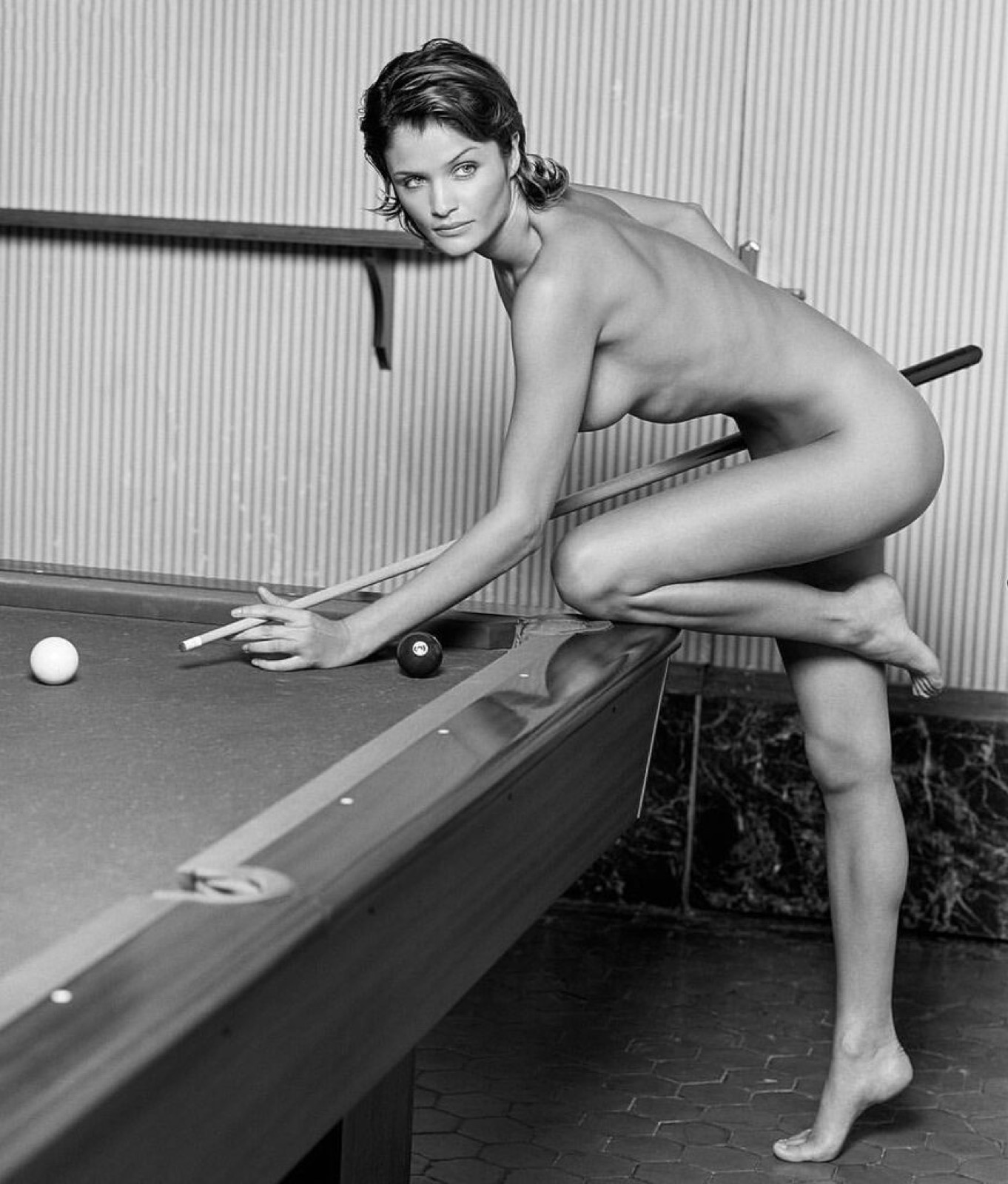

The picture refuses to tell us the score, or the story, or why a woman should be playing billiards with nothing on. It gives us only the moment of aim: the cue steadied across the rail, the black eight ball waiting an inch from her fingers, the white ball marooned at the far cushion. Everything narrative is withheld. What remains is pure composition, a diagonal of felt and limb under flat studio light.
This is directorial photography at its most knowing. The setting, corrugated panelling, a marble skirting, hexagonal floor tiles, is anonymous enough to read as anywhere and nowhere, a stage rather than a place. Weber choreographs the nude into the geometry of the table until skin and slate become one continuous plane, one bare foot hooked on the rail, one planted on the tile. She meets the lens directly, unbothered, complicit, as if the game were being played with us.
The tradition of the reclining nude is being quoted and updated at once, the odalisque relocated to a games room, made athletic and self-possessed rather than passive. Weber, who shaped the look of American fashion, has always understood that a body is most compelling when it seems indifferent to being watched. Here it is rendered as an archival pigment print, whose smooth continuous tones hold the sheen of the rail and the matte of the felt without a break. The shot is never taken. The eight ball never falls. The photograph keeps her forever on the verge of winning.