Txema Yeste
Spanish, b. 1972Needles, 2019-24
Gelatin silver print mounted on aluminium Dibond.
Image: 63 x 45 cm / 24 3/4 x 17 3/4 in / Paper: 78 x 59 cm / 30 3/4 x 23 1/4 in
Image: 110 x 78.5 cm / 43 1/4 x 30 7/8 in / Paper: 127 x 94.5 cm / 50 x 37 1/4 in
Image: 126 x 90 cm / 49 5/8 x 35 3/8 in / Paper: 143 x 106 cm / 56 1/4 x 41 3/4 in
Hand-signed by the artist, titled, editioned, and dated in ink on a label affixed to the verso of the mount
Edition of 10 — Image: 63 x 45 cm / 24 3/4 x 17 3/4 in / Paper: 78 x 59 cm / 30 3/4 x 23 1/4 in
Edition of 5 — Image: 110 x 78.5 cm / 43 1/4 x 30 7/8 in / Paper: 127 x 94.5 cm / 50 x 37 1/4 in
Edition of 3 — Image: 126 x 90 cm / 49 5/8 x 35 3/8 in / Paper: 143 x 106 cm / 56 1/4 x 41 3/4 in
© The Artist
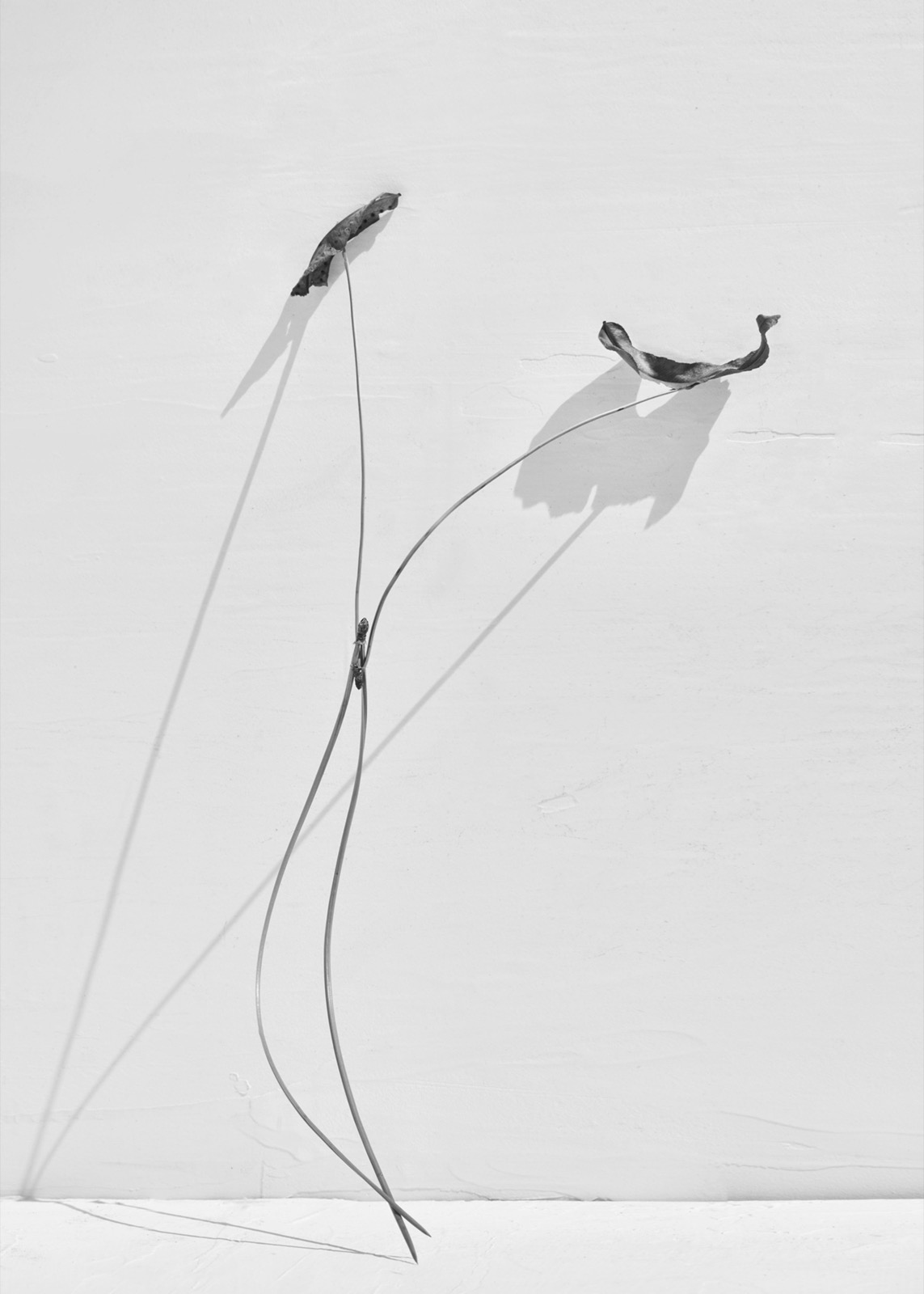
The picture declines to tell us how big any of this is, or where it stood before someone set it against a plaster wall. Two dried stems rise from a shelf at the bottom edge, cross once at a small dark knot near the middle, and carry at their tips a pair of curled, spotted pods that lean apart, two heads turned away. Nothing names the plant; nothing fixes the season. What Yeste gives instead is arrangement: two lines, one node, and the light that makes them legible.
The organization is almost diagrammatic. The left stem climbs nearly straight; the right one bows outward and back, so the two describe a slow lyre-shape against the wall. Each throws a shadow softer and greyer than itself, one long and vertical, one broad and low. The crossing point, where a knot of seed clenches the stems together, is the picture’s hinge. Everything above it opens; everything below descends to the floor in two thin, nearly parallel strokes.
Yeste made his name in fashion, working for Numéro, Harper’s Bazaar and Vogue, where the elemental things, wind, cloth, water, are pressed into service of the figure. Here the figure is withdrawn and the plant left to stand alone, which turns out to be enough. The Needles series treats such castoffs with a portraitist’s patience. The print is gelatin silver mounted on aluminium Dibond, a support that lets the wall’s faint cracks and the palest greys hold without wavering. It is a modest subject given the full weight of description, and it repays the attention.