Set a naked athlete against the earth and the whole history of Western art comes to attention: the discus throwers of antiquity, Michelangelo’s straining marbles. Weber knows this lineage exactly, and here he stages Roberto Bolle, the Italian ballet dancer, in the midst of it, one arm flung overhead, the other reaching back, a pointed foot touching a slope of red earth. Behind him a mound of ochre clay rises like a small mountain into a blue, cloud-scattered sky. The pose is centuries old; the color is entirely now.
What separates this from a marble is precisely its color. The red-orange of the earth is almost violent, a saturated mineral heat that throws the warm gold of the dancer’s skin forward and sends the sky’s cool blue receding above. Bolle’s musculature is described without exaggeration, each tendon and long line legible in the raking Miami light; the diagonal of his body cuts against the mound’s soft, crumbling slopes. It is a study in opposites held in balance: flesh and rock, control and gravity.
Weber has always treated the trained body as a subject worthy of the old reverence, and few subjects have earned it like Bolle, a principal dancer of international standing. This is an archival pigment print, the process that lets such color survive: the pigments hold that fierce ochre and the clean blue without shifting, giving the red its density and the skin its warmth on a stable, matte surface. Classical in its bones and modern in its palette, it is the male nude carried out of the museum and set down, barefoot, on the hot ground.
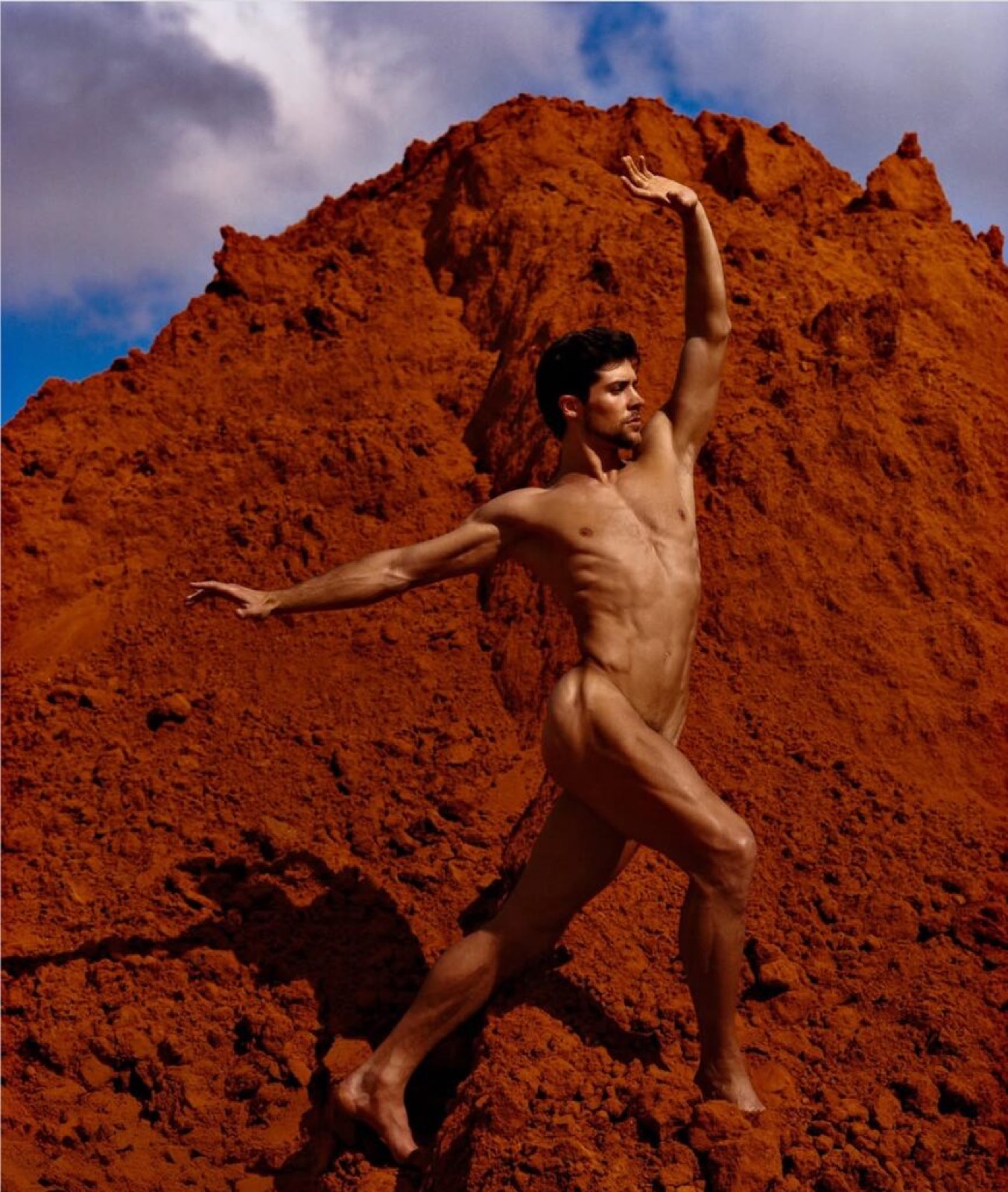

Set a naked athlete against the earth and the whole history of Western art comes to attention: the discus throwers of antiquity, Michelangelo’s straining marbles. Weber knows this lineage exactly, and here he stages Roberto Bolle, the Italian ballet dancer, in the midst of it, one arm flung overhead, the other reaching back, a pointed foot touching a slope of red earth. Behind him a mound of ochre clay rises like a small mountain into a blue, cloud-scattered sky. The pose is centuries old; the color is entirely now.
What separates this from a marble is precisely its color. The red-orange of the earth is almost violent, a saturated mineral heat that throws the warm gold of the dancer’s skin forward and sends the sky’s cool blue receding above. Bolle’s musculature is described without exaggeration, each tendon and long line legible in the raking Miami light; the diagonal of his body cuts against the mound’s soft, crumbling slopes. It is a study in opposites held in balance: flesh and rock, control and gravity.
Weber has always treated the trained body as a subject worthy of the old reverence, and few subjects have earned it like Bolle, a principal dancer of international standing. This is an archival pigment print, the process that lets such color survive: the pigments hold that fierce ochre and the clean blue without shifting, giving the red its density and the skin its warmth on a stable, matte surface. Classical in its bones and modern in its palette, it is the male nude carried out of the museum and set down, barefoot, on the hot ground.