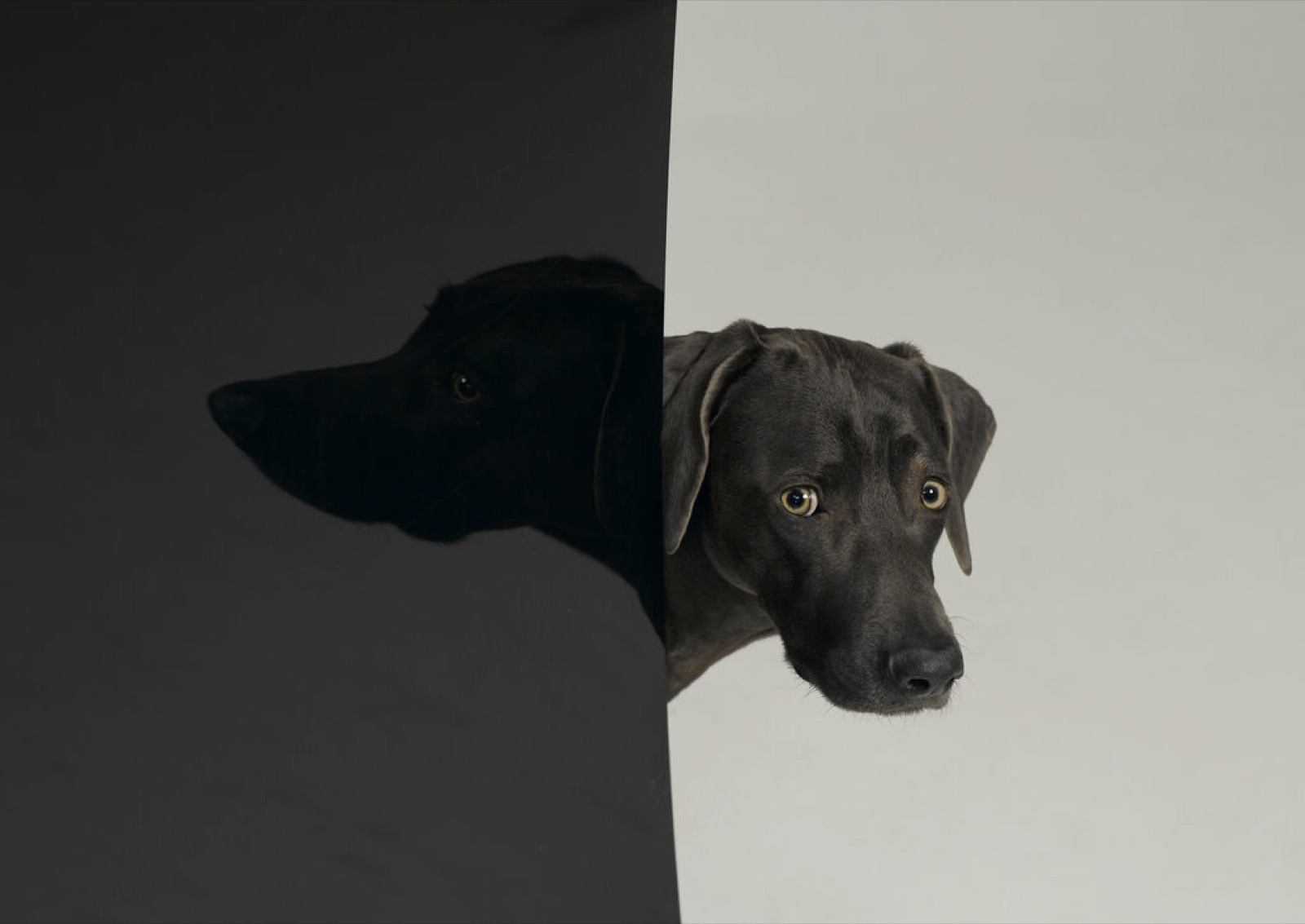
The reflective black panel that splits this frame belongs to a long lineage of optical devices, from the Claude glass that Romantic painters tilted toward a landscape to the dark mirrors of Victorian portrait studios. Wegman uses one here to cleave the picture in two: on the right, a Weimaraner cranes its grey head around the edge into pale light, amber eyes wide; on the left, the same head returns as a black silhouette, reflected and reversed in the glossy surface, one dim eye surfacing from the dark.
Everything about the arrangement is deliberate, a studio proposition rather than a candid glance. The vertical seam down the center divides light from shadow with the crispness of a color-field canvas, and the two heads, one substantial and one spectral, stage a small essay on original and copy, presence and its trace. The living dog looks out with real apprehension; its reflection looks nowhere, a shape drained of attention. It is a cool, formal argument about how a picture is built, the animal enlisted as its willing model.
Wegman came to the dogs as a conceptual artist in the 1970s, and beneath the popular affection for wigs and costumes runs this cooler, more rigorous practice, closer to Minimal sculpture than to pet portraiture. Rendered as an archival pigment print, the image keeps its two halves in exact tonal balance, the matte black holding depth without going dead, the greys of the fur crisp against near-white. What lingers is the restraint: no props, no punchline, only a dog, a mirror, and the oldest question in picture-making.
The reflective black panel that splits this frame belongs to a long lineage of optical devices, from the Claude glass that Romantic painters tilted toward a landscape to the dark mirrors of Victorian portrait studios. Wegman uses one here to cleave the picture in two: on the right, a Weimaraner cranes its grey head around the edge into pale light, amber eyes wide; on the left, the same head returns as a black silhouette, reflected and reversed in the glossy surface, one dim eye surfacing from the dark.
Everything about the arrangement is deliberate, a studio proposition rather than a candid glance. The vertical seam down the center divides light from shadow with the crispness of a color-field canvas, and the two heads, one substantial and one spectral, stage a small essay on original and copy, presence and its trace. The living dog looks out with real apprehension; its reflection looks nowhere, a shape drained of attention. It is a cool, formal argument about how a picture is built, the animal enlisted as its willing model.
Wegman came to the dogs as a conceptual artist in the 1970s, and beneath the popular affection for wigs and costumes runs this cooler, more rigorous practice, closer to Minimal sculpture than to pet portraiture. Rendered as an archival pigment print, the image keeps its two halves in exact tonal balance, the matte black holding depth without going dead, the greys of the fur crisp against near-white. What lingers is the restraint: no props, no punchline, only a dog, a mirror, and the oldest question in picture-making.