Bruce Weber is one of the great mythmakers of American photography — the eye behind the most indelible campaigns of the 1980s and 90s, from Calvin Klein to Ralph Lauren, an artist who turned advertising into a vast, romantic dream of youth, beauty and belonging. Yet his deepest subject was always time itself: the brief, golden hour of being young, photographed as though it were already a memory.
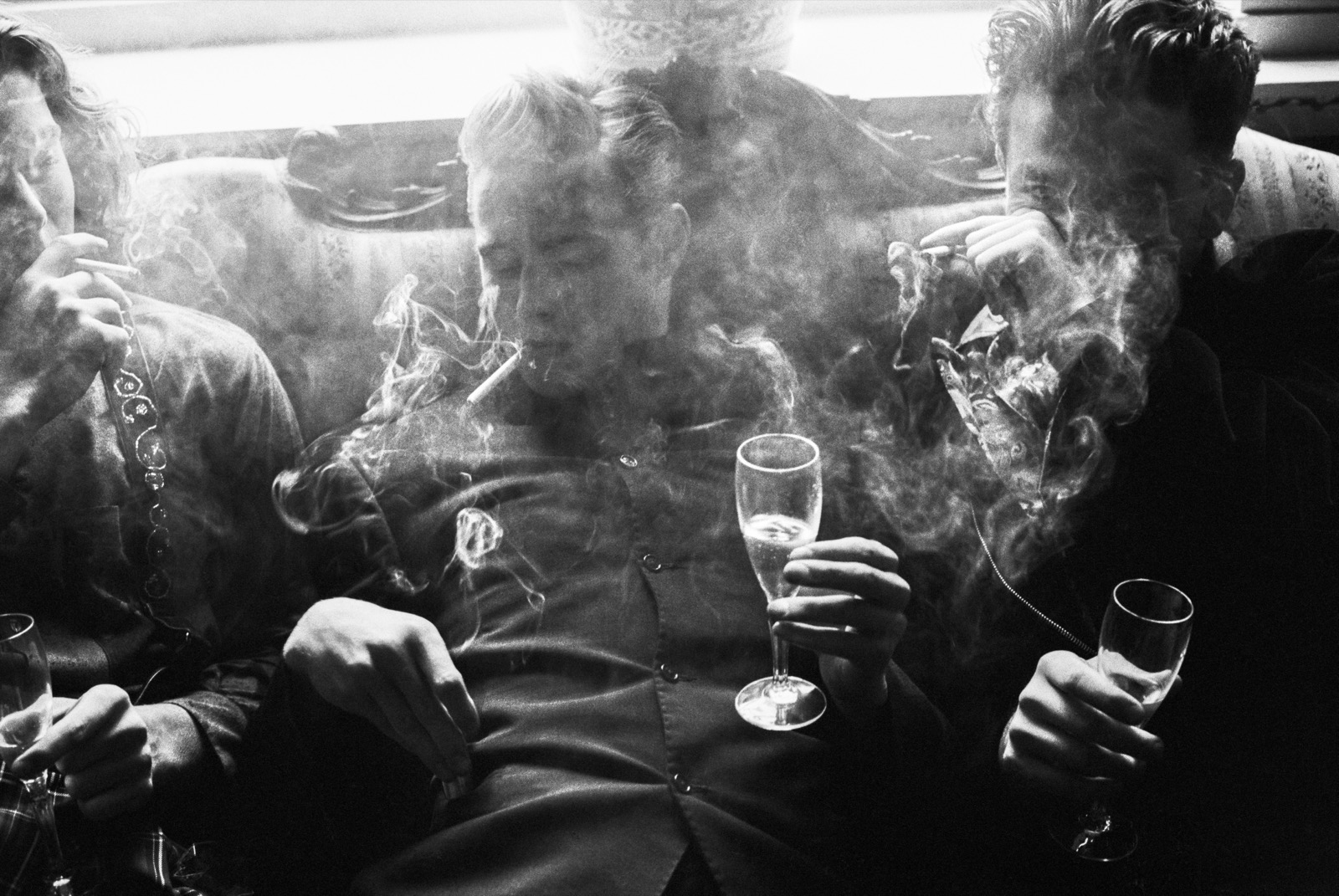
Eton Boys, London Deb Party gathers three young men into the velvet hush of a debutante evening — sunk into a brocade sofa with cigarettes and champagne, eyes lowered, faces half-dissolved in a slow drift of smoke. Weber lets the haze do the work that soft focus does in a painting, veiling the scene until it hovers between the documentary and the dreamed. The grain, the window light, the languor: everything pulls the picture toward reverie, toward something already passing even as it happens.
There is a whole world here — the last gilded ritual of the British upper class, the particular English theatre of privilege and ease, the decadence and tenderness of youth at the threshold of adulthood. Weber, an American abroad, photographs it with the fascinated affection of an outsider and the instinct of a born storyteller, finding in these boys the same wistful beauty he drew from athletes, farmhands and matinee idols alike.
It belongs to the body of work that made him one of the most influential image-makers of his generation — and, seen now, it reads less as a society picture than as an elegy: a cigarette, a glass of champagne, and the smoke that carries it all away. Few photographers did more to shape how an entire era imagined desire and ease, and fewer still could make an after-hours lull feel like a small, vanishing paradise.

Bruce Weber is one of the great mythmakers of American photography — the eye behind the most indelible campaigns of the 1980s and 90s, from Calvin Klein to Ralph Lauren, an artist who turned advertising into a vast, romantic dream of youth, beauty and belonging. Yet his deepest subject was always time itself: the brief, golden hour of being young, photographed as though it were already a memory.
Eton Boys, London Deb Party gathers three young men into the velvet hush of a debutante evening — sunk into a brocade sofa with cigarettes and champagne, eyes lowered, faces half-dissolved in a slow drift of smoke. Weber lets the haze do the work that soft focus does in a painting, veiling the scene until it hovers between the documentary and the dreamed. The grain, the window light, the languor: everything pulls the picture toward reverie, toward something already passing even as it happens.
There is a whole world here — the last gilded ritual of the British upper class, the particular English theatre of privilege and ease, the decadence and tenderness of youth at the threshold of adulthood. Weber, an American abroad, photographs it with the fascinated affection of an outsider and the instinct of a born storyteller, finding in these boys the same wistful beauty he drew from athletes, farmhands and matinee idols alike.
It belongs to the body of work that made him one of the most influential image-makers of his generation — and, seen now, it reads less as a society picture than as an elegy: a cigarette, a glass of champagne, and the smoke that carries it all away. Few photographers did more to shape how an entire era imagined desire and ease, and fewer still could make an after-hours lull feel like a small, vanishing paradise.