Hand-signed by the artist, with title, date, and edition number inscribed in ink on an archival label affixed to the reverse side of the mounted photograph.
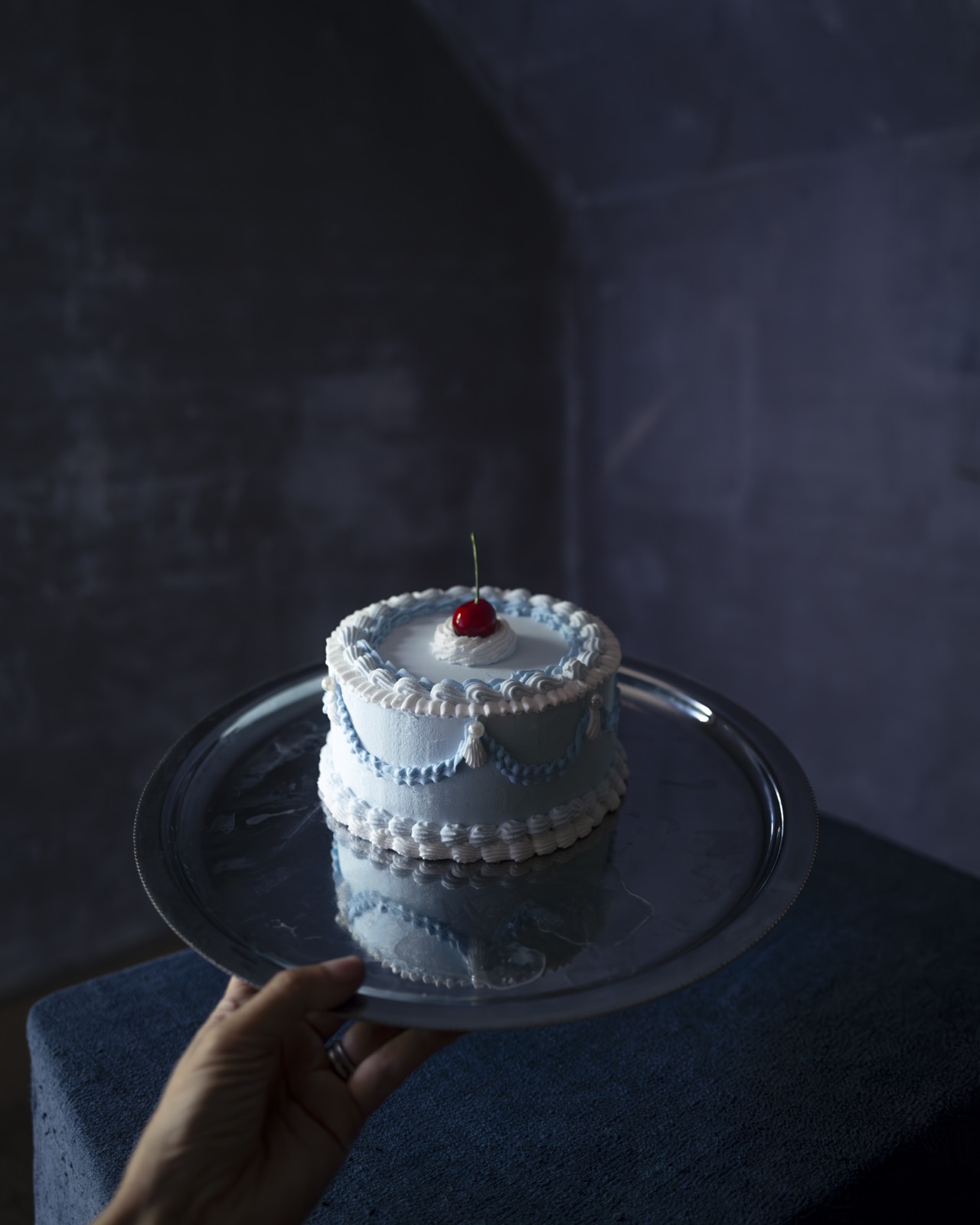
In the dark corner of a room in Camden, someone is holding out a cake. The hand enters from the lower left, a ring on one finger, balancing a silver tray whose surface carries the scratches of long service. On it sits a small pale-blue confection piped with swags, pearls and tassels, crowned by a single red cherry on its green stem, the one point in the picture that refuses the general blue.
The genre summoned is thoroughly vernacular: the cake carried toward the table, photographed a second before the singing starts. Such pictures are usually made in haste, flash-lit and blurred, then pasted into albums as proof that a family celebrated. Here the ritual has been slowed to a standstill and moved into near darkness. The buttercream swags mimic drapery, the piped tassels mimic upholstery, so the cake arrives dressed as a miniature room within a room gone almost black. Beneath it, the polished tray returns a dimmed reflection, the offering floating on its own ghost. Photography is being asked to do what it has always done best: keep the thing whose whole purpose is to disappear.
As an object, the picture repays the same attention as the tray: an archival pigment print, its saturated midnight blues laid down as ink on paper, made by a photographer who has built a sustained body of work around the sensory life of home. Harvey’s books, The Blue Notebook, You an Orchestra a Bomb, Blue Violet, and her presence in American museum collections, confirm what the cherry already suggests: sweetness, here, is a serious matter.

In the dark corner of a room in Camden, someone is holding out a cake. The hand enters from the lower left, a ring on one finger, balancing a silver tray whose surface carries the scratches of long service. On it sits a small pale-blue confection piped with swags, pearls and tassels, crowned by a single red cherry on its green stem, the one point in the picture that refuses the general blue.
The genre summoned is thoroughly vernacular: the cake carried toward the table, photographed a second before the singing starts. Such pictures are usually made in haste, flash-lit and blurred, then pasted into albums as proof that a family celebrated. Here the ritual has been slowed to a standstill and moved into near darkness. The buttercream swags mimic drapery, the piped tassels mimic upholstery, so the cake arrives dressed as a miniature room within a room gone almost black. Beneath it, the polished tray returns a dimmed reflection, the offering floating on its own ghost. Photography is being asked to do what it has always done best: keep the thing whose whole purpose is to disappear.
As an object, the picture repays the same attention as the tray: an archival pigment print, its saturated midnight blues laid down as ink on paper, made by a photographer who has built a sustained body of work around the sensory life of home. Harvey’s books, The Blue Notebook, You an Orchestra a Bomb, Blue Violet, and her presence in American museum collections, confirm what the cherry already suggests: sweetness, here, is a serious matter.