A wall this long stops being architecture and starts being a screen. The block runs the full width of the frame and keeps going, two storeys of greenish stucco fitted with barred windows and the humped boxes of air conditioners, and at dusk it performs exactly like a set: deep blue sky for a backdrop, a single palm placed above the roofline with suspicious perfection, a few windows switched on as if a gaffer were testing scenes one room at a time.
Nothing here was directed, which is the point the picture keeps testing. Hido works in the found world, yet he arrives at the exact look that staged photography of the period laboured to construct: colour temperature doing the storytelling, amber rooms against teal walls, narrative implied and withheld in the same gesture. Behind one grille, a curtain and the leaves of a houseplant; elsewhere, colder squares of white. Each window is a contact sheet of a life, cropped to a single frame. The empty asphalt in the foreground, crossed by one long diagonal shadow, is where a crew would stand if there were a crew. There is only a photographer, waiting for the sky to reach this particular blue.
It is the sensibility that made Hido central to the last two decades of art photography, collected by SFMOMA, the Getty and the Whitney: cinema’s mood without cinema’s budget, the American night as a standing set. The archival pigment print holds the two colour temperatures apart with real precision, teal wall, amber interiors, and lets the palm keep its perfect, improbable placement.
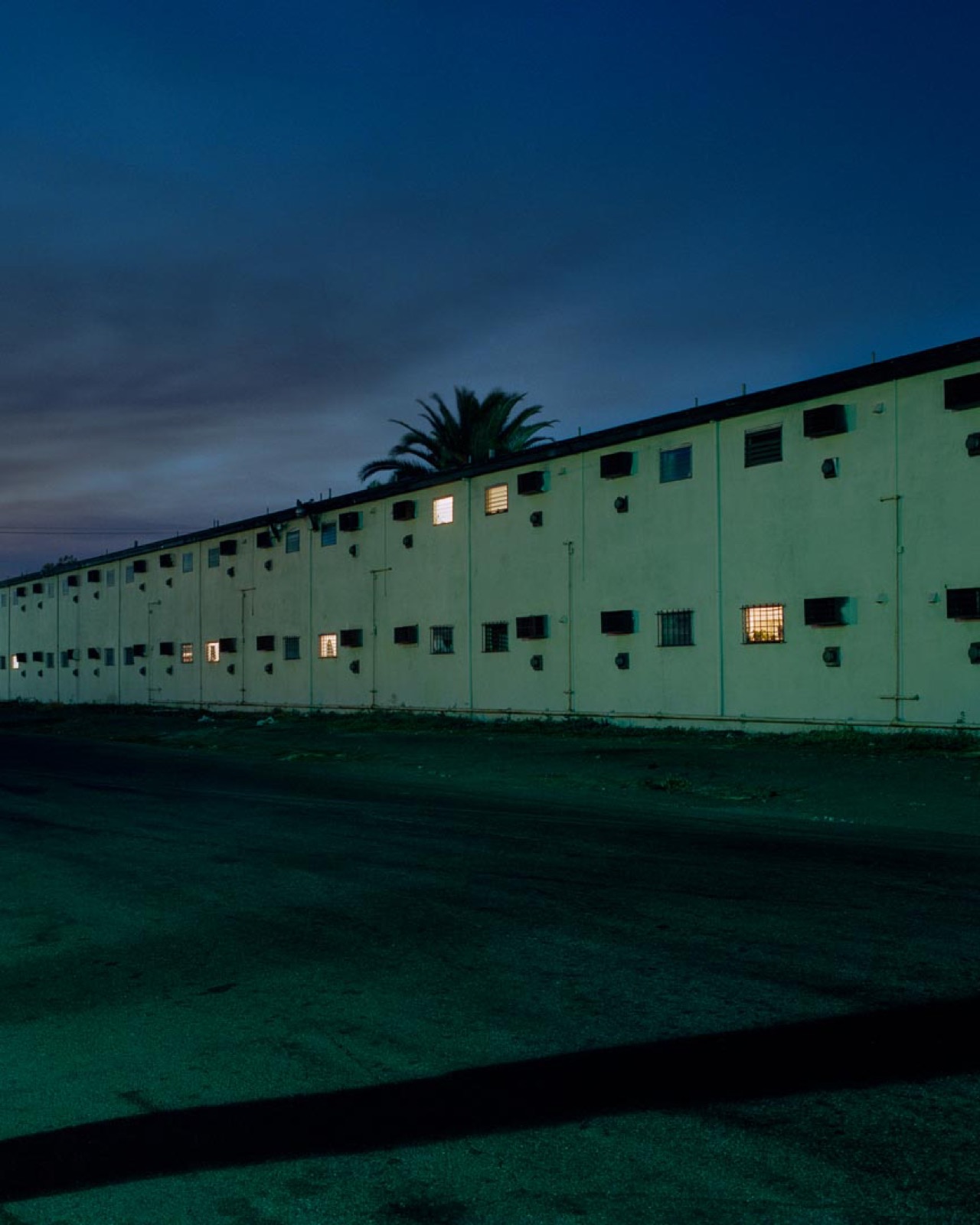

A wall this long stops being architecture and starts being a screen. The block runs the full width of the frame and keeps going, two storeys of greenish stucco fitted with barred windows and the humped boxes of air conditioners, and at dusk it performs exactly like a set: deep blue sky for a backdrop, a single palm placed above the roofline with suspicious perfection, a few windows switched on as if a gaffer were testing scenes one room at a time.
Nothing here was directed, which is the point the picture keeps testing. Hido works in the found world, yet he arrives at the exact look that staged photography of the period laboured to construct: colour temperature doing the storytelling, amber rooms against teal walls, narrative implied and withheld in the same gesture. Behind one grille, a curtain and the leaves of a houseplant; elsewhere, colder squares of white. Each window is a contact sheet of a life, cropped to a single frame. The empty asphalt in the foreground, crossed by one long diagonal shadow, is where a crew would stand if there were a crew. There is only a photographer, waiting for the sky to reach this particular blue.
It is the sensibility that made Hido central to the last two decades of art photography, collected by SFMOMA, the Getty and the Whitney: cinema’s mood without cinema’s budget, the American night as a standing set. The archival pigment print holds the two colour temperatures apart with real precision, teal wall, amber interiors, and lets the palm keep its perfect, improbable placement.