Black is not the absence of light but its most exacting host. Here the whole frame is given over to a single face, painted a deep glossy black, and across it light has been scattered like a fine silver dust — on the bridge of the nose, along one cheek, over the lower lip. The darker the ground, the more each grain of brightness insists on being counted.
Two amber eyes hold the center, warm as tigereye, rimmed in a light that seems to come from within them rather than from any lamp. They do not so much look out as receive; the picture is close enough that we have crossed some threshold of politeness and are now simply inside another person’s attention. A faint pale line runs from the cheek like a whisker, and for a moment the human and the feline share one face, without either surrendering to the other.
Yeste built his reputation in fashion — Numéro, Harper’s Bazaar — but at this magnification the commercial occasion falls away and what remains is closer to portraiture, even reverence. To render skin this dark with this much information is a technical feat and a moral one; the camera has been taught to see where lesser cameras give up and flatten everything to shadow. The archival pigment print is where that patience pays: the speckled highlights stay crisp, the blacks keep their depth without going dead, the amber holds its exact warmth. The gaze, once offered, is returned in kind, and with interest.
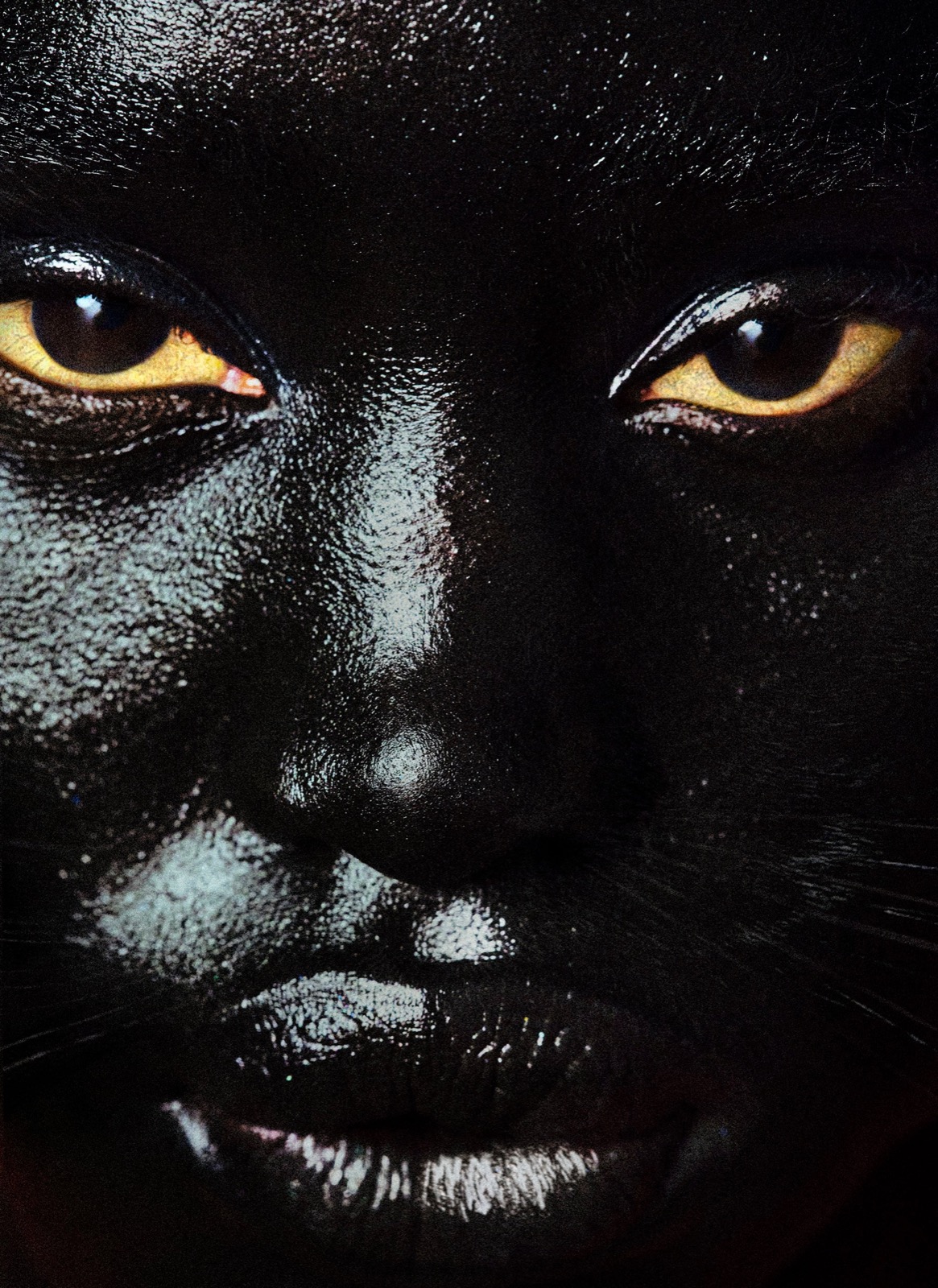

Black is not the absence of light but its most exacting host. Here the whole frame is given over to a single face, painted a deep glossy black, and across it light has been scattered like a fine silver dust — on the bridge of the nose, along one cheek, over the lower lip. The darker the ground, the more each grain of brightness insists on being counted.
Two amber eyes hold the center, warm as tigereye, rimmed in a light that seems to come from within them rather than from any lamp. They do not so much look out as receive; the picture is close enough that we have crossed some threshold of politeness and are now simply inside another person’s attention. A faint pale line runs from the cheek like a whisker, and for a moment the human and the feline share one face, without either surrendering to the other.
Yeste built his reputation in fashion — Numéro, Harper’s Bazaar — but at this magnification the commercial occasion falls away and what remains is closer to portraiture, even reverence. To render skin this dark with this much information is a technical feat and a moral one; the camera has been taught to see where lesser cameras give up and flatten everything to shadow. The archival pigment print is where that patience pays: the speckled highlights stay crisp, the blacks keep their depth without going dead, the amber holds its exact warmth. The gaze, once offered, is returned in kind, and with interest.