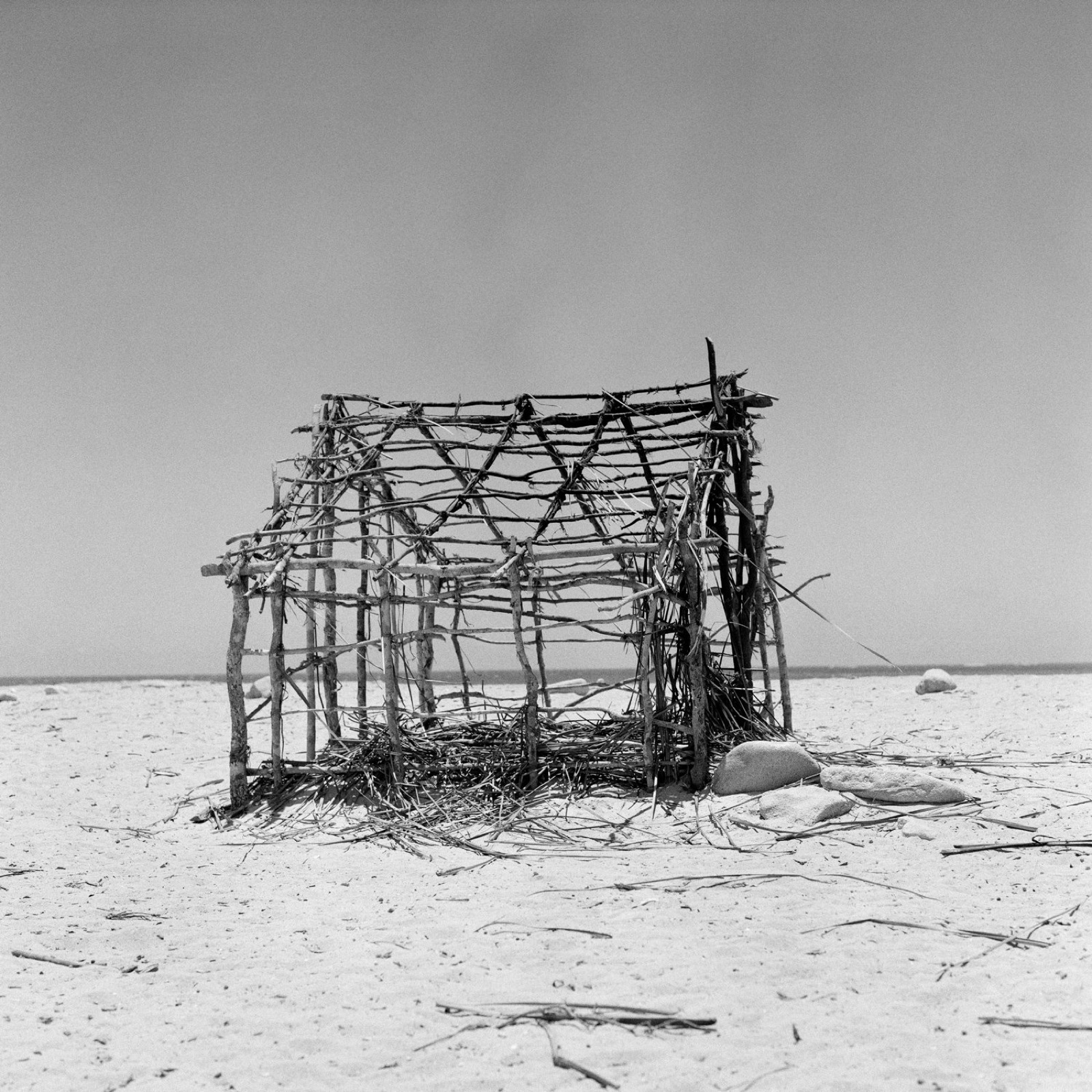
Merciless and even, the light is a white heat that flattens the sand to paper and drains the sky to a pale nothing. Under it stands a skeleton of sticks, a small hut with no walls and no roof, only its lattice of lashed branches holding a shape in the glare. Nothing casts much shadow; the day is too high and too bright for that, and the whole scene shimmers on the edge of dissolving into its own brightness.
I keep returning to the loose reeds strewn on the ground and the two or three pale stones set at the frame’s foot, as if someone had begun to build and then walked off, leaving the dream half-made. This is what moves me: not the shelter but its incompleteness, a house that is all threshold and no interior, offering shade it cannot give. The heat is almost audible. I feel it in the bleached grain of the sand more than in any thermometer.
The title turns the ruin tender: someone’s dream, framed and abandoned to the tide and sun. It is a gelatin silver print toned with selenium, made the year after the negative, and selenium is why so much white can hold without collapsing, the pale sky and paler sand kept just apart, the dark sticks etched clean against them. Saula, who made the image and founded the gallery that shows it, stays elemental on purpose, sun and sand and wood. I leave it uncertain whether I am looking at a beginning or an end, and that uncertainty is the dream.
Merciless and even, the light is a white heat that flattens the sand to paper and drains the sky to a pale nothing. Under it stands a skeleton of sticks, a small hut with no walls and no roof, only its lattice of lashed branches holding a shape in the glare. Nothing casts much shadow; the day is too high and too bright for that, and the whole scene shimmers on the edge of dissolving into its own brightness.
I keep returning to the loose reeds strewn on the ground and the two or three pale stones set at the frame’s foot, as if someone had begun to build and then walked off, leaving the dream half-made. This is what moves me: not the shelter but its incompleteness, a house that is all threshold and no interior, offering shade it cannot give. The heat is almost audible. I feel it in the bleached grain of the sand more than in any thermometer.
The title turns the ruin tender: someone’s dream, framed and abandoned to the tide and sun. It is a gelatin silver print toned with selenium, made the year after the negative, and selenium is why so much white can hold without collapsing, the pale sky and paler sand kept just apart, the dark sticks etched clean against them. Saula, who made the image and founded the gallery that shows it, stays elemental on purpose, sun and sand and wood. I leave it uncertain whether I am looking at a beginning or an end, and that uncertainty is the dream.