A fairground after dark is a machine built to manufacture intimacy, and Winter’s picture takes the proposition at its word. High on a spinning ride, two couples sit in seats backed by great luminous discs rimmed with bulbs, hoisted against a black sky threaded with neon and girders. The title, Romance, is almost a dare. Does the apparatus deliver the feeling it advertises, or only the conditions for it? The photograph keeps the question open, which is the more honest answer.
What the camera actually records is electricity. Long tubes of light streak and bend across the frame; the bulbs describe perfect ovals; a distant sign spells SNACK BAR and, below it, the word TÉLÉPHONE repeated along a railing. Photography and the illuminated midway grew up together, each a way of arresting the night, and here they collaborate completely. The couple nearest us leans in, the woman’s head tipped toward the man, while the whole scaffold tilts and the chain-link fence in the foreground reminds us we are outside, watching the ride we did not board.
Winter, an American drawn to the plainly observed, prints this on gelatin silver, and the choice matters: black and white strips the carnival of its garish color and leaves only structure and glare, the geometry of pleasure. What survives is not a souvenir of a good night but an essay on how such nights are engineered — lights, height, motion, the enforced closeness of a two-person seat. Romance, the picture suggests, is partly a feat of lighting.
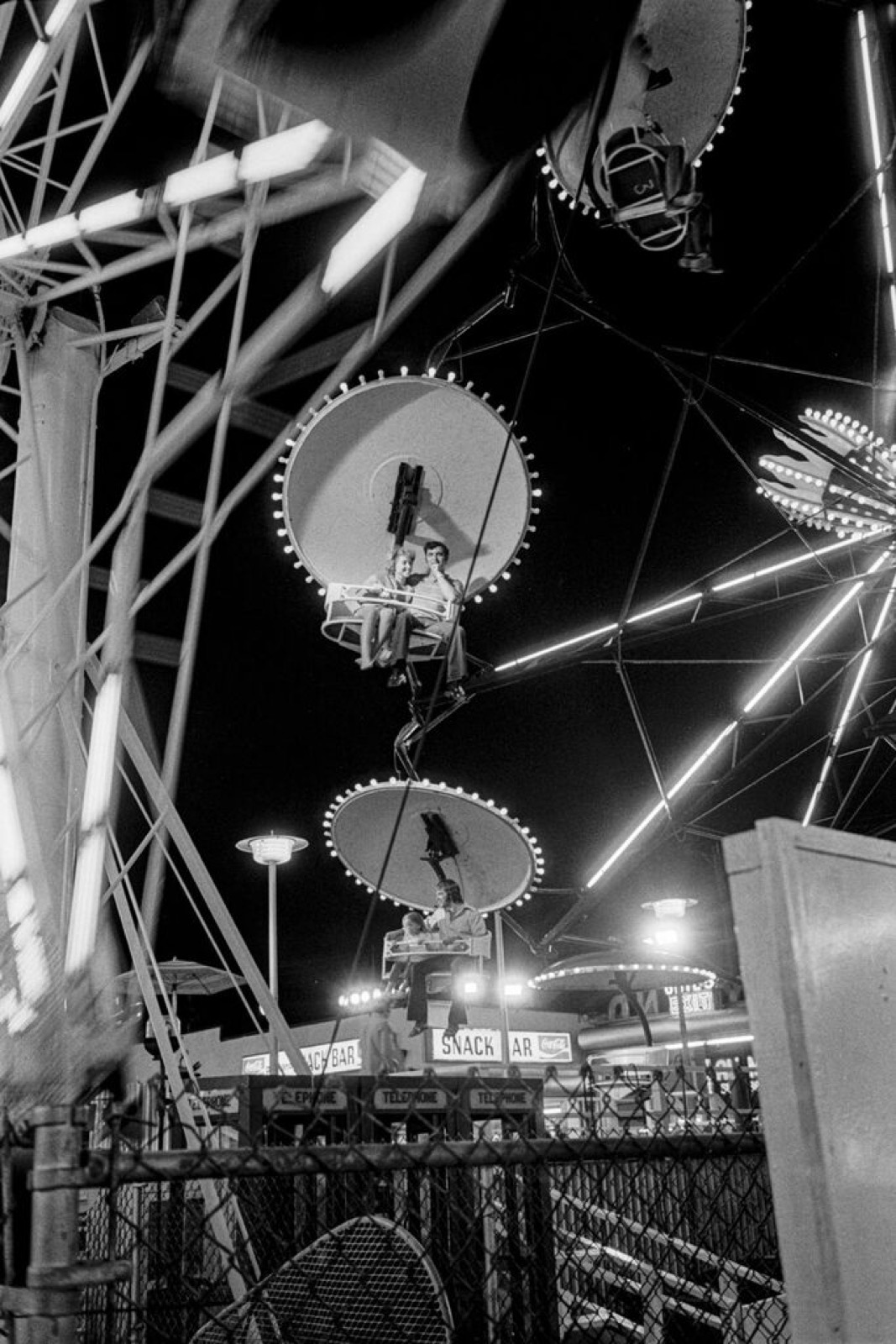

A fairground after dark is a machine built to manufacture intimacy, and Winter’s picture takes the proposition at its word. High on a spinning ride, two couples sit in seats backed by great luminous discs rimmed with bulbs, hoisted against a black sky threaded with neon and girders. The title, Romance, is almost a dare. Does the apparatus deliver the feeling it advertises, or only the conditions for it? The photograph keeps the question open, which is the more honest answer.
What the camera actually records is electricity. Long tubes of light streak and bend across the frame; the bulbs describe perfect ovals; a distant sign spells SNACK BAR and, below it, the word TÉLÉPHONE repeated along a railing. Photography and the illuminated midway grew up together, each a way of arresting the night, and here they collaborate completely. The couple nearest us leans in, the woman’s head tipped toward the man, while the whole scaffold tilts and the chain-link fence in the foreground reminds us we are outside, watching the ride we did not board.
Winter, an American drawn to the plainly observed, prints this on gelatin silver, and the choice matters: black and white strips the carnival of its garish color and leaves only structure and glare, the geometry of pleasure. What survives is not a souvenir of a good night but an essay on how such nights are engineered — lights, height, motion, the enforced closeness of a two-person seat. Romance, the picture suggests, is partly a feat of lighting.