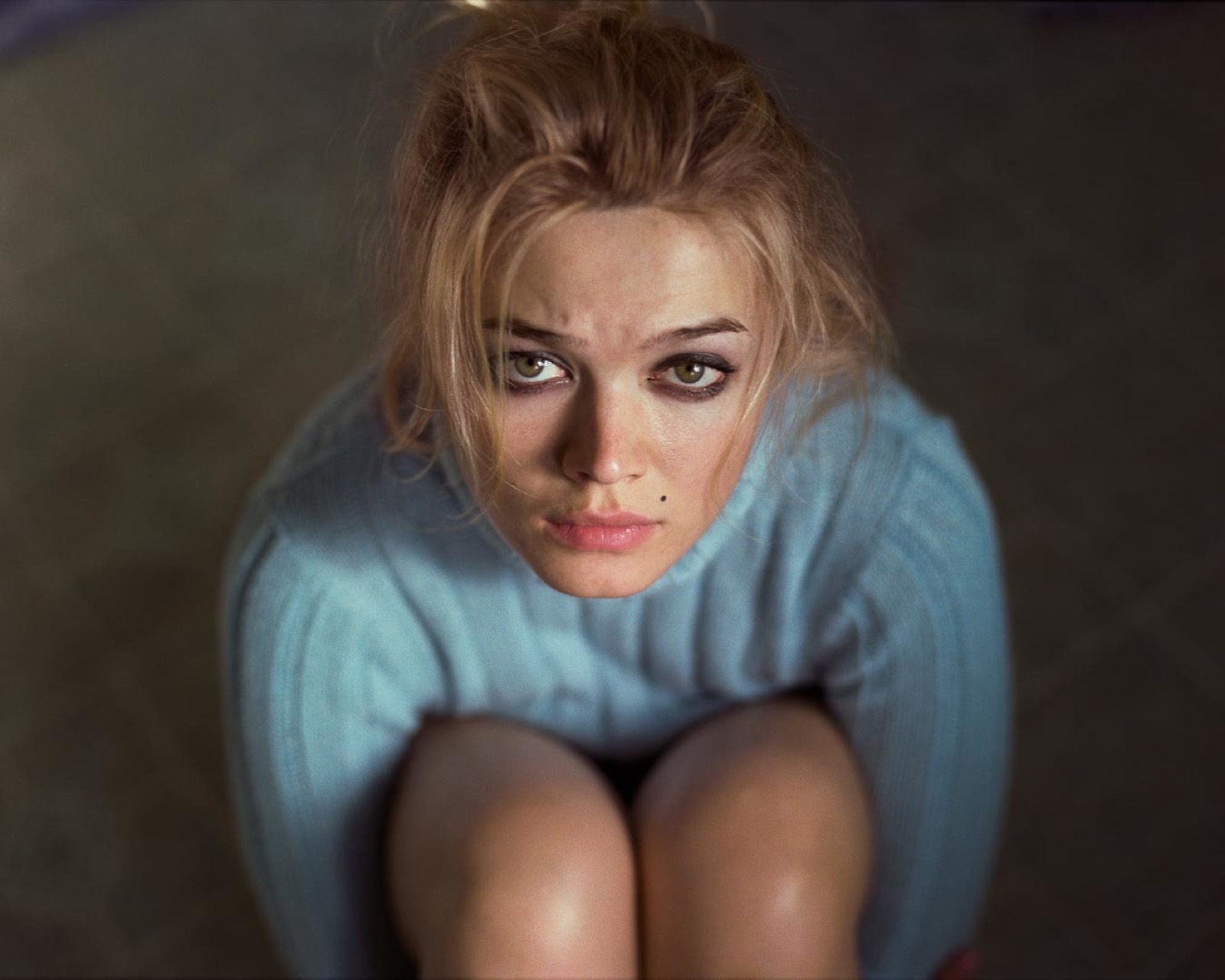
Where does a photographer have to stand to make a face tilt up like this? Directly above, near enough that the tiled floor becomes the picture’s whole background and the woman becomes its whole event. The vantage does the organizing: it gathers her into an oval, pale blue sweater over drawn-up knees, and sets the face at the top of that oval like the stone in a ring. The lens keeps her eyes sharp and lets the knees soften; the picture knows what it is about.
The light is plain and falls from her left, enough to model the small creases of worry on the forehead and to tell us the dark around her eyes is yesterday’s makeup, not this morning’s. A few strands of hair escape the pinned-up pile and drift out of focus. Nothing else is offered: no furniture, no window, no second figure, only the dim grid of the floor tipping away behind her. The expression is half appeal and half appraisal, and the photograph has the good manners not to decide which.
The man who made it is better known for houses at night and roads seen through weather, and this belongs to his unpublished sequences, numbered 10733-43 in the plain bookkeeping he prefers to titles. The habit fits: he was born in Kent, Ohio, in 1968, works from the San Francisco Bay Area, and his prints have settled into SFMOMA, the Getty and the Whitney. Mounted on aluminium Dibond, the archival pigment print sits flat and still, and she goes on asking her question, which is not one the medium can answer.
Where does a photographer have to stand to make a face tilt up like this? Directly above, near enough that the tiled floor becomes the picture’s whole background and the woman becomes its whole event. The vantage does the organizing: it gathers her into an oval, pale blue sweater over drawn-up knees, and sets the face at the top of that oval like the stone in a ring. The lens keeps her eyes sharp and lets the knees soften; the picture knows what it is about.
The light is plain and falls from her left, enough to model the small creases of worry on the forehead and to tell us the dark around her eyes is yesterday’s makeup, not this morning’s. A few strands of hair escape the pinned-up pile and drift out of focus. Nothing else is offered: no furniture, no window, no second figure, only the dim grid of the floor tipping away behind her. The expression is half appeal and half appraisal, and the photograph has the good manners not to decide which.
The man who made it is better known for houses at night and roads seen through weather, and this belongs to his unpublished sequences, numbered 10733-43 in the plain bookkeeping he prefers to titles. The habit fits: he was born in Kent, Ohio, in 1968, works from the San Francisco Bay Area, and his prints have settled into SFMOMA, the Getty and the Whitney. Mounted on aluminium Dibond, the archival pigment print sits flat and still, and she goes on asking her question, which is not one the medium can answer.